 Back
Vectors, Scalars, and Vector Components: Study Guide
Study Guide - Smart Notes
 Tailored notes based on your materials, expanded with key definitions, examples, and context.
Vectors vs. Scalars
Definitions and Classification
In physics, quantities are classified as either scalars or vectors. Understanding this distinction is fundamental for analyzing physical systems, especially in mechanics.
Scalar Quantity: A physical quantity described only by its magnitude (size or strength), with no direction. Examples include time, temperature, distance traveled, speed, mass, energy, and power.
Vector Quantity: A physical quantity described by both magnitude and direction. Examples include displacement, velocity, acceleration, and momentum.
Classifying quantities helps determine the appropriate mathematical tools for their analysis.

Examples and Applications
Displacement is a vector because it describes both how far and in which direction an object moves.
Speed is a scalar; it tells how fast an object moves but not the direction.
Velocity is a vector; it includes both speed and direction.
Energy and power are scalars; they do not depend on direction.
Key Point: Scalars are added algebraically, while vectors require vector addition rules.
Vector Notation and Direction
Representing Vectors
Vectors are typically represented in boldface (e.g., A) or with an arrow above the symbol (e.g., ). The magnitude of a vector is written as (always positive), and the direction is specified by an angle or other notation.
Trigonometric Direction: Measured counterclockwise (CCW) from the positive x-axis. Positive angles are CCW, negative are clockwise (CW).
Compass Bearing: Used for navigation, measured from North (0°), East (90°), South (180°), West (270°).
Component Notation: Vectors can be written as ordered pairs/triplets (e.g., ) or in unit-vector notation (e.g., ).
Example: The initial velocity of a soccer ball: at above the horizontal.
Magnitude:
Direction:
Vector Components
Decomposing Vectors
Any vector in a plane can be decomposed into its x and y components. This is essential for solving problems involving motion, forces, and other vector quantities.
Component Formulas:
Where is the magnitude and is the angle measured from the x-axis.
The vector can be reconstructed from its components: and .
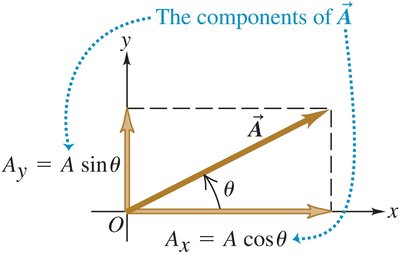
Example: If units and :
units
units
Applications
Vector components are used in projectile motion, force analysis, and electric field calculations.
Component notation simplifies calculations in two and three dimensions.
Converting Between Magnitude/Direction and Components
Conversion Formulas
To convert between a vector's magnitude/direction and its components:
Magnitude from Components:
Direction from Components:
Components from Magnitude and Direction: ,
Important: The arctangent function can yield two possible angles within to . Identify the correct quadrant for the vector.
Example
Given and ,
(Check quadrant: 2nd quadrant)
Review Quiz: Key Concepts
True/False and Multiple Choice
The magnitude of a vector is always positive and can have units.
Vector components can be positive or negative and have units.
Trigonometric direction angles can be expressed in multiple equivalent ways (e.g., is the same as ).
Vectors in different quadrants require careful interpretation of direction angles.
Example: For :
Magnitude:
Trigonometric direction: (points West)
Compass bearing: (Due West)
Key Point: Always specify both magnitude and direction for vectors, and use the correct notation for the context (trigonometric or compass).
