 Back
Vectors vs. Scalars and Vector Components: Study Guidance
Study Guide - Smart Notes
 Tailored notes based on your materials, expanded with key definitions, examples, and context.
Q1. Classify each of the following quantities as a scalar or vector:
time
temperature
displacement
distance traveled
velocity
speed
acceleration
mass
energy
power
momentum
Background
Topic: Scalars and Vectors
This question tests your understanding of the difference between scalar and vector quantities in physics. Scalars have only magnitude (size), while vectors have both magnitude and direction.
Key Terms:
Scalar: A quantity described only by its magnitude (e.g., mass, temperature).
Vector: A quantity described by both magnitude and direction (e.g., velocity, displacement).
Step-by-Step Guidance
Review the definition of scalar and vector quantities. Scalars are described by a single value and units, while vectors require both a value and a direction.
Go through each listed quantity and ask: Does it require a direction to be fully described? If yes, it's a vector; if not, it's a scalar.
For example, "displacement" is a vector because it describes both how far and in what direction an object moves. "Distance traveled" is a scalar because it only tells you how much ground was covered, not the direction.
Apply this reasoning to each quantity in the list. For quantities like "velocity" and "momentum," remember that they involve direction, so they are vectors. For "speed," "energy," and "power," direction is not needed, so they are scalars.
Make a table or list separating scalars and vectors, but stop before filling in the final answers for each item.
Try solving on your own before revealing the answer!

Final Answer:
Scalar quantities: time, temperature, distance traveled, speed, mass, energy, power
Vector quantities: displacement, velocity, acceleration, momentum
Scalars are quantities that do not require direction for their description, while vectors require both magnitude and direction.
Q2. How do you express a vector in terms of its components?
Background
Topic: Vector Components
This question is about breaking a vector into its x and y components using trigonometry. This is essential for analyzing vectors in two dimensions.
Key Terms and Formulas:
Component: The projection of a vector along an axis (x or y).
Magnitude: The length or size of the vector.
Direction (θ): The angle the vector makes with the x-axis.
Key formulas:
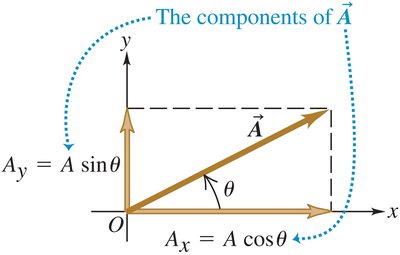
Step-by-Step Guidance
Start by identifying the magnitude and the direction angle of the vector.
To find the x-component (), use the formula . This gives the horizontal part of the vector.
To find the y-component (), use the formula . This gives the vertical part of the vector.
Draw the vector starting at the origin, and use the right triangle formed by the components to visualize how and relate to and .
Set up the calculation for a specific example, but stop before plugging in the numbers or finding the final values.
Try solving on your own before revealing the answer!
Final Answer:
A vector with magnitude and direction can be expressed in terms of its components as:
So, or in unit vector notation.
This allows you to work with vectors algebraically in two dimensions.
