 Back
BackEXAM #3: DAY 12 Vertical Dynamics and Apparent Weight in Elevator Motion
Study Guide - Smart Notes
 Tailored notes based on your materials, expanded with key definitions, examples, and context.
Vertical Dynamics in Elevator Motion
Introduction to Vertical Dynamics
Vertical dynamics involves analyzing the forces and motion of objects moving along the vertical axis, such as elevators. Understanding these dynamics is essential for applying Newton's laws to real-world scenarios, especially when considering the concept of apparent weight.
Representing Motion in an Elevator
Stages of Elevator Motion
Stage 1: At rest on the first floor (velocity and acceleration are zero).
Stage 2: Accelerating upward (velocity increases, acceleration upward).
Stage 3: Moving upward at constant speed (velocity constant, acceleration zero).
Stage 4: Slowing down while moving upward (velocity upward, acceleration downward).
Stage 5: At rest on the third floor (velocity and acceleration are zero).
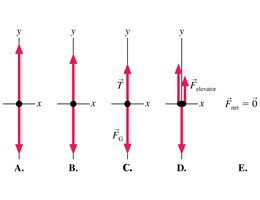
Each stage can be represented with motion diagrams, velocity and acceleration vectors, and free-body diagrams to visualize the forces involved.
Free-Body Diagrams for Elevator Motion
Free-body diagrams (FBDs) are essential tools for visualizing the forces acting on the elevator or its passengers during each stage of motion. The main forces are the tension in the cable (or normal force from the floor) and the gravitational force (weight).
Newton's Laws Applied to Elevator Motion
Newton's Second Law
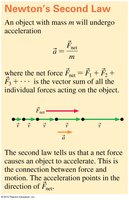
Newton's Second Law relates the net force acting on an object to its acceleration:
Where is the vector sum of all forces acting on the object. The direction of acceleration matches the direction of the net force.
Kinematics in Elevator Problems
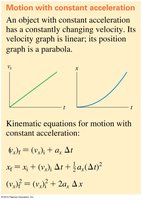
To analyze elevator motion, kinematic equations are used to relate velocity, acceleration, and displacement:
Apparent Weight and Normal Force
Definition of Apparent Weight
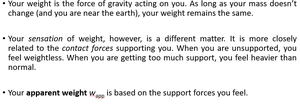
Apparent weight is the normal force exerted by a surface (such as a scale) supporting an object. It is the force you "feel" as your weight, which can differ from your actual weight depending on acceleration.
When accelerating upward, apparent weight increases.
When accelerating downward, apparent weight decreases.
At constant velocity or rest, apparent weight equals true weight.
Scales and Normal Force
Scales do not measure weight directly; they measure the normal force, which can change depending on the acceleration of the object or person on the scale.
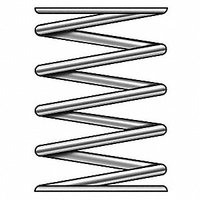
Situation | Scale Reading (N) | Explanation |
|---|---|---|
Object at rest | 50 | Normal force equals weight |
Object pushed down | 70 | Normal force greater than weight |
Object lifted up | 0 | Normal force less than weight (possibly zero) |
Calculating Apparent Weight in an Elevator
The apparent weight of a person in an accelerating elevator is given by:
If (upward acceleration),
If (downward acceleration),
If ,
Where is mass, is gravitational acceleration, and is the elevator's acceleration (positive upward).
Problem Solving: Elevator Example
Sample Problem
An elevator (with passenger) has a mass of 1,200 kg. It slows from 4 m/s to 0 m/s in 2 seconds. Find the tension in the cable during this time.
Calculate acceleration: m/s (downward)
Net force: N (downward)
Weight: N (downward)
Tension: N
Conclusion: The tension is less than the weight when the elevator is slowing down while moving upward.
Conceptual Questions and Applications
When Does Apparent Weight Change?
Heavier than normal: When the elevator accelerates upward.
Lighter than normal: When the elevator accelerates downward.
Normal weight: When the elevator is at rest or moving at constant velocity.
Graphical Representations
Velocity, acceleration, and force can be represented as functions of time for each stage of elevator motion. The scale reading (apparent weight) varies with acceleration.
Summary Table: Apparent Weight in Elevator Motion
Stage | Acceleration | Apparent Weight |
|---|---|---|
At rest / constant speed | 0 | Equal to true weight |
Speeding up (upward) | Upward | Greater than true weight |
Slowing down (upward) | Downward | Less than true weight |
Speeding up (downward) | Downward | Less than true weight |
Slowing down (downward) | Upward | Greater than true weight |
Key Takeaways
Apparent weight is determined by the normal force, not just gravity.
Elevator problems require careful identification of forces and application of Newton's laws.
Scales measure the normal force, which can differ from true weight during acceleration.
