 Back
BackWave Equation and Basic Wave Properties
Study Guide - Smart Notes
 Tailored notes based on your materials, expanded with key definitions, examples, and context.
Wave Equation and Basic Wave Properties
Introduction to Waves
Waves are disturbances that transfer energy from one place to another without the permanent displacement of the medium. Understanding the mathematical and physical properties of waves is fundamental in physics, especially in the study of oscillations, sound, and light.
Basic Concepts of Waves
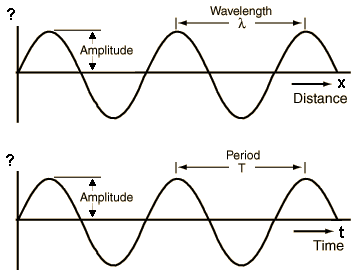
Amplitude (A): The maximum displacement from the equilibrium position. It represents the 'height' of the wave and is a measure of the wave's energy.
Wavelength (\(\lambda\)): The distance between two identical points in consecutive cycles of a wave (e.g., crest to crest or trough to trough).
Period (T): The time taken to complete one full cycle of the wave.
Frequency (f): The number of cycles per second, measured in Hertz (Hz). Frequency and period are inversely related:
Wave Speed (v): The speed at which the phase of the wave propagates through the medium. It is given by:
Types of Waves
Transverse Waves: The oscillation is perpendicular to the direction of wave propagation (e.g., light waves, water surface waves).
Longitudinal Waves: The oscillation is parallel to the direction of wave propagation (e.g., sound waves in air).
Wave Propagation in Different Media
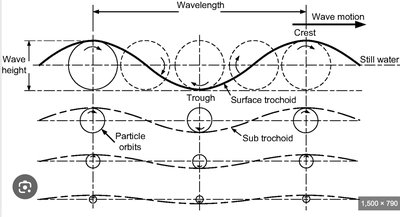
In water waves, molecules move in circular orbits but do not travel with the wave; only the phase and energy move forward.
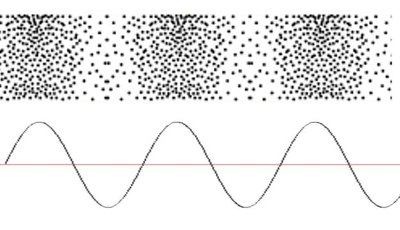
In sound waves, air molecules oscillate back and forth, creating regions of compression and rarefaction, but the molecules themselves do not travel with the wave.
Mathematical Description of Harmonic Waves
Harmonic waves can be described using sine and cosine functions. The general form for a traveling wave is:
or
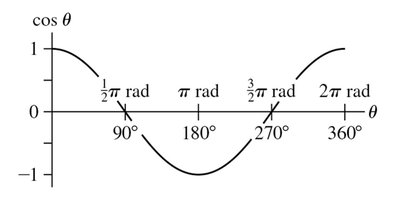
Phase (\(\theta\)): Indicates the position within the cycle at a given point in space and time.
Wave Number (k): (measured in rad/m)
Angular Frequency (\(\omega\)): (measured in rad/s)
Wave Equation and Its Parameters
The compact wave equation contains all the information about the wave:
Amplitude (A): Maximum value of displacement.
Wavelength (\(\lambda\)): Distance over which the wave's shape repeats.
Frequency (f) and Period (T): Related by .
Wave Speed (v):
Phase (\(\theta\)):
Direction of Propagation: The sign in the argument indicates direction (negative for rightward, positive for leftward).
Moving a Wave Graph
Shifting a wave by a distance to the right is represented by replacing with in the wave equation:
If , then
General form:
Summary Table of Wave Quantities
Quantity | Symbol | Formula | Unit |
|---|---|---|---|
Amplitude | A | - | m (meters) |
Wavelength | \(\lambda\) | - | m (meters) |
Frequency | f | Hz (s-1) | |
Period | T | s (seconds) | |
Wave Speed | v | m/s | |
Wave Number | k | rad/m | |
Angular Frequency | \(\omega\) | rad/s | |
Phase | \(\theta\) | radians |
Example Problem: Analyzing a Traveling Wave
Given the wave , calculate the following:
Amplitude (A): 2.0 m
Wave Number (k): 5.0 rad/m
Angular Frequency (\(\omega\)): 2.5 rad/s
Wavelength (\(\lambda\)): m
Frequency (f): Hz
Period (T): s
Wave Speed (v): m/s or m/s
Phase at m, s: rad
Direction: Positive (to the right), since the argument is
Key Takeaways
Waves are described by amplitude, wavelength, frequency, period, and speed.
The mathematical form or encodes all wave properties.
Understanding the relationships between these quantities is essential for solving wave problems in physics.
