 Back
BackWave Motion and Standing Waves: Physics Study Guide
Study Guide - Smart Notes
 Tailored notes based on your materials, expanded with key definitions, examples, and context.
Wave Motion
Types of Waves
Waves are disturbances that transfer energy from one place to another without transferring matter. There are two main types of waves: mechanical waves and electromagnetic waves.
Mechanical Waves: Require a physical medium (e.g., water, air, string). The disturbance propagates through the medium.
Electromagnetic Waves: Do not require a medium. Examples include light, radio waves, and x-rays.
Example: Dropping a pebble into water creates circular waves; objects on the water move but do not undergo net displacement.
General Features of Waves
Wave motion is characterized by the transfer of energy over a distance, while the medium's particles oscillate around their equilibrium positions without net movement.
Energy Transfer: Waves carry energy from the source to distant locations.
Matter Transfer: The medium's particles do not travel with the wave; they oscillate locally.
Requirements for Mechanical Waves: A disturbance source, a medium, and a mechanism for interaction between elements.
Classification of Waves
Transverse Waves
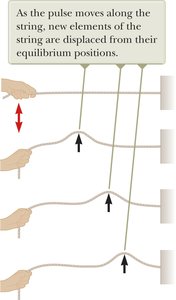
In a transverse wave, the particles of the medium move perpendicular to the direction of wave propagation. This is typical for waves on strings and surface water waves.
Particle Motion: Up and down relative to the direction of travel.
Example: Moving the end of a string up and down creates a transverse wave.
Longitudinal Waves
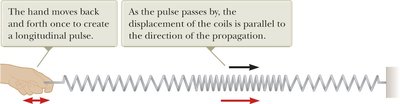
In a longitudinal wave, the particles of the medium move parallel to the direction of wave propagation. Sound waves in air are a classic example.
Particle Motion: Back and forth along the direction of travel.
Example: Compressing and releasing a spring creates a longitudinal wave.
Mathematical Description of Waves
Wave Function and Traveling Pulse
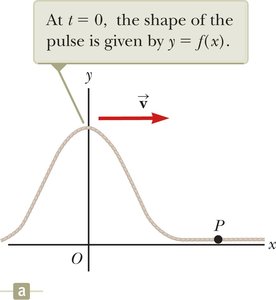
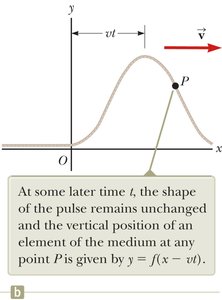
The shape of a wave pulse at any time can be described mathematically by a wave function. For a pulse traveling to the right, the function is , and for a pulse traveling to the left, .
Wave Function: gives the transverse position at location and time .
Waveform: The shape of the wave at a fixed time.
Sinusoidal Waves
Periodic Continuous Waves
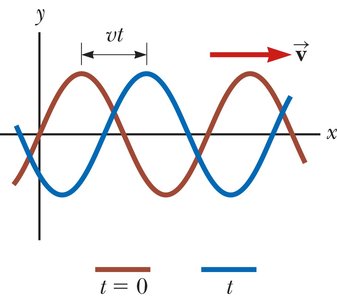
A sinusoidal wave is a periodic wave described by sine or cosine functions. It is the simplest form of a continuous wave and forms the basis for more complex waveforms.
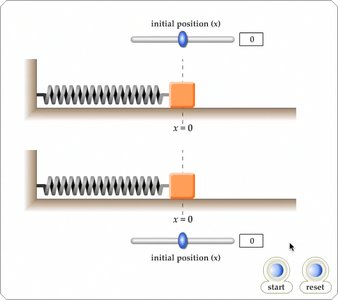
Simple Harmonic Motion: Each element of the medium oscillates in simple harmonic motion.
Wave Motion vs. Particle Motion: The wave moves through the medium, while individual particles oscillate locally.
Wave Terminology
Amplitude and Wavelength
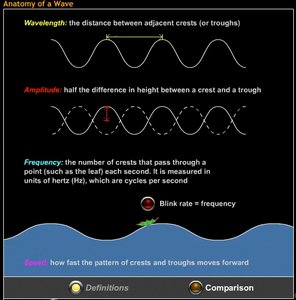
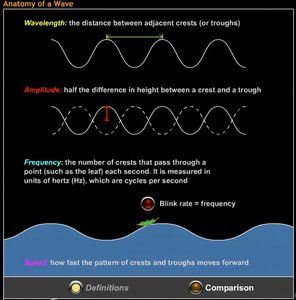
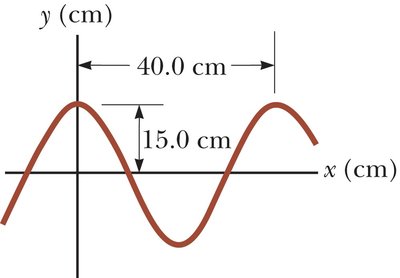
The amplitude () is the maximum displacement from equilibrium, and the wavelength () is the distance between two identical points on adjacent waves (e.g., crest to crest).
Crest: Point of maximum displacement.
Wavelength: Minimum distance between identical points.
Period and Frequency
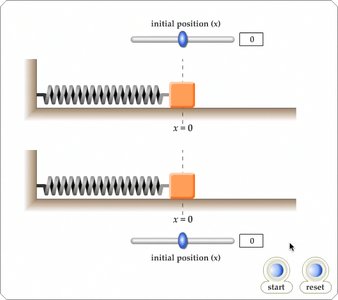
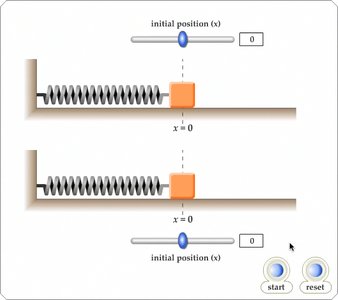
The period () is the time for two identical points of adjacent waves to pass a fixed point. The frequency () is the number of crests passing a point per unit time, measured in hertz (Hz).
Relationship:
Units: Frequency is measured in s (Hz).
Wave Function Example
For a sinusoidal wave, the wave function can be written as , where and .
Example: If cm and cm, the wave function describes the displacement at any point.
Wave Speed and Physical Properties
Speed of a Wave on a String
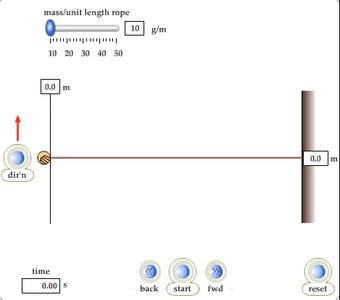
The speed of a wave () on a string depends on the tension () and the mass per unit length () of the string:
Formula:
Physical Dependence: Higher tension or lower mass per unit length increases wave speed.
Reflection of Waves
Reflection at Free and Fixed Ends
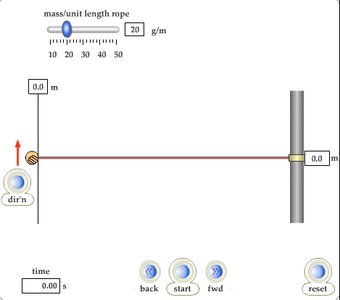
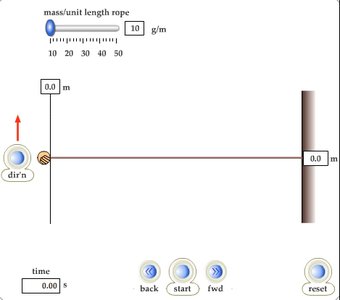
When a wave pulse reaches the end of a string, it is reflected. The nature of the reflection depends on whether the end is free or fixed.
Free End: The pulse is reflected without inversion; amplitude remains unchanged.
Fixed End: The pulse is reflected and inverted due to Newton's third law; amplitude remains unchanged.
Standing Waves
Formation and Properties
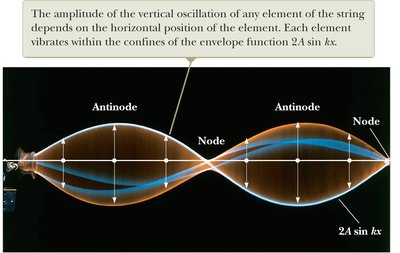
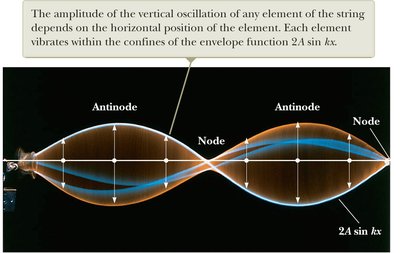
Standing waves are formed by the superposition of two identical waves traveling in opposite directions. The amplitude at any point depends on the location, and nodes and antinodes are formed.
Amplitude: for a given element.
Nodes: Points of zero amplitude.
Antinodes: Points of maximum amplitude ().
Distance: Between adjacent antinodes or nodes is ; between node and antinode is .
Standing Waves in a String
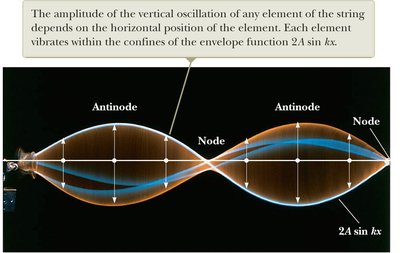
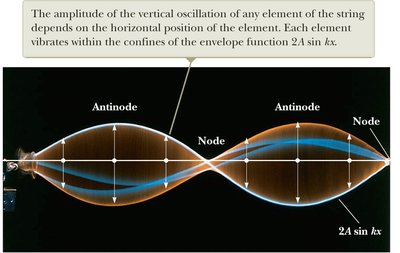
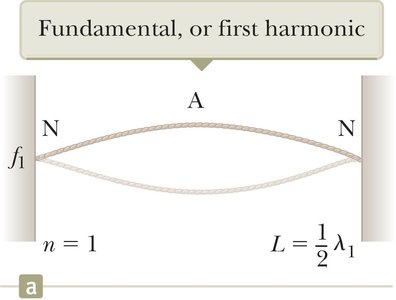
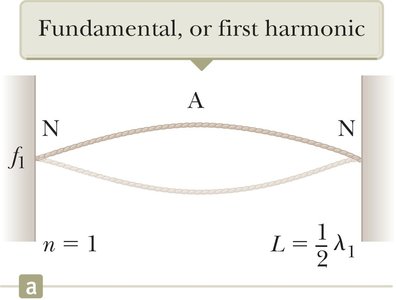
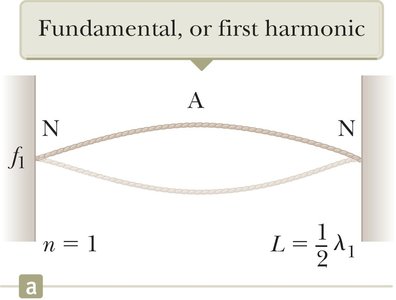
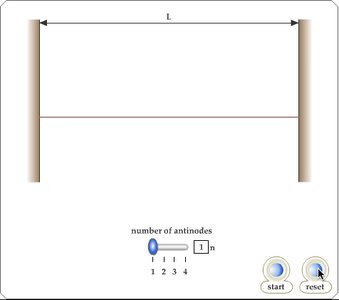
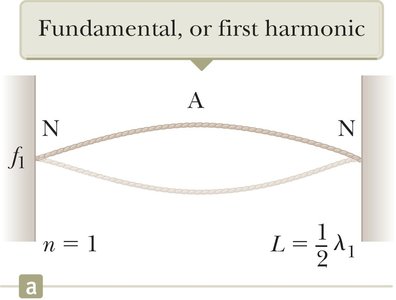
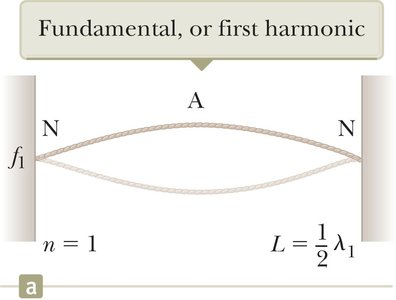
For a string fixed at both ends, standing waves are set up by continuous superposition of incident and reflected waves. The ends must be nodes due to boundary conditions.
Normal Modes: Natural patterns of oscillation, each with a characteristic frequency.
Quantization: Only certain frequencies are allowed.
Harmonic Series and Musical Notes
The fundamental frequency () is the lowest allowed frequency. Higher modes (harmonics) are integer multiples of the fundamental frequency.
Wavelengths: for the nth mode.
Frequencies:
Fundamental Frequency:
Example: For a middle "C" string ( Hz), Hz, Hz.
Summary Table: Wave Properties
Property | Definition | Formula |
|---|---|---|
Amplitude (A) | Maximum displacement from equilibrium | - |
Wavelength (\lambda) | Distance between identical points on adjacent waves | - |
Period (T) | Time for one complete cycle | - |
Frequency (f) | Cycles per second | |
Wave Speed (v) | Speed of wave propagation |
|
