 Back
Wave Motion, Sound, and Interference: Physics with Calculus Study Notes
Study Guide - Smart Notes
 Tailored notes based on your materials, expanded with key definitions, examples, and context.
Wave Motion and Types of Waves
Introduction to Waves
Waves are traveling disturbances that transfer energy through an elastic medium without transporting matter. They can be observed in various physical systems, such as water, strings, and air.
Pulse: A single, localized disturbance that moves through a medium.
Continuous Wave: A repetitive, periodic disturbance.
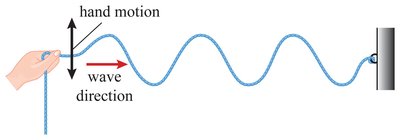
Transverse Wave: The disturbance is perpendicular to the direction of wave propagation.
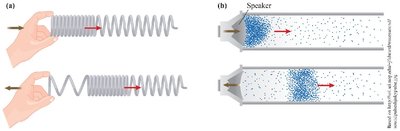
Longitudinal Wave: The disturbance is parallel to the direction of wave propagation.
Waves Carry Energy: Energy is transmitted through the medium, not the medium itself.
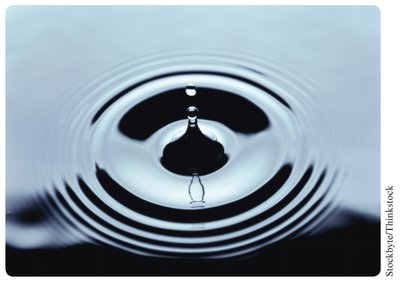
Transverse and Longitudinal Waves
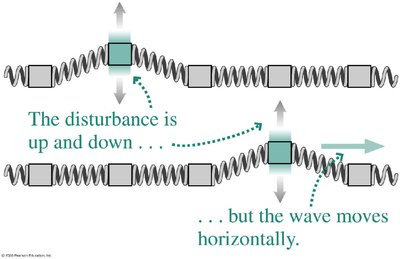
Transverse waves involve oscillations perpendicular to the direction of propagation, while longitudinal waves involve oscillations parallel to the direction of propagation.
Transverse Example: Waves on a string or surface water waves.
Longitudinal Example: Sound waves in air, compressions and rarefactions in a slinky.
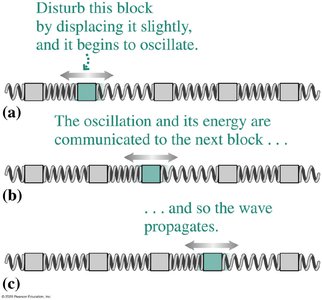
Pulses and Demonstrations
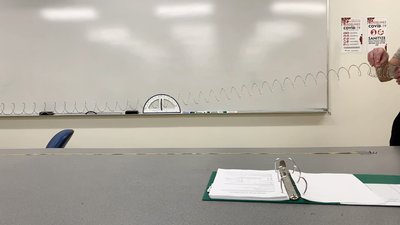
Pulses are localized disturbances that can be easily demonstrated with a slinky or rope. The energy and oscillation are transferred from one part of the medium to the next, causing the pulse to propagate.
Wave Properties and Mathematical Description
Key Properties: Amplitude, Wavelength, Period, and Speed
Waves are characterized by several measurable properties:
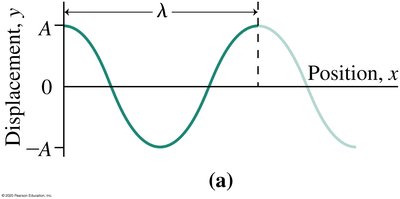
Amplitude (A): Maximum displacement from equilibrium.
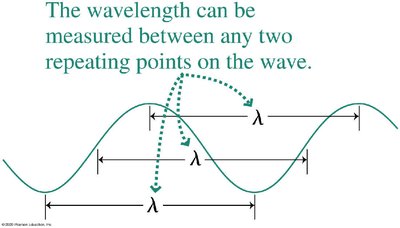
Wavelength (\(\lambda\)): Distance between two consecutive points in phase (e.g., crest to crest).
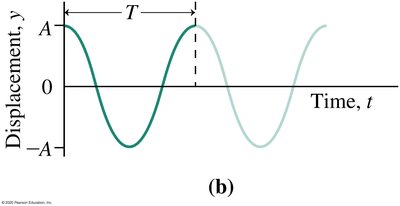
Period (T): Time for one complete cycle.
Frequency (f): Number of cycles per second, \(f = 1/T\).
Wave Speed (v): Speed at which the wave pattern moves, \(v = \lambda/T = f\lambda\).
Pulse Propagation and Mathematical Representation
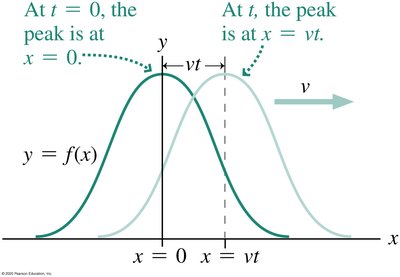
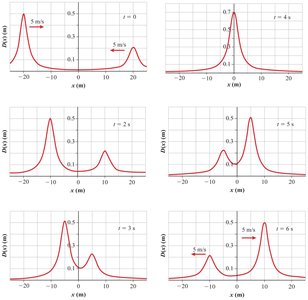
The shape of a pulse remains stable as it propagates. The general form for a pulse moving at speed \(v\) is:
\(y(x, t) = a / ((x \mp vt)^2 + b)\)
The sign determines direction: minus for right, plus for left.
Harmonic (Sinusoidal) Waves
Harmonic waves are described by sinusoidal functions. The general equation for a traveling wave is:
\(y(x, t) = A \cos(kx \mp \omega t + \phi)\)
Where \(A\) is amplitude, \(k = 2\pi/\lambda\) is the wave number, \(\omega = 2\pi/T\) is angular frequency, and \(\phi\) is phase.
Waves on a String
Transverse Waves on a String
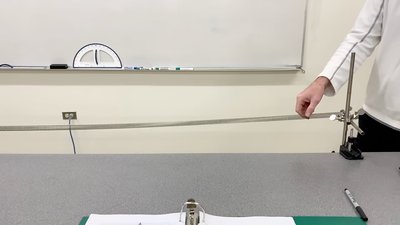
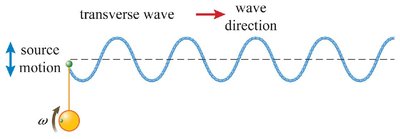
When a string is agitated vertically, a transverse wave propagates horizontally due to the tension in the string.
Wave Speed on a String
The speed of a wave on a string depends on the tension (F) and the mass per unit length (\(\mu\)):
\(v = \sqrt{F/\mu}\)
Higher tension or lower mass density increases wave speed.
Energy, Power, and Intensity in Waves
Energy and Power in Waves
Waves transport energy. The power transmitted by a wave on a string is given by:
\(\overline{P} = \frac{1}{2} \mu \omega^2 A^2 v\)
Where \(\mu\) is mass per unit length, \(\omega\) is angular frequency, \(A\) is amplitude, and \(v\) is wave speed.
Intensity and the Inverse-Square Law
For isotropic sources (e.g., sound, light), intensity is the power per unit area:
\(I = \frac{P}{A_s} = \frac{P}{4\pi R^2}\)
Intensity decreases with the square of the distance from the source (inverse-square law).

Sound Waves
Nature and Properties of Sound Waves
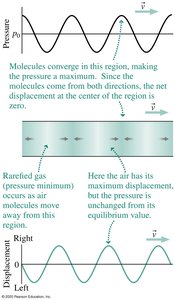
Sound waves are longitudinal waves that propagate as compressions and rarefactions in a medium (gas, liquid, or solid). The speed of sound in a gas is:
\(v = \sqrt{\gamma p / \rho}\)
Where \(\gamma\) is the adiabatic constant, \(p\) is pressure, and \(\rho\) is density.
Intensity and Human Hearing
The human ear perceives sound intensity logarithmically. The intensity level in decibels (dB) is:
\(\beta = 10 \log_{10} (I/I_0)\)
\(I_0 = 10^{-12} \text{ W/m}^2\) is the reference intensity (threshold of hearing).

Superposition and Interference
Principle of Superposition
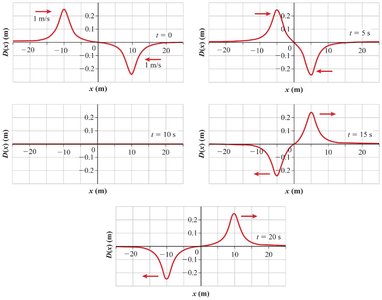
When two or more waves overlap in a linear medium, the net displacement is the sum of the individual displacements:
\(y_{net}(x, t) = \sum_{i=1}^n y_i(x, t)\)
Constructive interference occurs when waves add to produce a larger amplitude.
Destructive interference occurs when waves add to produce a smaller (or zero) amplitude.
Beats
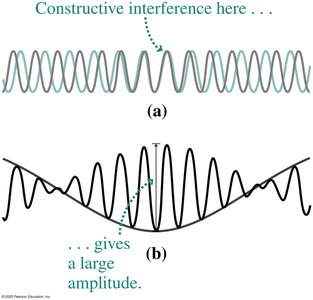
When two waves of slightly different frequencies interfere, they produce beats:
Beat frequency: \(f_b = |f_2 - f_1|\)
Average frequency: \(\overline{f} = (f_2 + f_1)/2\)
Reflection, Standing Waves, and Resonance
Reflection at Boundaries
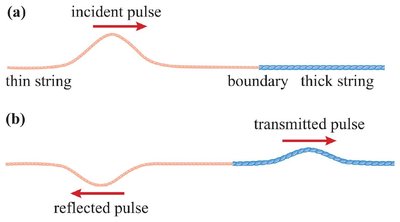
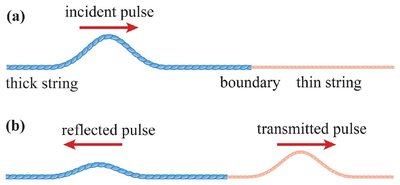
When a wave encounters a boundary between two media, part of the wave is reflected and part is transmitted. The orientation of the reflected pulse depends on the relative densities:
Reflection with inversion: when moving from a lighter to a denser medium.
Reflection without inversion: when moving from a denser to a lighter medium.
Standing Waves
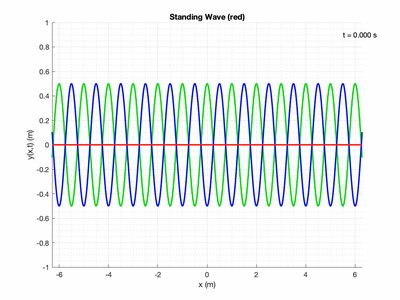
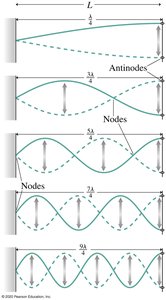
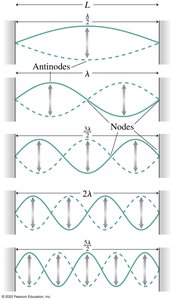
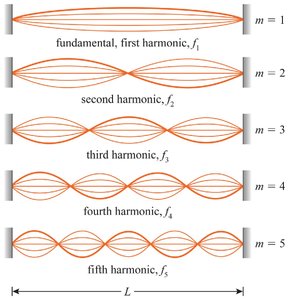
Standing waves are formed by the superposition of two identical waves traveling in opposite directions. They are characterized by nodes (points of zero amplitude) and antinodes (points of maximum amplitude).
On strings fixed at both ends, only certain wavelengths fit, leading to quantized frequencies (harmonics).
For a string of length L, the allowed wavelengths are \(\lambda_n = 2L/n\), and frequencies \(f_n = nv/(2L)\).
The Doppler Effect
Frequency Shift Due to Relative Motion
The Doppler effect describes the change in observed frequency when the source and/or observer are moving relative to each other:
If the observer moves toward the source, the observed frequency increases.
If the observer moves away, the observed frequency decreases.
If the source moves toward the observer, the wavelength is compressed and frequency increases; if away, the wavelength is stretched and frequency decreases.
The general formula is:
Where \(f_r\) is the received frequency, \(f_s\) is the source frequency, \(v\) is the speed of sound, \(v_r\) is the receiver's speed (positive if moving toward the source), and \(v_s\) is the source's speed (positive if moving toward the receiver).
Summary Table: Standing Waves in Pipes
Mode | Both Ends Closed | Both Ends Open | Wavelength | Frequency |
|---|---|---|---|---|
n = 1 | \(\lambda_1 = 2L\) | \(\lambda_1 = 2L\) | \(f_1 = v/(2L)\) | \(f_1 = v/(2L)\) |
n = 2 | \(\lambda_2 = L\) | \(\lambda_2 = L\) | \(f_2 = v/L\) | \(f_2 = v/L\) |
n = 3 | \(\lambda_3 = 2L/3\) | \(\lambda_3 = 2L/3\) | \(f_3 = 3v/(2L)\) | \(f_3 = 3v/(2L)\) |
General | \(\lambda_n = 2L/n\) | \(\lambda_n = 2L/n\) | \(f_n = nv/(2L)\) | \(f_n = nv/(2L)\) |
Additional info: These notes cover the core concepts of wave motion, sound, interference, and resonance, as required for a Physics with Calculus course. All equations are provided in LaTeX format for clarity and further study.
