 Back
BackWave Motion, Sound, and Rotational Dynamics: Study Notes
Study Guide - Smart Notes
 Tailored notes based on your materials, expanded with key definitions, examples, and context.
Wave Motion and Sound
Introduction to Wave Motion
Wave motion describes the transfer of energy through a medium without the permanent displacement of the medium itself. Waves can be classified as transverse or longitudinal, depending on the direction of particle displacement relative to the direction of wave propagation.
Transverse Waves: Disturbance is perpendicular to the direction of motion (e.g., waves on a string).
Longitudinal Waves: Disturbance is parallel to the direction of motion (e.g., sound waves in air).
Key Terms: Wavelength (\(\lambda\)), frequency (\(f\)), period (\(T\)), amplitude (\(A\)).
Wave Speed and Mathematical Description
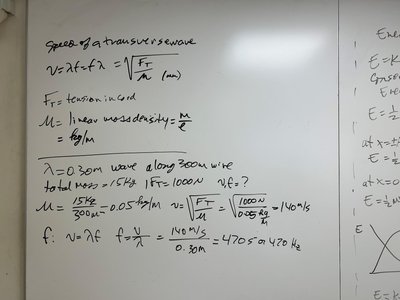
The speed of a wave depends on the properties of the medium. For a stretched string, the wave speed is determined by the tension and the mass per unit length.
Wave Speed on a String: where \(F_T\) is the tension and \(\mu\) is the mass per unit length.
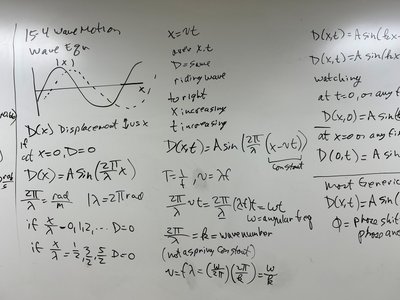
General Wave Equation: where \(A\) is amplitude, \(k = \frac{2\pi}{\lambda}\) is the wave number, \(\omega = 2\pi f\) is angular frequency, and \(\phi\) is the phase shift.
Relationship between Parameters:
Standing Waves and Harmonics
Standing waves are formed by the superposition of two waves traveling in opposite directions. They are characterized by nodes (points of zero displacement) and antinodes (points of maximum displacement).
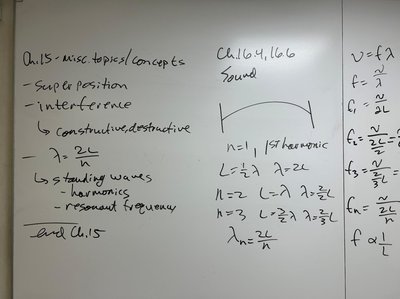
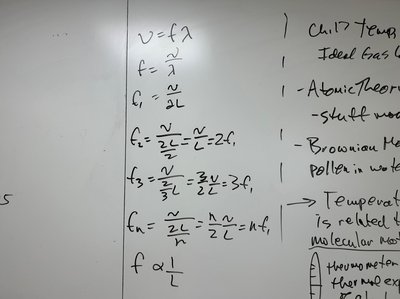
Standing Wave Condition: Only certain wavelengths fit on a string of length \(L\): , where \(n = 1, 2, 3, ...\)
Frequencies of Harmonics: , where \(f_1 = \frac{v}{2L}\) is the fundamental frequency.
Resonance: Occurs when the driving frequency matches a natural frequency of the system, resulting in large amplitude oscillations.
Wave Interference and Superposition
When two or more waves overlap, their displacements add according to the principle of superposition. Interference can be constructive (amplitudes add) or destructive (amplitudes subtract).
Constructive Interference: Occurs when waves are in phase.
Destructive Interference: Occurs when waves are out of phase by \(\pi\) radians (180°).
Sound Waves
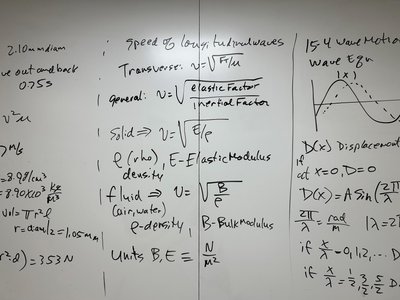
Sound is a longitudinal wave that propagates through a medium (solid, liquid, or gas) via compressions and rarefactions. The speed of sound depends on the medium's properties.
Speed of Sound in Air: Approximately 343 m/s at room temperature.
Speed in General: where \(B\) is the bulk modulus and \(\rho\) is the density.
Harmonics in Pipes: For open and closed pipes, the allowed wavelengths and frequencies differ due to boundary conditions.
Worked Examples: Wave Motion and Sound
Several examples illustrate the application of wave equations to real systems, such as strings and musical instruments.
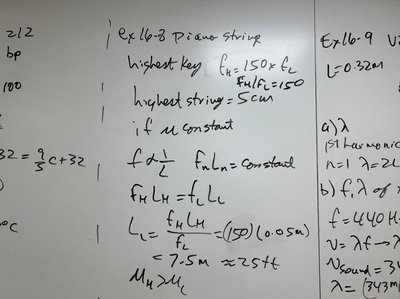
Example: Piano String (Ex 16-8):
Relationship between frequency and string length:
For constant tension and mass per unit length,
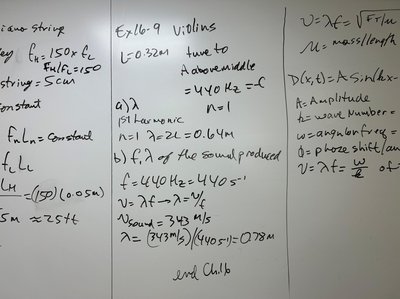
Example: Violin String (Ex 16-9):
Calculation of harmonics and sound frequencies using
Oscillations (Simple Harmonic Motion)
Simple Harmonic Motion (SHM)
Simple harmonic motion describes periodic oscillations where the restoring force is proportional to displacement and directed toward equilibrium.
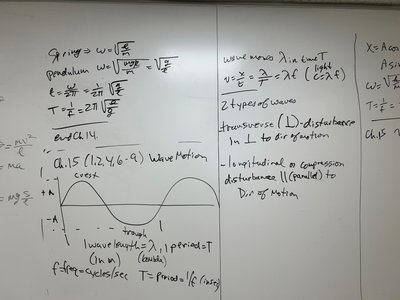
Equation of Motion: or
Angular Frequency: for a spring, for a pendulum
Period:
Energy in SHM
The total mechanical energy in SHM is conserved and is the sum of kinetic and potential energies.
Total Energy:
Kinetic Energy:
Potential Energy:
Rotational Motion and Dynamics
Rotational Kinematics
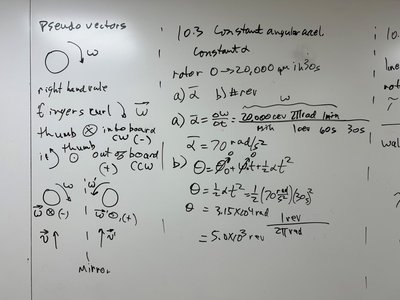
Rotational motion involves the movement of objects around a fixed axis. Key quantities include angular displacement, velocity, and acceleration.
Angular Displacement (\(\theta\)): Measured in radians.
Angular Velocity (\(\omega\)):
Angular Acceleration (\(\alpha\)):
Linear and Angular Relationship: ,
Torque and Rotational Dynamics
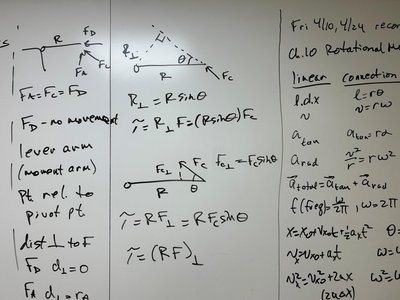
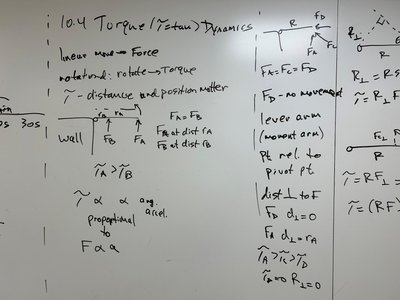
Torque is the rotational analog of force and causes angular acceleration. The effectiveness of a force in producing rotation depends on its magnitude, direction, and the distance from the axis of rotation (moment arm).
Torque (\(\tau\)): where \(r\) is the lever arm and \(\theta\) is the angle between \(\vec{r}\) and \(\vec{F}\).
Rotational Dynamics: where \(I\) is the moment of inertia.
Right-Hand Rule: Used to determine the direction of angular velocity and torque vectors.
Worked Example: Rotational Motion
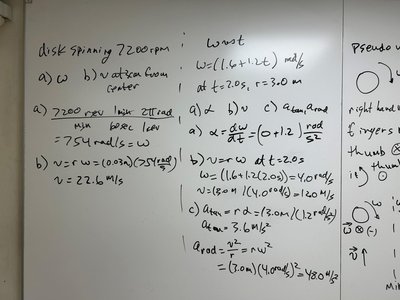
Example problems illustrate the calculation of angular velocity, acceleration, and torque for rotating objects such as disks and rotors.
Example: Disk spinning at 7200 rpm, calculation of angular velocity, linear velocity, and angular acceleration.
Example: Constant angular acceleration, calculation of angular displacement and number of revolutions.
Temperature, Thermal Expansion, and the Ideal Gas Law
Temperature and Thermal Expansion
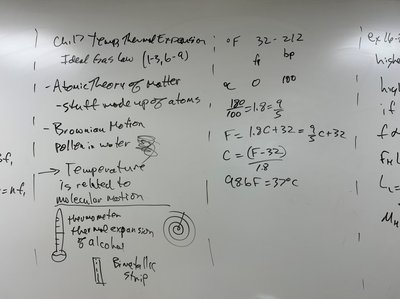
Temperature is a measure of the average kinetic energy of particles in a substance. Thermal expansion describes how materials change in size with temperature.
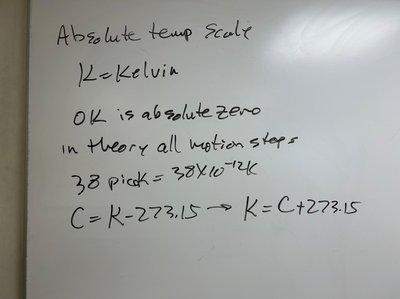
Temperature Scales: Celsius (°C), Fahrenheit (°F), Kelvin (K)
Conversions:
Thermal Expansion: Most materials expand when heated due to increased molecular motion.
Ideal Gas Law and Kinetic Theory
The ideal gas law relates the pressure, volume, temperature, and number of moles of a gas. The kinetic theory explains the macroscopic properties of gases in terms of molecular motion.
Ideal Gas Law: where \(P\) is pressure, \(V\) is volume, \(n\) is number of moles, \(R\) is the gas constant, and \(T\) is temperature in Kelvin.
Atomic Theory of Matter: Matter is composed of atoms and molecules in constant motion.
Brownian Motion: Random movement of particles suspended in a fluid, evidence for molecular motion.
Summary Table: Key Equations
Topic | Equation | Description |
|---|---|---|
Wave Speed (string) | Speed of wave on a stretched string | |
Wave Equation | General form of a traveling wave | |
Standing Wave Harmonics | Frequencies of harmonics on a string | |
Speed of Sound | Speed of sound in a medium | |
Torque | Rotational analog of force | |
Rotational Dynamics | Newton's second law for rotation | |
Ideal Gas Law | Equation of state for an ideal gas |
