 Back
BackWave Motion: Superposition, Reflection, Transmission, Refraction, and Standing Waves
Study Guide - Smart Notes
 Tailored notes based on your materials, expanded with key definitions, examples, and context.
Wave Motion
Principle of Superposition
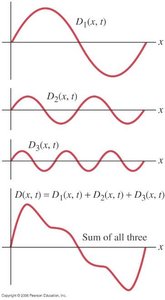
The principle of superposition states that when two or more waves traverse the same medium simultaneously, the resultant displacement at any point is the algebraic sum of the displacements due to each wave. This principle is fundamental to understanding complex wave phenomena such as interference and standing waves.
Composite Waves: When multiple waves overlap, the resulting wave is called a composite or complex wave.
Fourier's Theorem: Any complex periodic wave can be represented as a sum of simple sinusoidal waves (harmonics). For example, a square wave can be constructed from an infinite sum of sine waves with odd harmonics.
Example: The first five terms of a square wave Fourier series:
Additive Synthesis: This principle is used in sound synthesis, where complex tones are created by adding together simple oscillations.
Reflection and Transmission of Waves
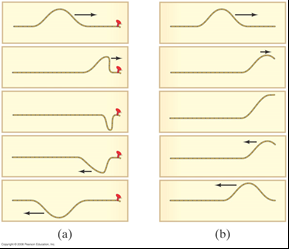
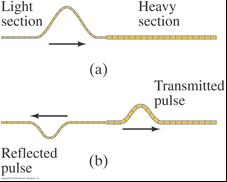
When a wave encounters a boundary between two media, part of the wave may be reflected and part transmitted. The behavior depends on the properties of the media and the boundary conditions.
Fixed End Reflection: If a wave pulse meets a fixed boundary, it reflects and inverts (phase change of π).
Free End Reflection: If the boundary is free to move, the pulse reflects without inversion.
Impedance Mismatch: When a wave passes from a light string to a heavy string, part of the wave is reflected (inverted) and part is transmitted (upright but reduced in amplitude).
Wave Fronts and Huygen’s Principle
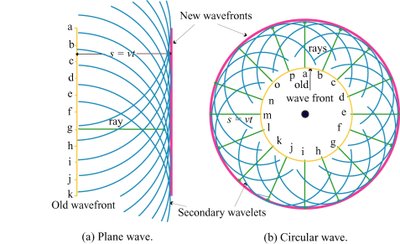
A wave front is a surface over which the phase of the wave is constant (e.g., all crests or all troughs). Huygen’s principle states that every point on a wave front acts as a source of secondary spherical wavelets, and the new wave front is the tangent to these wavelets.
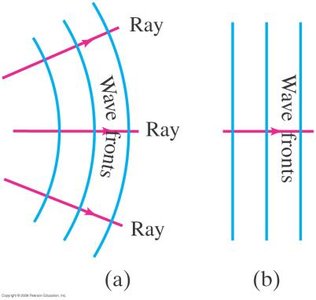
Plane Wave: Wave fronts are parallel lines (crests).
Circular Wave: Wave fronts are concentric circles.
Ray: A line perpendicular to the wave front indicating the direction of energy propagation.
Reflection of a Wave Front: Fermat’s Principle of Least Time
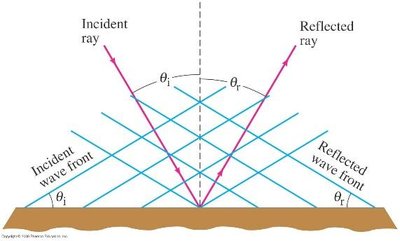
Fermat’s principle states that the path taken by a ray of light (or any wave) between two points is the one that takes the least time. For reflection, this leads to the law of reflection: the angle of incidence equals the angle of reflection.
Law of Reflection:
Universality: This law applies to both mechanical and electromagnetic waves.
Interference
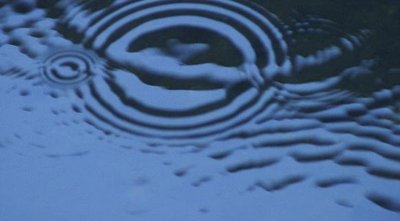
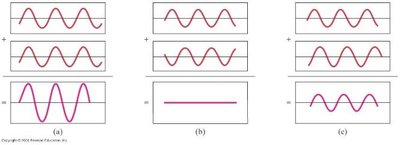
Interference occurs when two or more waves overlap in space, resulting in a new wave pattern. The principle of superposition governs the resultant displacement.
Constructive Interference: Occurs when waves are in phase, resulting in increased amplitude.
Destructive Interference: Occurs when waves are out of phase by half a wavelength ( radians), resulting in reduced or zero amplitude.
Standing Waves
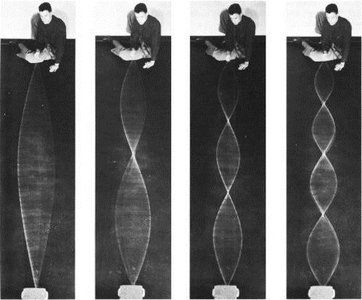
A standing wave is formed by the superposition of two waves of the same frequency and amplitude traveling in opposite directions. The result is a wave pattern that appears stationary, with nodes (points of zero displacement) and antinodes (points of maximum displacement).
Mathematical Form:
Nodes: Points where (displacement always zero).
Antinodes: Points where is maximum (displacement oscillates maximally).
Boundary Conditions: For a string fixed at both ends, standing waves occur at specific frequencies (harmonics): , , where
Fundamental Frequency: The lowest frequency (first harmonic) at which a standing wave can form.
Refraction of a Wave Front: Fermat’s Principle of Least Time
Refraction occurs when a wave passes from one medium into another with a different wave speed, causing the wave to change direction. Fermat’s principle leads to the law of refraction (Snell’s Law):
Law of Refraction (Snell’s Law):
If the wave enters a medium where the speed is higher, it bends away from the normal; if lower, it bends toward the normal.
Example: A sound wave traveling from warm air ( m/s) into cold air ( m/s) at will refract according to Snell’s law.
Diffraction of a Wave Front
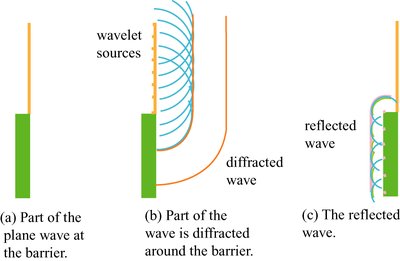
Diffraction is the bending of waves around obstacles or through openings. Huygen’s principle explains diffraction by considering each point on a wave front as a source of secondary wavelets that spread out in all directions.
Diffraction is most pronounced when the size of the obstacle or opening is comparable to the wavelength of the wave.
Important Equations
General wave equation:
Wavenumber:
Wave speed:
Law of reflection:
Standing wave:
Law of refraction (Snell’s law):
