 Back
BackWave Optics: Diffraction and Interference of Light
Study Guide - Smart Notes
 Tailored notes based on your materials, expanded with key definitions, examples, and context.
Chapter 33: Wave Optics
33.1 Models of Light
Light exhibits different behaviors depending on the physical situation, and three primary models are used to describe its nature: the wave model, the ray model, and the photon model. Each model is valid within a certain range of phenomena.
Wave Model: Light behaves as a wave, similar to sound or water waves. This model explains phenomena such as diffraction and interference.
Ray Model: Light travels in straight lines, useful for understanding mirrors, lenses, and optical instruments.
Photon Model: In quantum physics, light consists of photons, which exhibit both wave-like and particle-like properties.
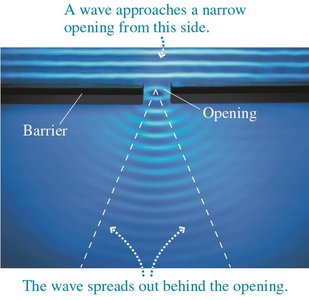
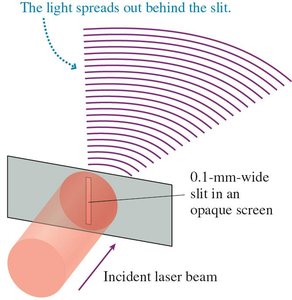
Diffraction is a key wave phenomenon where light spreads out after passing through a narrow opening, indicating its wave nature.
Example: The bright colors of a hummingbird and the blue sky are best explained by the wave model.
Propagation of Light Waves
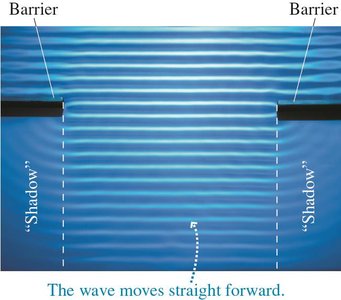
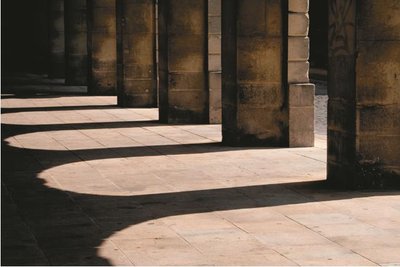
The behavior of light waves as they encounter barriers and openings depends on the size of the opening relative to the wavelength.
When the opening is much larger than the wavelength, light travels straight, creating sharp shadows.
When the opening is comparable to the wavelength, diffraction occurs and the wave spreads out.
33.2 The Interference of Light
Interference is a phenomenon where waves overlap and combine, resulting in regions of constructive (bright) and destructive (dark) interference. This is a fundamental property of waves, including light.
Coherent Light: Light waves that are in phase, such as those produced by a laser, are necessary to observe clear interference patterns.
Double-Slit Experiment: When light passes t``hrough two narrow slits, the waves spread out and overlap, producing an interference pattern on a screen.
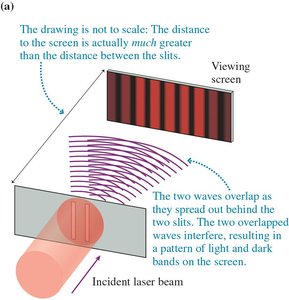
Young’s Double-Slit Experiment
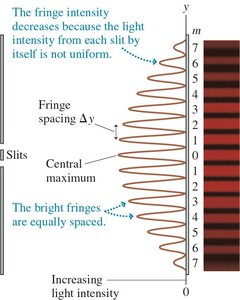
Thomas Young's experiment demonstrated the wave nature of light by showing interference patterns. The pattern consists of alternating bright and dark fringes, called interference fringes.
Constructive Interference: Occurs when the path difference between the two slits is an integer multiple of the wavelength: where
Destructive Interference: Occurs when the path difference is a half-integer multiple of the wavelength:
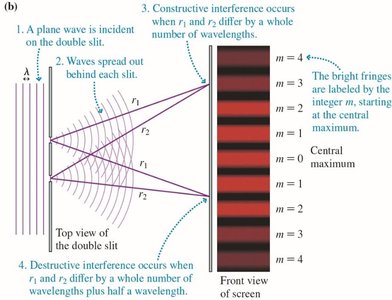
Analyzing Double-Slit Interference
The geometry of the double-slit experiment allows us to calculate the positions of bright and dark fringes on the screen.
Path-Length Difference:
Bright Fringes:
Fringe Position:
Fringe Spacing:
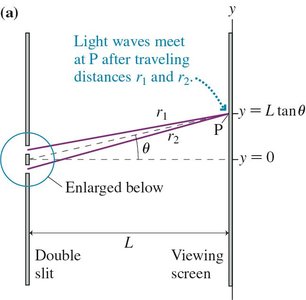
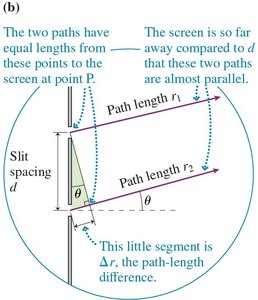
The intensity of the interference pattern varies, with maximum intensity at the central maximum and decreasing intensity for higher-order fringes.
33.3 The Diffraction Grating
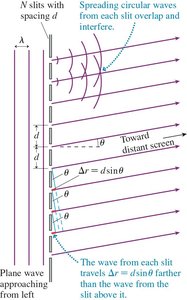
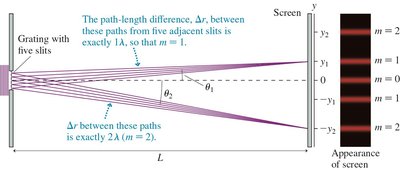
A diffraction grating consists of many closely spaced slits, producing a sharper and brighter interference pattern compared to the double-slit experiment. The principle is similar: constructive interference occurs when the path-length difference is an integer multiple of the wavelength.
Condition for Maxima:
Order of Diffraction: The integer indicates the order of the bright fringe.
Fringe Narrowness: As the number of slits increases, fringes become narrower and brighter.
Spectroscopy
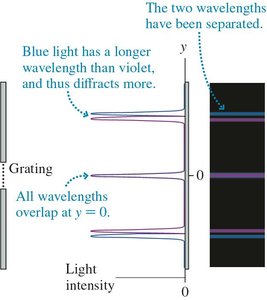
Spectroscopy uses diffraction gratings to measure the wavelengths of light emitted by atoms and molecules. The number of lines per millimeter determines the slit spacing .
Slit Spacing:
Application: By measuring the angles at which different wavelengths appear, the composition of a sample can be determined.
33.4 Single-Slit Diffraction
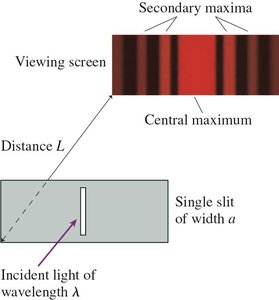
Single-slit diffraction occurs when light passes through a narrow slit of width . The resulting pattern consists of a broad central maximum and weaker secondary maxima.
Central Maximum: The brightest and broadest fringe at the center.
Condition for Minima: for
Width of Central Maximum: where is the distance to the first minimum.
Huygens’ Principle
Huygens’ Principle states that every point on a wavefront acts as a source of spherical wavelets, and the new wavefront is the tangent to all these wavelets. This principle explains the formation of diffraction patterns.
Wavelets: Overlapping wavelets interfere to produce the observed pattern.
33.6 Circular-Aperture Diffraction
Diffraction also occurs when light passes through a circular aperture, producing a circular pattern with a central maximum and surrounding rings.
First Minimum: (in radians), where is the diameter of the aperture.
Diameter of Central Maximum: Increases with distance and decreases with aperture diameter .
Summary Table: Comparison of Interference and Diffraction Phenomena
Phenomenon | Condition for Maxima | Pattern Characteristics | Key Equation |
|---|---|---|---|
Double-Slit Interference | Equally spaced bright and dark fringes | ||
Diffraction Grating | Narrow, bright fringes; sharper with more slits | ||
Single-Slit Diffraction | Broad central maximum, weaker secondary maxima | ||
Circular-Aperture Diffraction | Circular central maximum, surrounding rings | Diameter increases with , decreases with |
Additional info: The notes expand on brief points by providing definitions, equations, and examples, ensuring completeness and academic quality for exam preparation.
