 Back
Wave Optics: Interference, Diffraction, and Thin-Film Effects
Study Guide - Smart Notes
 Tailored notes based on your materials, expanded with key definitions, examples, and context.
Wave Optics
Introduction to Wave Optics
Wave optics, also known as physical optics, explores the behavior of light as a wave. This chapter focuses on phenomena such as interference, diffraction, and thin-film effects, which cannot be explained by ray optics alone. These effects become significant when light interacts with objects or apertures comparable in size to its wavelength.
Models of Light
The Three Models of Light
Wave Model: Describes light as an electromagnetic wave, explaining phenomena like interference and diffraction.
Ray Model: Treats light as traveling in straight lines (rays), useful for understanding reflection and refraction in lenses and mirrors.
Photon Model: Considers light as quantized photons, essential for quantum optics and explaining phenomena like the photoelectric effect.
Wave optics is primarily concerned with the wave model, which is essential for understanding interference and diffraction.
Nature and Propagation of Light
Light as an Electromagnetic Wave
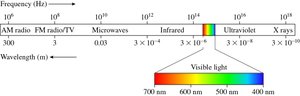
Light consists of oscillating electric and magnetic fields and travels in a vacuum at the speed of light, m/s. The visible spectrum ranges from 400 nm (violet) to 700 nm (red).
Index of Refraction
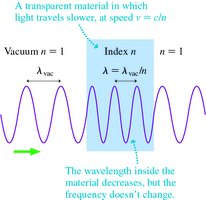
The index of refraction of a material quantifies how much light slows down in that medium:
where is the speed of light in the material. The wavelength of light decreases in a medium, but its frequency remains unchanged:
Diffraction
What is Diffraction?
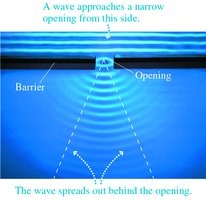
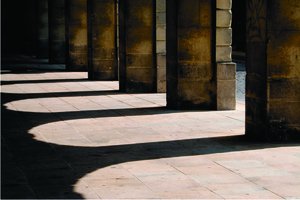
Diffraction is the bending and spreading of waves when they encounter an obstacle or pass through a narrow opening. It is a hallmark of wave behavior and becomes significant when the size of the opening is comparable to the wavelength of the wave.
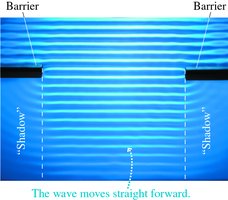
When the opening is much larger than the wavelength, waves travel straight with sharp shadows.
When the opening is similar in size to the wavelength, waves spread out significantly.
Interference of Light
Principle of Superposition
When two or more waves overlap, their amplitudes add according to the principle of superposition. This can result in:
Constructive interference: Waves add to produce a larger amplitude (bright fringe).
Destructive interference: Waves cancel each other out (dark fringe).
Young's Double-Slit Experiment
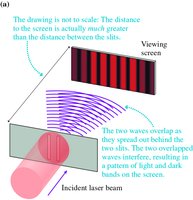
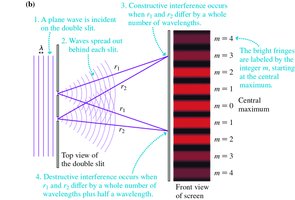
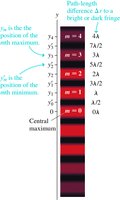
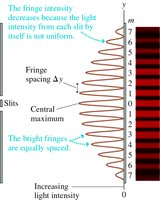
Thomas Young's experiment demonstrated the wave nature of light by showing an interference pattern when light passes through two closely spaced slits. The resulting pattern consists of alternating bright and dark fringes on a screen.
Mathematical Analysis of Double-Slit Interference
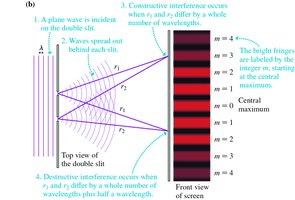
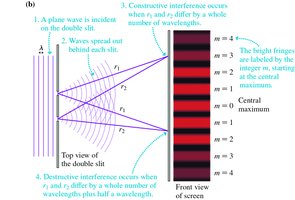
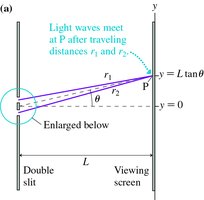
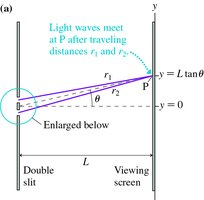
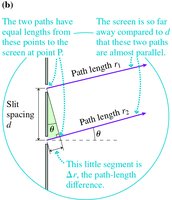
Constructive interference (bright fringes): Occurs when the path-length difference is an integer multiple of the wavelength:
Destructive interference (dark fringes): Occurs when the path-length difference is a half-integer multiple of the wavelength:
Here, is the slit separation, is the angle from the central axis, is the order of the fringe, and is the wavelength.
Diffraction Gratings
Principle of Diffraction Gratings
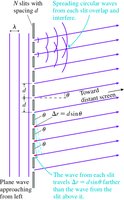
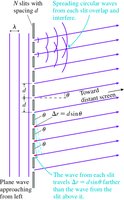
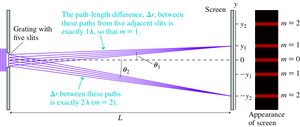
A diffraction grating consists of many equally spaced slits. When light passes through, it produces sharp, narrow, and bright interference maxima at specific angles. The condition for constructive interference is:
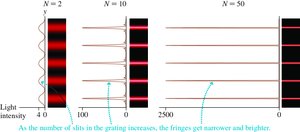
As the number of slits increases, the bright fringes become narrower and more intense.
Applications: Spectroscopy
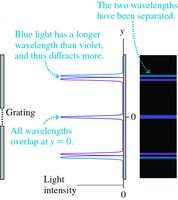
Spectroscopy uses diffraction gratings to measure the wavelengths of light emitted by atoms and molecules. Each element emits light at characteristic wavelengths, allowing identification of substances.
Reflection Gratings
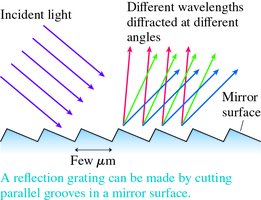
Reflection gratings are mirrors with many fine grooves that diffract light, used in practical spectroscopy instruments.
Thin-Film Interference
Principle of Thin-Film Interference
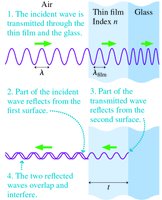
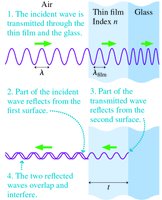
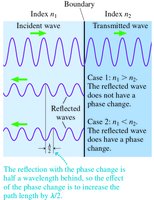
Thin-film interference occurs when light reflects from the upper and lower boundaries of a thin film, such as oil on water or soap bubbles. The two reflected waves can interfere constructively or destructively, depending on the film's thickness and the wavelength of light.
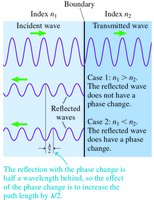
A phase change of half a wavelength occurs when light reflects from a medium with a higher index of refraction.
The path-length difference for the two reflected waves is , where is the film thickness.
Conditions for Interference in Thin Films
Constructive interference: Occurs when the effective path-length difference is an integer multiple of the wavelength.
Destructive interference: Occurs when the effective path-length difference is a half-integer multiple of the wavelength.
The exact condition depends on whether there is a phase change at one or both boundaries.
Summary Table: Key Equations and Concepts
Phenomenon | Condition for Bright Fringe | Condition for Dark Fringe | Key Equation |
|---|---|---|---|
Double-Slit Interference | |||
Diffraction Grating | — | — | |
Thin-Film Interference | Depends on phase changes and path difference | Depends on phase changes and path difference | Path difference (phase change) |
Applications and Importance
Wave optics explains phenomena such as the colors in soap bubbles, the operation of antireflection coatings, and the analysis of light from stars and laboratory sources.
Understanding interference and diffraction is essential for modern optical technology, including lasers, spectrometers, and fiber optics.
