 Back
BackWaves & Sound: Fundamental Concepts and Applications- lecture 25
Study Guide - Smart Notes
 Tailored notes based on your materials, expanded with key definitions, examples, and context.
Waves & Sound
The Nature of Waves
Waves are fundamental phenomena in physics, characterized by their ability to transfer energy from one location to another without the bulk movement of matter. Understanding the properties and types of waves is essential for analyzing a wide range of physical systems, from water waves to electromagnetic radiation.
Traveling Disturbances: All waves are disturbances that propagate through a medium or space.
Energy Transfer: Waves carry energy as they travel, but do not necessarily transport matter along with them. For example, a ripple on water moves energy but does not move a bulk of water with it.
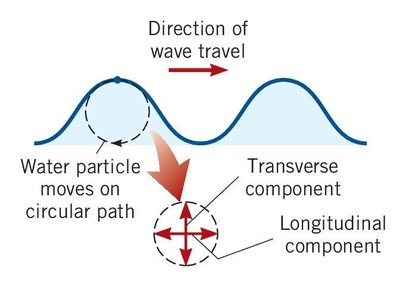
Types of Wave Motion
Waves can be classified based on the direction of oscillation relative to the direction of propagation:
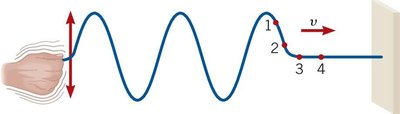
Transverse Waves: Oscillations are perpendicular to the direction of wave travel. Examples include light waves and waves on a string.
Longitudinal Waves: Oscillations are parallel to the direction of wave travel. Sound waves in air are longitudinal.
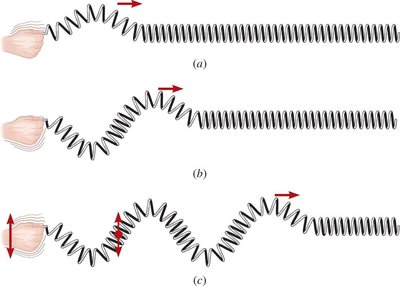
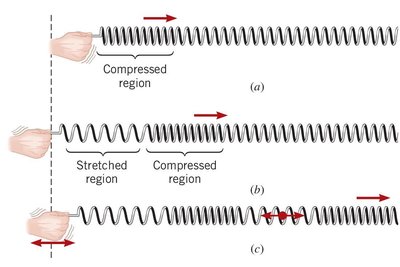
Periodic Waves
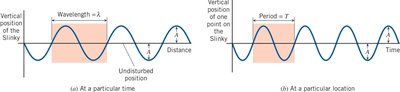
Periodic waves repeat their patterns at regular intervals, characterized by several key parameters:
Amplitude (A): The maximum displacement from the equilibrium position.
Wavelength (\( \lambda \)): The distance between two consecutive peaks (or troughs) of the wave.
Period (T): The time required for one complete cycle of the wave to pass a given point.
Frequency (f): The number of cycles per second, measured in hertz (Hz). Frequency and period are related by:
Wave Speed (v): The speed at which the wave propagates, given by:
Example: Radio Waves
Given: Speed of light m/s.
AM radio frequency Hz. Wavelength: m
FM radio frequency Hz. Wavelength: m
Wave Speed on a String
The speed of a wave traveling along a stretched string depends on the tension in the string and its linear mass density:
Wave Speed Formula: where is the tension in the string and is the linear density (, mass per unit length).
Example: Guitar Strings
Highest E string: g, m, N kg/m m/s
Lowest E string: g, m, N kg/m m/s
Mathematical Description of a Wave
The displacement of a point on a wave traveling in the positive -direction can be described by:
For a wave traveling in the negative -direction:
The argument of the sine function is called the phase angle (), measured in radians.
Example: Determining Frequency and Wavelength
Given:
Frequency: Hz
Wavelength: m
Phase angle at s, m: rad
Using Waves to Probe Earth's Interior
Seismic waves generated by earthquakes provide valuable information about Earth's internal structure. There are two main types of seismic waves:
Pressure Waves (P-waves): Longitudinal waves that can travel through solids, liquids, and gases.
Shear Waves (S-waves): Transverse waves that can only travel through solids.
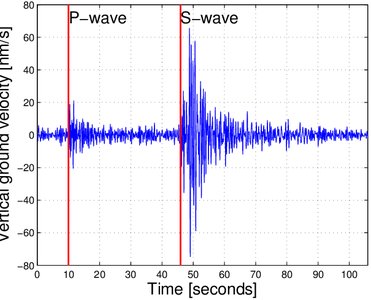
Both P-waves and S-waves are affected by the boundaries and densities within Earth's interior. The inability of S-waves to travel through liquid regions creates 'S-wave shadows,' indicating the presence of a liquid outer core.
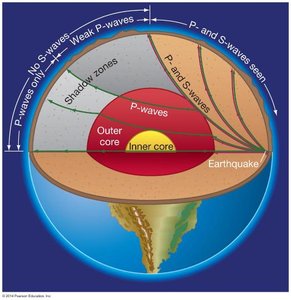
Wave Type | Oscillation Direction | Medium | Speed |
|---|---|---|---|
Transverse (e.g., S-wave) | Perpendicular to propagation | Solids | Slower than P-waves |
Longitudinal (e.g., P-wave) | Parallel to propagation | Solids, liquids, gases | Fastest seismic wave |
