 Back
BackWaves and Sound II: Energy, Intensity, Decibels, and Standing Waves
Study Guide - Smart Notes
 Tailored notes based on your materials, expanded with key definitions, examples, and context.
Energy and Intensity in Mechanical Waves
Introduction to Mechanical Waves
Mechanical waves are disturbances that propagate through a medium, transporting energy but not matter. As these waves move, they carry the energy provided by their source through the medium. Understanding how energy is distributed and measured in waves is essential for analyzing sound and other wave phenomena.
Circular, Spherical, and Plane Waves
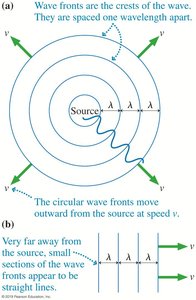
Circular Waves: These waves move outward in two dimensions, such as ripples on a pond's surface. The wave crests form concentric circles, each spaced one wavelength apart.
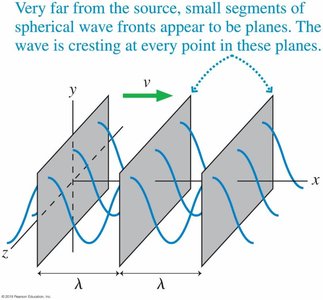
Spherical Waves: These waves propagate in three dimensions, like sound radiating from a point source. The energy spreads over the surface of expanding spheres.
Plane Waves: At large distances from the source, both circular and spherical waves can be approximated as plane waves, where the wave fronts appear flat and parallel.

Power, Energy, and Intensity
The power (P) of a wave is the rate at which energy is transported by the wave. Intensity (I) is defined as the power transmitted per unit area perpendicular to the direction of energy flow. For a spherical wave, the intensity decreases with the square of the distance from the source because the energy spreads over a larger area.
General Intensity Formula:
Intensity for Spherical Waves:
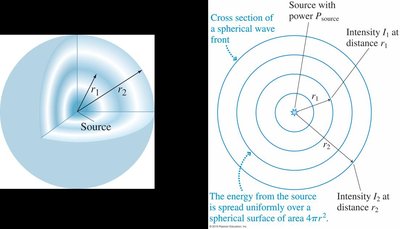
Example: If a plane, circular, and spherical wave all start with the same intensity and travel the same distance, the plane wave maintains its intensity, while the circular and spherical waves' intensities decrease due to spreading.
Loudness of Sound and the Decibel Scale
Loudness and Human Perception
Loudness is the subjective perception of sound intensity. The human ear can detect sounds with intensities from W/m2 (threshold of hearing, ) up to about 10 W/m2 (threshold of pain). The perceived loudness is not directly proportional to intensity; a tenfold increase in intensity is typically perceived as only about twice as loud.
Threshold of Hearing: W/m2
The Decibel Scale
Because the range of audible intensities is so large, sound levels are measured on a logarithmic scale called the decibel (dB) scale. The sound level β in decibels is given by:
To find intensity from sound level:
Table: Typical Sound Levels and Intensities
Sound | β (dB) | I (W/m2) |
|---|---|---|
Threshold of pain | 130 | 10 |
Rock concert | 120 | 1.0 |
Home stereo at max | 110 | 0.10 |
Pneumatic hammer (2 m) | 100 | 0.010 |
Niagara Falls (viewpoint) | 90 | 1.0 × 10⁻³ |
Vacuum cleaner | 80 | 1.0 × 10⁻⁴ |
Busy traffic | 70 | 1.0 × 10⁻⁵ |
Normal conversation (1 m) | 60 | 1.0 × 10⁻⁶ |
Quiet restaurant | 50 | 1.0 × 10⁻⁷ |
Residential street | 40 | 1.0 × 10⁻⁸ |
Classroom during test | 30 | 1.0 × 10⁻⁹ |
Whisper (1 m) | 20 | 1.0 × 10⁻¹⁰ |
Person breathing (3 m) | 10 | 1.0 × 10⁻¹¹ |
Threshold of hearing | 0 | 1.0 × 10⁻¹² |
The Principle of Superposition and Interference
Superposition Principle
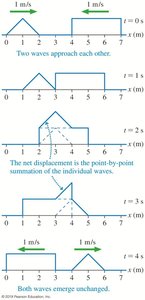
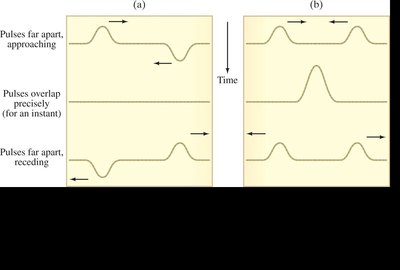
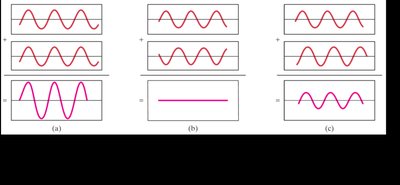
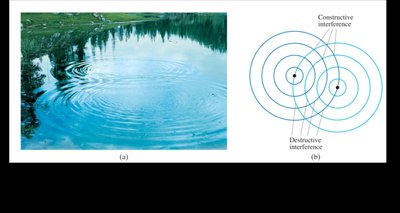
When two or more waves pass through the same region of space, the resulting displacement is the algebraic sum of the individual displacements. This is known as the principle of superposition.
Constructive and Destructive Interference
Constructive Interference: Occurs when waves combine to produce a displacement greater than either wave alone.
Destructive Interference: Occurs when waves combine to produce a smaller displacement, possibly canceling each other out.
Standing Waves
Formation and Properties of Standing Waves
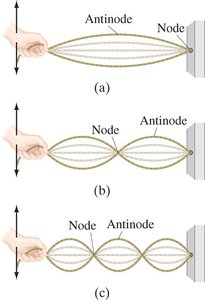
A standing wave forms when two sinusoidal waves of equal amplitude and wavelength travel in opposite directions and interfere. Standing waves do not appear to travel; instead, certain points (nodes) remain stationary, while others (antinodes) oscillate with maximum amplitude.
Nodes: Points of destructive interference where the medium does not move.
Antinodes: Points of constructive interference with maximum oscillation.
Mathematical Description of Standing Waves
The displacement of a sinusoidal traveling wave is given by: where is amplitude, is wavelength, is period, and the sign indicates direction.
Example: Determining Wavelength from Standing Wave Patterns
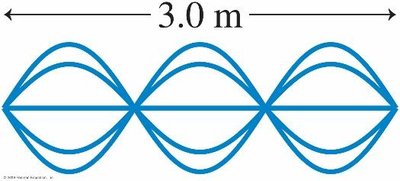
Given a standing wave with a total length of 3.0 m and three loops (antinodes), the wavelength can be determined by noting that each loop corresponds to half a wavelength. Thus, m, so m.
Equation Summary
Concept | Equation or Description |
|---|---|
Intensity (general) | |
Intensity (spherical wave) | |
Threshold of hearing | W/m2 |
Sound level (dB) | |
Intensity from sound level | |
Displacement of sinusoidal wave |
