 Back
BackWaves and Sound: Principles, Properties, and Applications
Study Guide - Smart Notes
 Tailored notes based on your materials, expanded with key definitions, examples, and context.
Chapter 16: Waves and Sound
16.1 The Nature of Waves
Waves are fundamental phenomena in physics, representing traveling disturbances that transfer energy from one location to another without the permanent displacement of the medium through which they travel.
Wave: A traveling disturbance that carries energy from place to place.
Types of Waves:
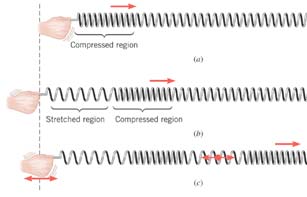
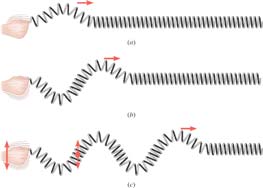
Transverse Waves: The disturbance is perpendicular to the direction of wave propagation (e.g., waves on a string).
Longitudinal Waves: The disturbance is parallel to the direction of wave propagation (e.g., sound waves in air).
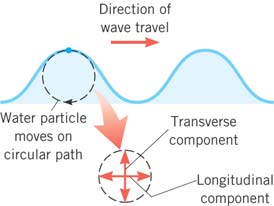
Water Waves: Exhibit both transverse and longitudinal characteristics; water particles move in circular paths.
Energy Transfer: Waves transport energy, not matter, across space.
16.2 Periodic Waves
Periodic waves are waves that repeat in a regular pattern, typically generated by sources undergoing simple harmonic motion. Each segment of the medium vibrates in simple harmonic motion if the source does so.
Amplitude (A): Maximum displacement from the equilibrium position.
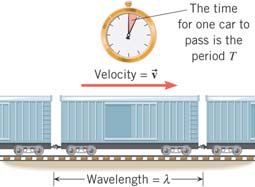
Wavelength (\(\lambda\)): The distance between two consecutive points in phase (e.g., crest to crest).
Period (T): Time for one complete cycle of the wave.
Frequency (f): Number of cycles per second (Hz). Related to period by \(f = \frac{1}{T}\).
Wave Speed (v): The speed at which the wave propagates, given by \(v = f \lambda\).
Example: Radio waves (AM and FM) are transverse electromagnetic waves. For a given frequency, the wavelength can be found using \(\lambda = \frac{v}{f}\), where \(v = 3.00 \times 10^8\) m/s for light in vacuum.
16.3 The Speed of a Wave on a String
The speed of a wave on a string depends on the tension in the string and its linear mass density.
Formula: \(v = \sqrt{\frac{F}{\mu}}\), where \(F\) is the tension and \(\mu\) is the linear mass density (mass per unit length).
Application: Used to calculate the speed of waves on guitar strings, which affects the pitch produced.
16.4 The Mathematical Description of a Wave
The displacement \(y\) of a particle at position \(x\) and time \(t\) in a wave can be described mathematically by a sinusoidal function:
\(y(x, t) = A \sin(kx - \omega t + \phi)\)
Where \(A\) is amplitude, \(k = \frac{2\pi}{\lambda}\) is the wave number, \(\omega = 2\pi f\) is the angular frequency, and \(\phi\) is the phase constant.
16.5 The Nature of Sound Waves
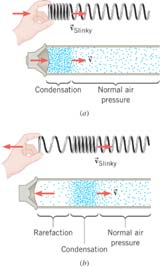
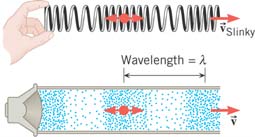
Sound waves are longitudinal waves that propagate through compressions and rarefactions in a medium such as air.
Compressions: Regions where particles are close together (high pressure).
Rarefactions: Regions where particles are spread apart (low pressure).
Wavelength: Distance between adjacent compressions or rarefactions.
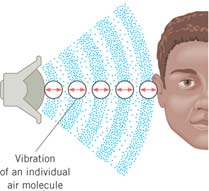
Sound does not transport air molecules from the source to the listener; molecules oscillate about their equilibrium positions.
Frequency and Pitch
Frequency (f): Number of cycles per second; measured in Hertz (Hz).
Pitch: The subjective perception of frequency by the human ear.
Pure Tone: A sound with a single frequency.
Pressure Amplitude and Loudness
Pressure Amplitude: Determines the loudness of a sound; higher amplitude means louder sound.
16.6 The Speed of Sound
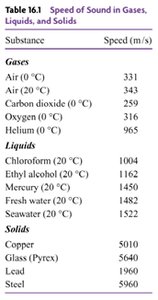
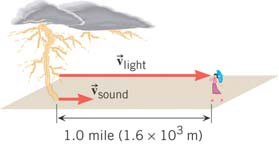
The speed of sound varies depending on the medium (gas, liquid, or solid) and its properties.
In Gases: \(v = \sqrt{\gamma \frac{kT}{m}}\), where \(\gamma\) is the adiabatic index, \(k\) is Boltzmann's constant, \(T\) is temperature, and \(m\) is molecular mass.
In Liquids: \(v = \sqrt{\frac{B}{\rho}}\), where \(B\) is the bulk modulus and \(\rho\) is density.
In Solids: \(v = \sqrt{\frac{Y}{\rho}}\), where \(Y\) is Young's modulus.
16.7 Sound Intensity
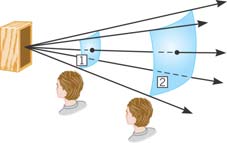
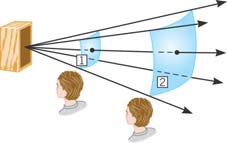
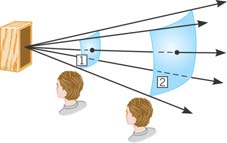
Sound intensity quantifies the power transmitted by a sound wave per unit area.
Formula: \(I = \frac{P}{A}\), where \(P\) is power and \(A\) is area.
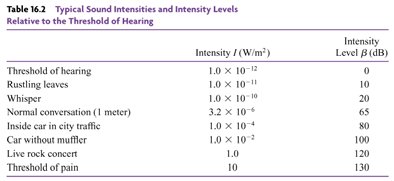
Threshold of Hearing: The minimum intensity detectable by the human ear, about \(1 \times 10^{-12}\) W/m2.
Threshold of Pain: Intensities above 1 W/m2 can be painful.
Inverse Square Law: For a point source emitting sound uniformly, \(I = \frac{P}{4\pi r^2}\).
16.8 Decibels
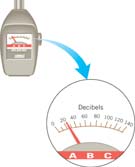
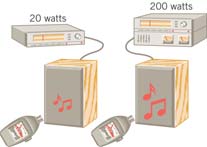
The decibel (dB) is a logarithmic unit used to compare sound intensities. The intensity level \(\beta\) in decibels is given by:
\(\beta = 10 \log_{10}\left(\frac{I}{I_0}\right)\), where \(I_0 = 1.0 \times 10^{-12}\) W/m2 is the reference intensity (threshold of hearing).
When \(I = I_0\), \(\beta = 0\) dB.
16.9 The Doppler Effect
The Doppler effect describes the change in frequency or pitch of a sound as perceived by an observer due to the relative motion between the source and the observer.
Source Moving Toward Observer: \(f' = f \left(\frac{v}{v - v_s}\right)\)
Source Moving Away: \(f' = f \left(\frac{v}{v + v_s}\right)\)
Observer Moving Toward Source: \(f' = f \left(\frac{v + v_o}{v}\right)\)
General Case: \(f' = f \left(\frac{v + v_o}{v - v_s}\right)\)
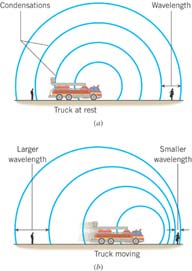
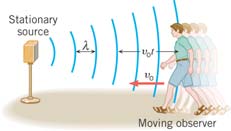
Example: A train horn (415 Hz) is heard at a higher frequency when approaching and a lower frequency when receding, due to the Doppler effect.
16.10 Applications of Sound in Medicine
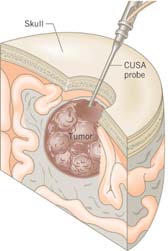
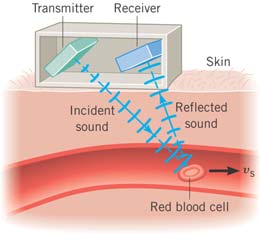
Ultrasound technology uses high-frequency sound waves for medical imaging and treatment.
Ultrasound Imaging: Ultrasonic waves are reflected from tissues to create images of internal body structures.
Tumor Treatment: Ultrasonic probes can vibrate at high frequencies to break apart tumors.
Doppler Ultrasound: Measures blood flow by detecting frequency shifts in reflected sound from moving red blood cells.

16.11 The Sensitivity of the Human Ear
The human ear is sensitive to a wide range of frequencies and intensities, with the threshold of hearing varying by frequency. The ear's response is not uniform across all frequencies.
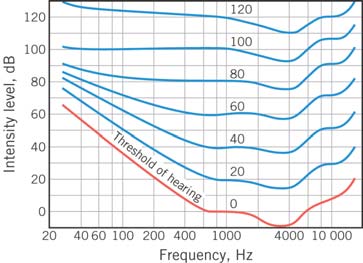
Additional info: Where equations or context were incomplete, standard physics formulas and definitions were supplied for completeness. All images included are directly relevant to the adjacent explanations and reinforce the concepts discussed.
