 Back
BackWaves & Sound: Properties, Propagation, and the Doppler Effect- lecture 26
Study Guide - Smart Notes
 Tailored notes based on your materials, expanded with key definitions, examples, and context.
Waves & Sound
The Nature of Sound
Sound is a longitudinal wave produced by vibrating objects, such as guitar strings, vocal cords, or loudspeakers. These vibrations cause compressions and rarefactions in the surrounding medium, which propagate as sound waves. Sound requires a physical medium (solid, liquid, or gas) to travel and cannot propagate through a vacuum.
Condensation: Region of high pressure where particles are compressed.
Rarefaction: Region of low pressure where particles are spread apart.
Medium Requirement: Sound cannot travel through a vacuum because there are no particles to transmit the vibrations.
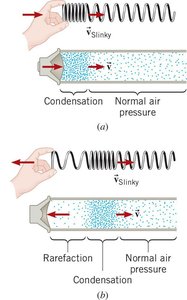
Example: A loudspeaker diaphragm oscillates, pushing and pulling air molecules to create alternating zones of condensation and rarefaction, which travel to your ear as sound.
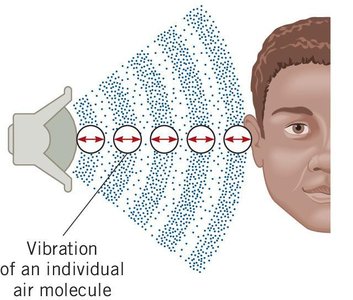
Sound Frequency and Pitch
The frequency of a sound wave is the number of cycles (one condensation and one rarefaction) passing a point per second, measured in hertz (Hz). A sound with a single frequency is called a pure tone. The subjective perception of frequency is known as pitch.
Human Hearing Range: 20 Hz (low pitch) to 20 kHz (high pitch), most sensitive to 1–5 kHz.
Infrasonic: Frequencies below 20 Hz.
Ultrasonic: Frequencies above 20 kHz.
Pressure Amplitude and Loudness
Sound waves are pressure waves, and their amplitude represents the maximum change in pressure. The loudness of a sound is related to its pressure amplitude. For example, normal conversation produces a pressure change of about , much less than atmospheric pressure ().
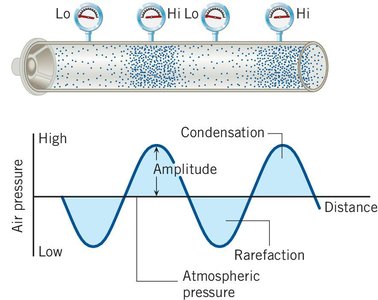
Propagation of Sound
Velocity of Sound
The speed of sound depends on the medium and its properties. Generally, sound travels fastest in solids, slower in liquids, and slowest in gases. Temperature also affects the speed of sound in a medium.
Speed in Air (20°C): About 343 m/s.
Speed in Liquids and Solids: Higher due to greater elasticity and density.
Substance | Speed (m/s) |
|---|---|
Air (0°C) | 331 |
Air (20°C) | 343 |
Carbon dioxide (0°C) | 259 |
Oxygen (0°C) | 316 |
Helium (0°C) | 965 |
Chloroform (20°C) | 1004 |
Ethyl alcohol (20°C) | 1162 |
Mercury (20°C) | 1450 |
Fresh water (20°C) | 1482 |
Seawater (20°C) | 1522 |
Copper | 5010 |
Glass (Pyrex) | 5640 |
Lead | 1960 |
Steel | 5960 |
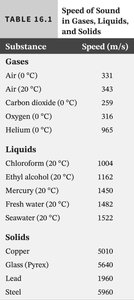
Formulas:
Speed in a liquid:
Speed in a solid bar:
Where is the adiabatic bulk modulus, is Young's modulus, and is density.
Sound Intensity and Decibels
Sound intensity () is the power per unit area carried by a wave. For a point source emitting sound uniformly in all directions, intensity decreases with the square of the distance from the source.
Intensity:
For a spherical wave:
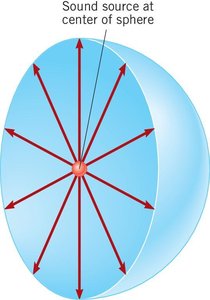
The decibel (dB) scale is used to express sound intensity levels logarithmically, as the human ear perceives intensity changes in this way.
Intensity level:
Reference intensity:
The Doppler Effect
Understanding the Doppler Effect
The Doppler effect describes the change in observed frequency of a wave when the source or observer is moving relative to the medium. If the source approaches the observer, the observed frequency increases; if it moves away, the frequency decreases.
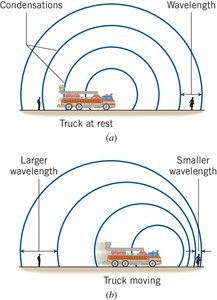
Approaching source: Higher frequency, shorter wavelength.
Receding source: Lower frequency, longer wavelength.
Formulas:
Approaching source:
Receding source:
General case (moving source and/or observer):
Where is observed frequency, is source frequency, is speed of sound, is source velocity, is observer velocity.
Doppler Effect for Light
The Doppler effect also applies to light waves. When a light source moves away from an observer, the observed frequency decreases (redshift); when it approaches, the frequency increases (blueshift).
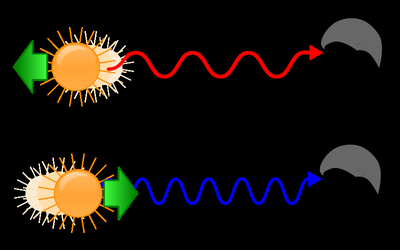
Redshift: Decrease in frequency (longer wavelength) due to receding source.
Blueshift: Increase in frequency (shorter wavelength) due to approaching source.
Doppler Effect Example
Example: A train travels at 44.7 m/s and sounds a 415 Hz horn. The speed of sound is 343 m/s. What frequency and wavelength does a stationary observer hear as the train approaches and recedes?
Approaching: ,
Receding: ,
Conclusion: The frequency is higher and wavelength shorter when the source approaches; lower frequency and longer wavelength when receding.
