Back
BackWaves & Sound: Resonance in Air Columns and Strings
Study Guide - Smart Notes
 Tailored notes based on your materials, expanded with key definitions, examples, and context.
Waves & Sound
Resonance in Air Columns
Resonance occurs when an air column vibrates at its natural frequency, producing standing waves. The frequency at which resonance occurs depends on the length of the air column and whether the ends are open or closed.
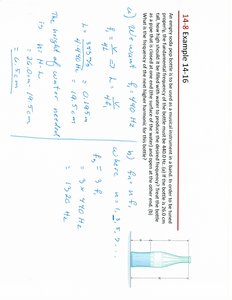
Fundamental Frequency (First Resonance): For a tube closed at one end and open at the other, the fundamental frequency is given by: where v is the speed of sound in air and L is the length of the air column.
Higher Resonances: Only odd harmonics are present in a tube closed at one end: , where n = 1, 3, 5, ...
Example Application: If a bottle resonates at 440 Hz when blown across its top, and the speed of sound is 343 m/s, the length of the air column can be calculated as:
Practical Use: The height of water in the bottle can be adjusted to change the length of the air column, thus changing the resonant frequency.
Resonance in Strings
Strings fixed at both ends can vibrate at specific frequencies, producing standing waves. The frequency depends on the length, tension, and mass per unit length of the string.
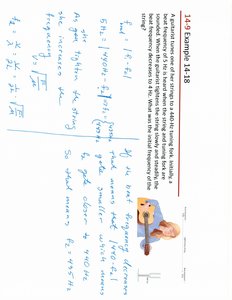
Fundamental Frequency: The lowest frequency at which a string vibrates is: where L is the length of the string, T is the tension, and μ is the mass per unit length.
Effect of Tension: Increasing the tension T increases the frequency. If the tension is doubled, the frequency increases by a factor of .
Effect of Length: Shortening the string increases the frequency, while lengthening it decreases the frequency.
Example Application: If a guitar string tuned to 440 Hz is tightened so the tension increases by a factor of 4, the new frequency is:
Practical Use: Musicians adjust the tension and length of strings to tune their instruments to desired frequencies.