 Back
BackWaves and the Electromagnetic Spectrum: Key Concepts and Applications
Study Guide - Smart Notes
 Tailored notes based on your materials, expanded with key definitions, examples, and context.
Key Concepts in Physics
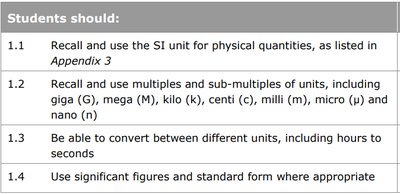
SI Units and Unit Conversions
Understanding and using the International System of Units (SI) is fundamental in physics. SI units provide a standardized way to express physical quantities, ensuring clarity and consistency in scientific communication.
SI Units: The base units for common physical quantities include the meter (m) for length, kilogram (kg) for mass, and second (s) for time.
Multiples and Sub-multiples: Prefixes are used to denote multiples or fractions of units, such as giga (G, ), mega (M, ), kilo (k, ), centi (c, ), milli (m, ), micro (μ, ), and nano (n, ).
Unit Conversion: Converting between units (e.g., hours to seconds) is essential for calculations. For example, .
Significant Figures and Standard Form: Results should be reported with the correct number of significant figures and, when appropriate, in standard form (scientific notation), e.g., m/s.
Waves
Wave Refraction at Boundaries
When a wave passes from one medium to another, its speed and direction can change. This phenomenon is known as refraction.
Change of Direction: Waves bend at the boundary between two media due to a change in speed.
Change of Speed: The speed of a wave depends on the properties of the medium. For example, light slows down when entering glass from air.
Explanation: If a wave enters a denser medium at an angle, it slows down and bends towards the normal; if it enters a less dense medium, it speeds up and bends away from the normal.

Measuring Wave Properties: Core Practical
Investigating waves involves measuring their speed, frequency, and wavelength in different media (solids and fluids).
Speed (): The speed of a wave is given by , where is frequency and is wavelength.
Frequency (): The number of wave cycles passing a point per second (measured in hertz, Hz).
Wavelength (): The distance between two consecutive points in phase on a wave (e.g., crest to crest).
Equipment: Rulers, stopwatches, signal generators, and oscilloscopes are commonly used to measure these properties in practical investigations.

The Electromagnetic Spectrum
Nature and Properties of Electromagnetic Waves
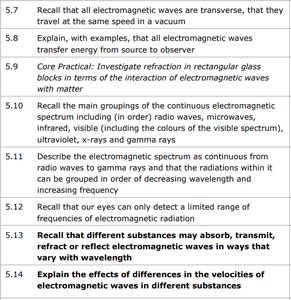
The electromagnetic spectrum encompasses all types of electromagnetic radiation, which are transverse waves that travel at the same speed in a vacuum ( m/s).
Transverse Waves: All electromagnetic waves are transverse, meaning their oscillations are perpendicular to the direction of energy transfer.
Energy Transfer: Electromagnetic waves transfer energy from a source to an observer.
Refraction and Interaction with Matter
Refraction in Glass Blocks: When electromagnetic waves enter a new medium (e.g., glass), they may refract due to a change in speed, which is a result of the interaction with matter.
Groupings and Detection
Main Groupings: The electromagnetic spectrum includes (in order of increasing frequency): radio waves, microwaves, infrared, visible light, ultraviolet, x-rays, and gamma rays.
Detection: Human eyes can only detect a limited range (visible light) within the electromagnetic spectrum.
Absorption, Transmission, and Reflection
Material Interactions: Different substances may absorb, transmit, refract, or reflect electromagnetic waves in ways that vary with wavelength.
Velocity Differences: The speed of electromagnetic waves can differ in various substances, affecting how they are refracted or transmitted.
Potential Dangers and Effects
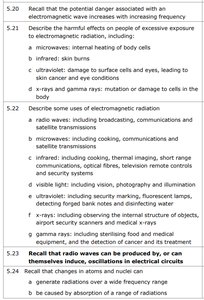
Increasing Frequency: The potential danger associated with electromagnetic waves increases with frequency (e.g., gamma rays are more dangerous than radio waves).
Biological Effects:
Microwaves: Internal heating of body cells
Infrared: Skin burns
Ultraviolet: Damage to skin cells and eyes, risk of skin cancer
X-rays and Gamma rays: Mutation and damage to cells
Uses of Electromagnetic Radiation
Radio Waves: Broadcasting, communications, satellite transmissions
Microwaves: Cooking, communications, satellite transmissions
Infrared: Thermal imaging, short-range communications, remote controls, security systems
Visible Light: Vision, photography, illumination
Ultraviolet: Security marking, fluorescent lamps, detecting forged bank notes
X-rays: Medical imaging, security scanning
Gamma Rays: Sterilizing food and medical equipment, cancer treatment
Production and Detection of Radio Waves
Production: Radio waves can be produced by oscillations in electrical circuits.
Detection: Radio waves can induce oscillations in electrical circuits, allowing for their detection.
Changes in Atoms and Nuclei
Generation of Electromagnetic Radiation: Changes in atoms and nuclei can generate electromagnetic radiation over a wide frequency range.
Absorption: Absorption of radiation by atoms and nuclei can also occur, leading to various physical effects.
Summary Table: Electromagnetic Spectrum Properties and Uses
Type | Wavelength Range | Main Uses | Potential Dangers |
|---|---|---|---|
Radio Waves | >1 m | Broadcasting, communications | None significant |
Microwaves | 1 mm – 1 m | Cooking, satellite transmissions | Internal heating of body cells |
Infrared | 700 nm – 1 mm | Thermal imaging, remote controls | Skin burns |
Visible Light | 400–700 nm | Vision, photography | Bright light can damage eyes |
Ultraviolet | 10–400 nm | Fluorescent lamps, security marking | Skin and eye damage, cancer risk |
X-rays | 0.01–10 nm | Medical imaging | Cell mutation, cancer |
Gamma Rays | <0.01 nm | Sterilization, cancer treatment | Cell mutation, cancer |
Additional info: Table entries inferred and expanded for completeness based on standard physics curriculum.
