 Back
Waves and Thermodynamics: Physics with Calculus Study Notes
Study Guide - Smart Notes
 Tailored notes based on your materials, expanded with key definitions, examples, and context.
Waves
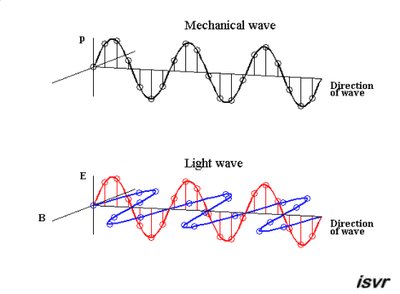
Mechanical and Non-Mechanical Waves
Waves are disturbances that transfer energy from one point to another without the transfer of matter. They are classified as either mechanical or non-mechanical (electromagnetic) waves.
Mechanical waves require a medium (solid, liquid, or gas) to propagate. Examples include sound waves and water waves.
Non-mechanical waves (electromagnetic waves) do not require a medium and can travel through a vacuum. All electromagnetic waves travel at the speed of light in a vacuum.
Types of Mechanical Waves: Longitudinal and Transverse
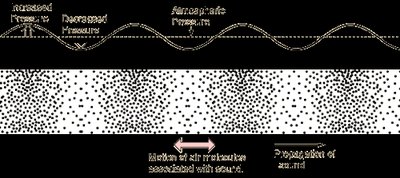
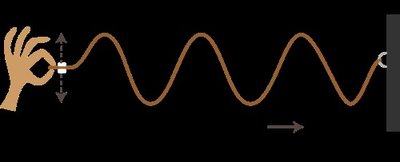
Mechanical waves can be further classified based on the direction of particle vibration relative to the direction of wave propagation:
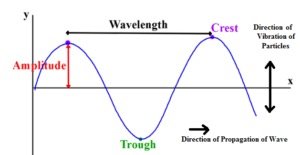
Longitudinal waves: The particles of the medium vibrate parallel to the direction of wave propagation. Example: sound waves.
Transverse waves: The particles of the medium vibrate perpendicular to the direction of wave propagation. Example: waves on a string.
Electromagnetic Waves
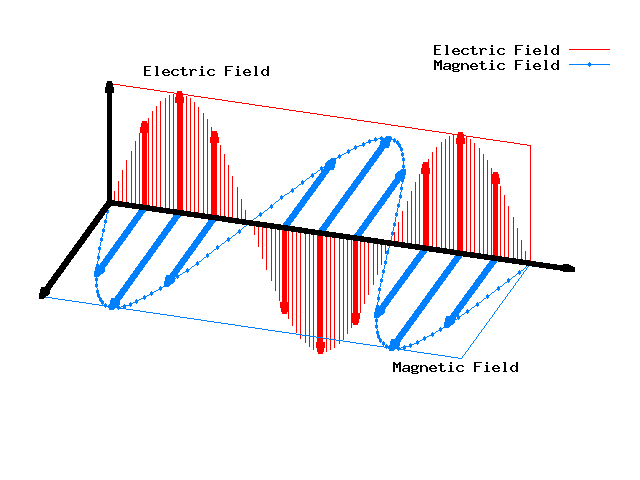
Electromagnetic waves consist of oscillating electric and magnetic fields at right angles to each other and to the direction of propagation. They do not require a medium and travel at the speed of light in a vacuum.
The Electromagnetic Spectrum
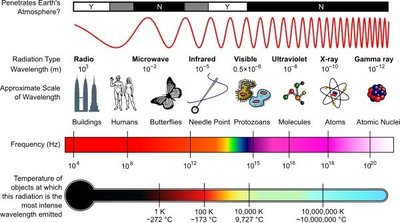
The electromagnetic spectrum encompasses all types of electromagnetic radiation, classified by wavelength and frequency. Examples include radio waves, microwaves, infrared, visible light, ultraviolet, X-rays, and gamma rays.
Wave Properties and Descriptions
Key Terms: Wavelength, Amplitude, Frequency, Period, Velocity
All waves are described using the following terms:
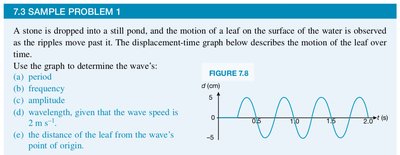
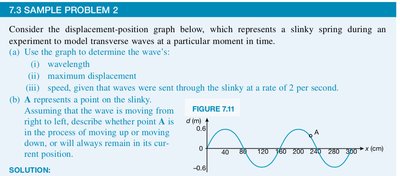
Wavelength (\(\lambda\)): The distance between two successive points in phase (e.g., crest to crest).
Amplitude (A): The maximum displacement from equilibrium position.
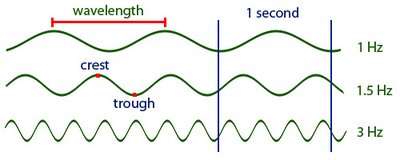
Frequency (f): The number of wave cycles passing a point per second (measured in Hz).
Period (T): The time taken for one complete cycle (measured in seconds).
Velocity (v): The speed at which the wave propagates through the medium.
Relationship Between Frequency and Period
The frequency and period of a wave are inversely related:
\(f = \frac{1}{T}\)
The Wave Equation
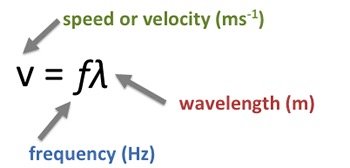
The wave equation relates the speed, frequency, and wavelength of a wave:
\(v = f \lambda\)
Sample Problems and Applications
Sample problems often involve calculating period, frequency, amplitude, wavelength, and velocity using graphs and the wave equation.
Tabular Data: Calculating Wave Properties
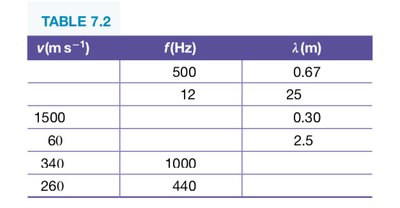
Wave properties can be organized in tables for comparison and calculation:
v (m/s) | f (Hz) | \(\lambda\) (m) |
|---|---|---|
500 | 0.67 | 0.67 |
1500 | 0.30 | 0.30 |
60 | 2.5 | 2.5 |
340 | 1000 | |
260 | 440 |
Additional info: Students are often asked to fill in missing values using the wave equation.
Wave Behavior
Interference and Superposition
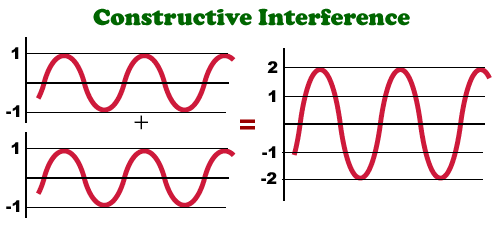
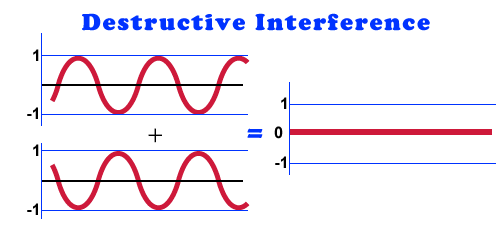
When two waves meet, their displacements add together (superposition principle). This can result in:
Constructive interference: Waves add to produce a larger amplitude.
Destructive interference: Waves add to produce a smaller (or zero) amplitude.
Two-Dimensional Interference Patterns
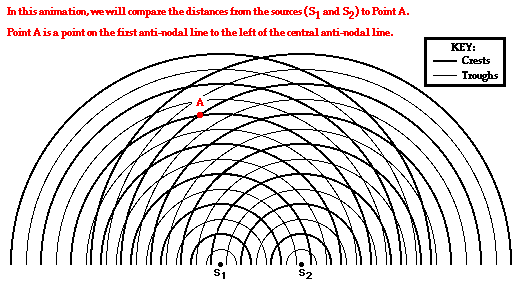
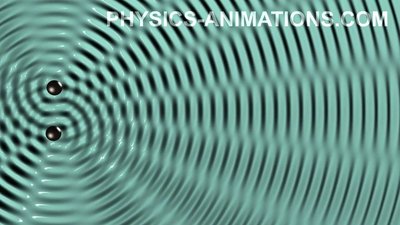
When two sources emit waves in phase, the resulting interference pattern consists of lines of constructive (antinodal) and destructive (nodal) interference.
Antinodal lines: Where crests meet crests or troughs meet troughs (\(AS_1 - AS_2 = n\lambda\)).
Nodal lines: Where crests meet troughs (\(AS_1 - AS_2 = (n - 1/2)\lambda\)).
Beats
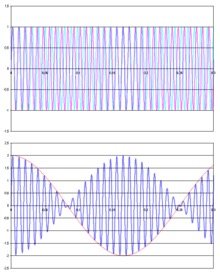
Beats occur when two waves of slightly different frequencies interfere, producing a fluctuation in amplitude at the beat frequency:
\(f_{\text{beat}} = |f_1 - f_2|\)

Standing Waves
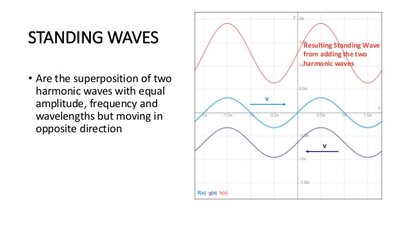
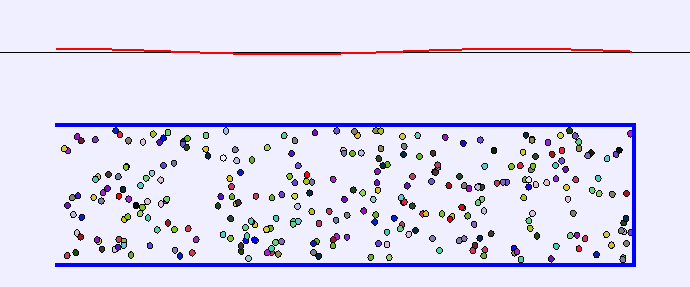
Standing waves are formed by the interference of two waves of the same frequency and amplitude traveling in opposite directions. Nodes (points of no motion) and antinodes (points of maximum motion) are stationary.
Harmonics and Overtones
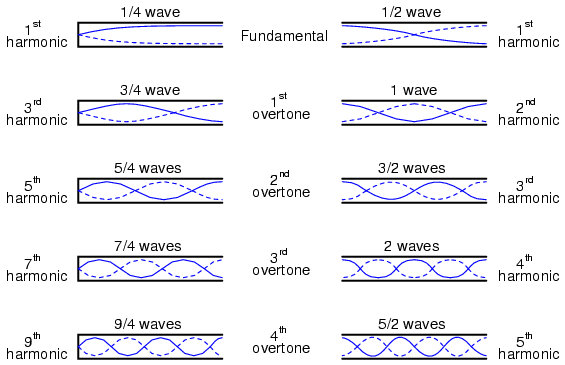
Harmonics are resonant frequencies at which standing waves are established. The first harmonic is the fundamental frequency; higher harmonics are called overtones.
Standing Waves in Strings and Pipes
The frequency of standing waves depends on the length of the string or pipe, the wave speed, and the harmonic number:
For strings: \(\lambda = \frac{2L}{n}\), \(f_n = n f_1\), \(v = f \lambda\)
For pipes open at one end: \(\lambda = \frac{4L}{n}\), where n = 1, 3, 5, ... (odd harmonics only)
For pipes open at both ends: \(\lambda = \frac{2L}{n}\), n = 1, 2, 3, ...
Wave Speed in Strings
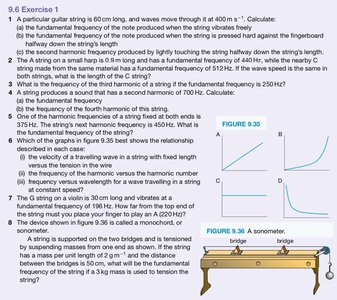
The speed of a wave on a string depends on the tension (T) and the linear mass density (\(\mu\)):
\(v = \sqrt{\frac{T}{\mu}}\)
Doppler Effect
Concept and Mathematical Description
The Doppler effect describes the change in observed frequency when the source and/or observer are moving relative to the medium:
\(f' = \frac{v \pm v_o}{v \mp v_s} f\)
Where \(v\) is the speed of sound, \(v_o\) is the observer's speed, \(v_s\) is the source's speed, and the signs depend on the direction of motion.
Reflection, Refraction, and Diffraction
Reflection
All waves reflect off surfaces, obeying the law of reflection: the angle of incidence equals the angle of reflection.
Refraction
Refraction is the bending of waves as they pass from one medium to another due to a change in speed. Snell's Law describes this relationship:
\(n_1 \sin \theta_1 = n_2 \sin \theta_2\)
Where \(n\) is the refractive index, \(\theta\) is the angle to the normal.
Total Internal Reflection and Critical Angle
Total internal reflection occurs when a wave traveling from a medium with higher refractive index to one with lower refractive index hits the boundary at an angle greater than the critical angle:
\(\sin \theta_c = \frac{n_2}{n_1}\)
Diffraction
Diffraction is the bending of waves around obstacles or through openings. The amount of diffraction increases when the wavelength is comparable to the size of the opening or obstacle.
Sound Intensity and the Inverse Square Law
Intensity and Intensity Level
Intensity (I) is the power per unit area carried by a wave:
\(I = \frac{P}{A}\)
Sound intensity level (L) in decibels (dB): \(L = 10 \log_{10} \left( \frac{I}{I_0} \right)\), where \(I_0 = 1 \times 10^{-12} \text{ W/m}^2\) is the threshold of hearing.
The intensity of a wave decreases with the square of the distance from the source (inverse square law):
\(I \propto \frac{1}{d^2}\)
Thermodynamics
Thermodynamic Systems and Temperature
Thermodynamics studies the relationships between heat, work, and energy. Temperature is a measure of the average kinetic energy of particles in a substance.
Celsius and Kelvin scales are commonly used. Kelvin is the SI unit, with absolute zero (0 K) as the lowest possible temperature.
Kinetic Theory of Matter
All matter is composed of particles in constant motion. The kinetic energy of these particles is directly related to temperature.
Thermal Equilibrium and Zeroth Law
When two objects are in thermal contact, heat flows from the hotter to the cooler object until they reach the same temperature (thermal equilibrium). The Zeroth Law states that if A is in equilibrium with B, and B with C, then A is in equilibrium with C.
First Law of Thermodynamics
The First Law is the law of conservation of energy applied to thermodynamic systems:
\(\Delta U = Q - W\)
\(\Delta U\): Change in internal energy, \(Q\): Heat added to the system, \(W\): Work done by the system.
Specific Heat Capacity
The specific heat capacity (c) is the energy required to raise the temperature of 1 kg of a substance by 1°C:
\(Q = mc\Delta T\)
Latent Heat
During phase changes, temperature remains constant while energy is used to change the state. The energy required is called latent heat:
\(Q = mL\)
L: Specific latent heat of fusion (solid to liquid) or vaporization (liquid to gas).
Heat Transfer: Conduction
Heat flows from hot to cold regions by conduction, described by:
\(\frac{Q}{t} = kA \frac{\Delta T}{d}\)
k: Thermal conductivity, A: Cross-sectional area, \(\Delta T\): Temperature difference, d: Thickness.
Geometric Optics: Lenses
Converging and Diverging Lenses
Lenses use refraction to focus or diverge light. Convex (converging) lenses bring light to a focus, while concave (diverging) lenses spread light out.
Real images: Formed by convex lenses when the object is beyond the focal length; inverted and on the opposite side of the lens.
Virtual images: Formed by concave lenses or by convex lenses when the object is within the focal length; upright and on the same side as the object.
Important Terminology
Optical centre: Centre of the lens.
Principal axis: Line passing through the optical centre.
Focal length (f): Distance from the optical centre to the focus.
Focal plane: Plane perpendicular to the principal axis at the focus.
