 Back
Waves in One Dimension: Physics with Calculus Study Notes
Study Guide - Smart Notes
 Tailored notes based on your materials, expanded with key definitions, examples, and context.
Waves in One Dimension
Introduction to Waves
Waves are fundamental phenomena in physics, representing disturbances that propagate through material media or empty space. The study of waves involves understanding both their kinematics (motion) and dynamics (energy transport).
Wave: A disturbance that propagates through a medium or space.
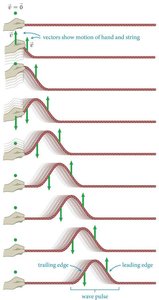
Wave pulse: A single, isolated propagating disturbance.
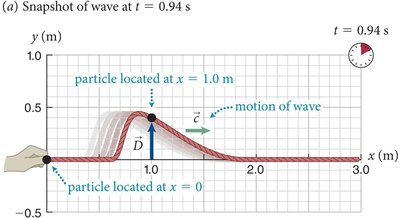
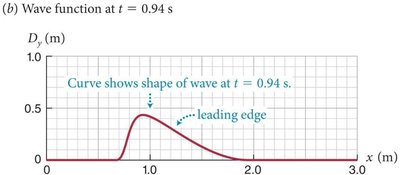
Wave function: Mathematical representation of the wave's shape at any instant, changing with time as the wave travels.
Representing Waves Graphically
Waves can be visualized using frame-sequence diagrams and displacement curves. The motion of the wave is distinct from the motion of the particles in the medium.
Transverse wave: The medium moves perpendicular to the direction of wave propagation.
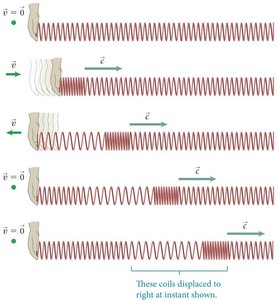
Longitudinal wave: The medium moves parallel to the direction of wave propagation.
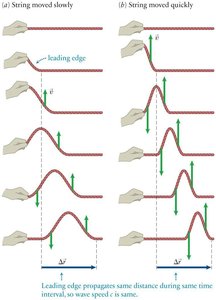
Wave speed (c): The speed at which the disturbance travels through the medium.
Particle speed (v): The speed of individual particles in the medium.


Wave Functions and Displacement Curves
The wave function describes the displacement of particles as a function of position and time. For a wave traveling in the positive x-direction:
Wave function:
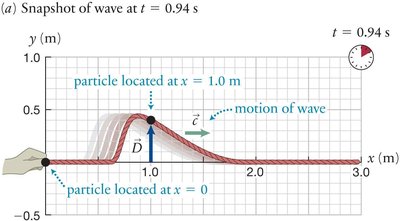
Snapshot: Shows the shape of the wave at a specific time.
Displacement curve: Shows the displacement of a particle as a function of time.



Longitudinal Waves
In longitudinal waves, the disturbance propagates parallel to the direction of the wave. Examples include sound waves and waves in springs.
Displacement: Compression and rarefaction of the medium.
Wave function: Can be represented similarly to transverse waves.

Periodic and Harmonic Waves
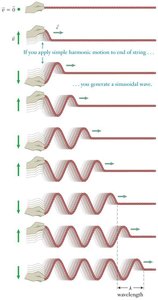
A periodic wave repeats itself over a distance called the wavelength (λ). If the displacement is sinusoidal, the wave is harmonic.
Wavelength (λ): The distance over which the wave repeats.
Period (T): The time for one complete oscillation.
Frequency (f): Number of oscillations per second.
Wave speed:
Angular frequency:
Wave number:
Wave Propagation: Effect of Tension and Mass
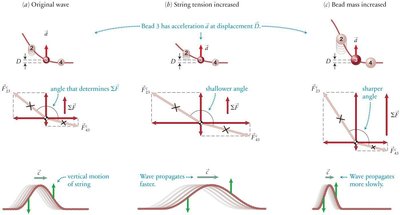
The speed of a wave on a string depends on the tension and the mass per unit length (linear mass density) of the string.
Wave speed equation:
Tension (T): Force stretching the string.
Linear mass density (μ): Mass per unit length of the string.
Superposition and Interference of Waves
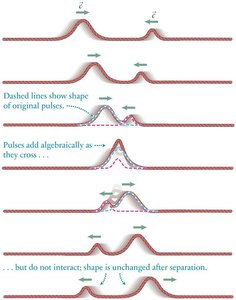
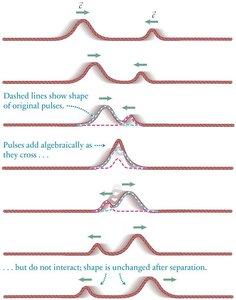
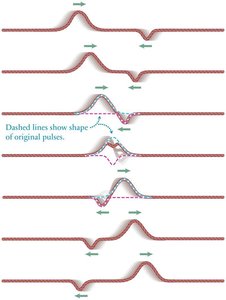
When two or more waves overlap in a medium, their displacements add algebraically. This principle is called superposition and leads to interference effects.
Constructive interference: Waves add to produce greater displacement.
Destructive interference: Waves add to produce smaller or zero displacement.
Node: Point of zero displacement in a medium.
Boundary Effects
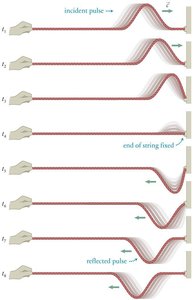
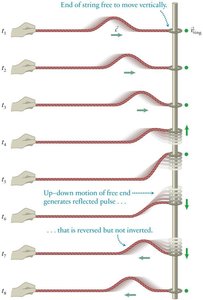
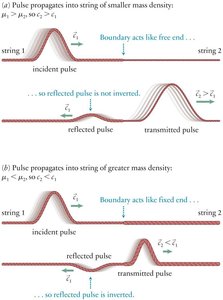
When a wave encounters a boundary, it can be reflected, transmitted, or both. The nature of the boundary (fixed, free, or intermediate) determines the behavior of the reflected and transmitted waves.
Fixed end: Reflected wave is inverted.
Free end: Reflected wave is not inverted.
Intermediate boundary: Partial transmission and reflection, depending on mass density.
Standing Waves
Standing waves are formed by the interference of two harmonic waves of equal amplitude traveling in opposite directions. Nodes and antinodes are characteristic features of standing waves.
Node: Point of zero displacement.
Antinode: Point of maximum displacement.
Mathematical form:
Node positions: , where n = 0, ±1, ±2, ...
Antinode positions: , where n = 0, ±1, ±2, ...
Energy Transport in Waves
Waves transport energy through the medium. The energy is carried as both kinetic and potential energy, and the average power transported by a harmonic wave can be calculated.
Kinetic energy: Associated with the motion of particles.
Potential energy: Associated with the stretching or compression of the medium.
Average power:
Quantity | Formula | Description |
|---|---|---|
Wave speed | Speed of wave on string | |
Wavelength | Distance over which wave repeats | |
Frequency | Oscillations per second | |
Angular frequency | Rate of phase change | |
Wave number | Spatial frequency | |
Average power | Power transported by wave |
Additional info: These notes expand on the original lecture slides by providing full definitions, mathematical context, and examples for each concept. All included images directly illustrate the physical phenomena or mathematical representations discussed in the adjacent paragraphs.
