 Back
Waves in Two and Three Dimensions: Study Notes for Physics with Calculus
Study Guide - Smart Notes
 Tailored notes based on your materials, expanded with key definitions, examples, and context.
Waves in Two and Three Dimensions
Wavefronts
Wavefronts are fundamental concepts in wave physics, representing the loci of points in a medium that oscillate in phase. Understanding wavefronts is essential for analyzing the propagation of waves in both two and three dimensions.
Definition: A wavefront is a surface (or curve in 2D) where all points have the same phase of oscillation.
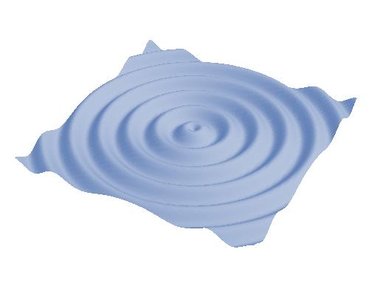
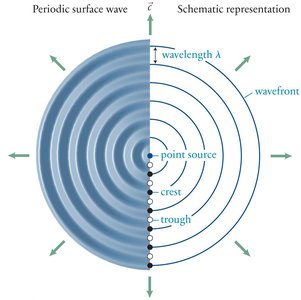
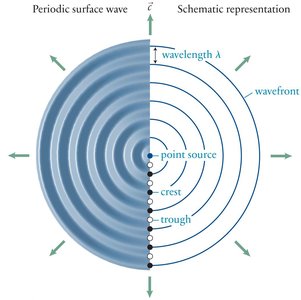
Point Source: When a wave originates from a single point, it produces circular (2D) or spherical (3D) wavefronts.
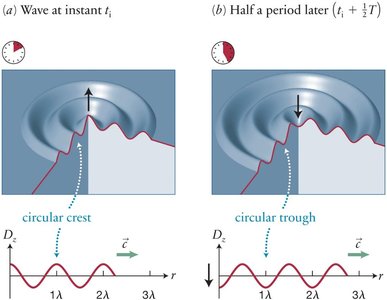
Periodic Surface Waves: Created by periodic disturbances, such as poking water with a stick, resulting in regularly spaced wavefronts.
Crests and Troughs: Crests are points of maximum positive displacement, while troughs are points of maximum negative displacement. The distance between successive crests (or troughs) is the wavelength ().
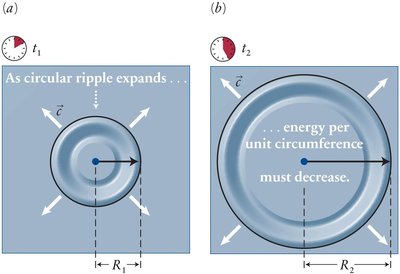
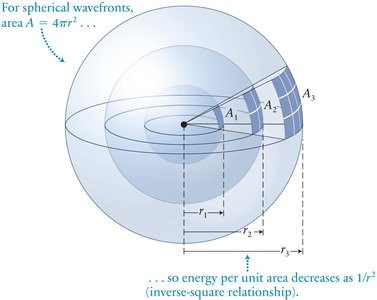
Energy Distribution: As waves spread, energy per unit length (2D) or area (3D) decreases. For 2D waves: , and amplitude . For 3D waves: , and amplitude .
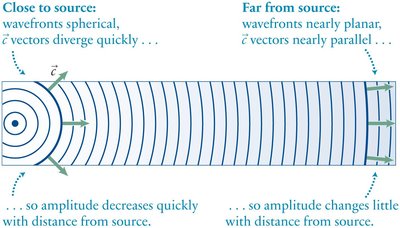
Planar Wavefronts: Far from the source, spherical wavefronts become nearly planar.
Sound
Sound is a mechanical wave that propagates as longitudinal waves through various media. Its properties and behavior are crucial for understanding acoustics and wave phenomena.
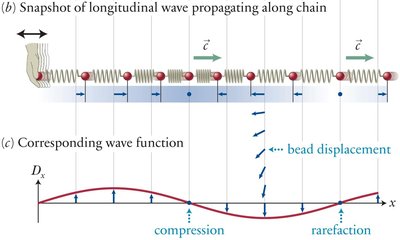
Definition: Sound consists of longitudinal waves, characterized by alternating compressions and rarefactions.
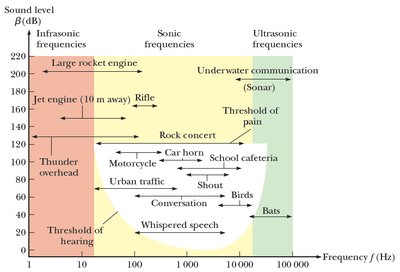
Frequency Range: The human ear detects frequencies from 20 Hz to 20 kHz.
Speed of Sound: In dry air at 20°C, the speed is 343 m/s.
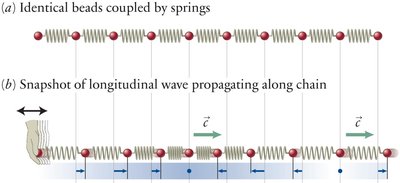
Mechanical Model: Sound can be modeled as beads coupled by springs, where the wave transports energy and momentum, not the beads themselves.
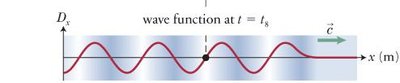
Wave Function: Displacement of particles from equilibrium can be plotted to visualize the wave.
Propagation: In open air, sound spreads in 3D, forming spherical shells of compression and rarefaction.
Intensity
Intensity quantifies the power delivered by a wave per unit area or length. It is a key parameter in acoustics and wave energy analysis.
Definition: For 3D waves, , where is power and is area. For 2D waves, , where is length.
Inverse-Square Law: For a point source radiating uniformly, .
Decibel Scale: Intensity level in decibels (dB) is , where is the threshold of hearing.
Range: Human hearing spans from (threshold) to (pain).
Beats
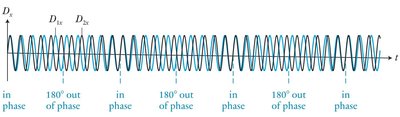
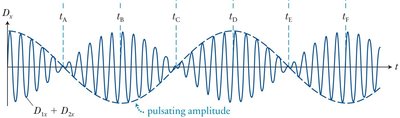
Beats arise from the superposition of two waves with slightly different frequencies, resulting in periodic variations in amplitude.
Definition: Beats are oscillations in amplitude due to interference between waves of similar frequency.
Mathematical Representation: If and , their sum is .
Beat Frequency: .
Doppler Effect
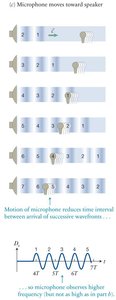
The Doppler effect describes the change in observed frequency of a wave when the source or observer is in motion relative to the medium.
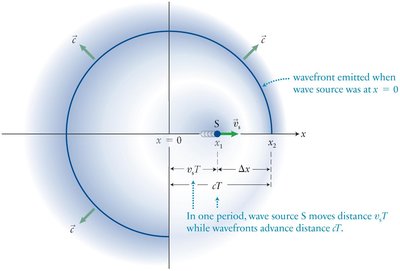
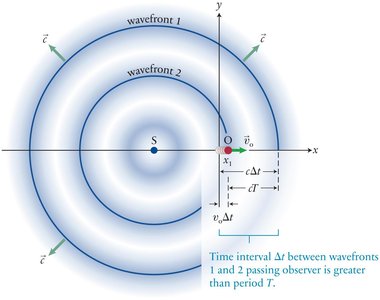
Definition: The observed frequency differs from the emitted frequency when there is relative motion between source and observer.
Source Moving Toward Observer:
Source Moving Away:
Observer Moving Toward Source:
Observer Moving Away:
General Doppler Equation:
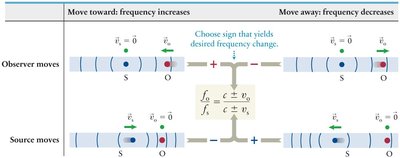
Shock Waves
Shock waves occur when a source moves faster than the speed of the wave in the medium, creating a cone of wavefronts.
Mach Number: The ratio defines the Mach number.
Shock Angle: , where .

Interference
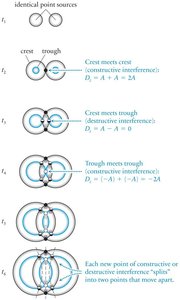
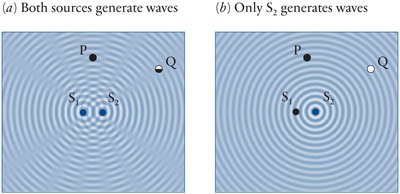
Interference is the superposition of two or more waves, resulting in patterns of constructive and destructive interference.
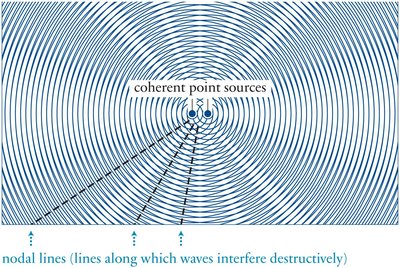
Coherent Sources: Sources with constant phase difference produce stable interference patterns.
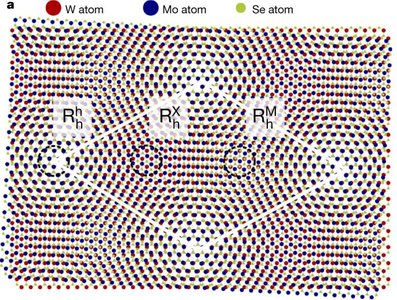
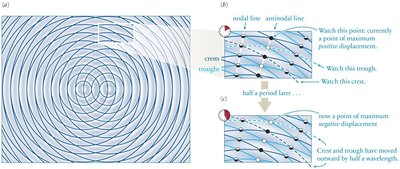
Moiré Pattern: Overlapping circular wavefronts create complex patterns.
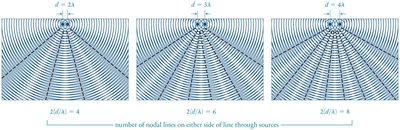
Nodal Lines: Lines where waves cancel (destructive interference).
Antinodal Lines: Lines where displacement is maximum (constructive interference).
Number of Nodal Lines: For two sources separated by and wavelength , the number is .
Diffraction
Diffraction is the spreading of waves when they encounter obstacles or apertures comparable to their wavelength.
Huygens' Principle: Every point on a wavefront acts as a source of secondary wavelets.
Diffraction: Significant spreading occurs when aperture width is less than the wavelength.
Diffraction of Light
Light waves also undergo diffraction, but the effect is only noticeable when the aperture is comparable to the wavelength of light.
Diffraction Grating: Multiple slits act as coherent sources, producing interference patterns of bright and dark fringes.
Fringe Order: Bright fringes are labeled by order , with the central fringe at .
Angular Position: for bright fringes, for dark fringes.
Principal Maxima: Brightest fringes; secondary maxima are fainter.
Dark Fringe Condition: For slits, , not a multiple of $N$.
X-Ray Diffraction
X-ray diffraction is a technique used to study the structure of materials, exploiting the short wavelength of x-rays.
Wavelength: X-rays range from 0.01 nm to 10 nm.
Medical Application: X-rays pass through soft tissue but are absorbed by bones, enabling imaging of the skeleton.
