 Back
BackWork and Energy: Principles, Calculations, and Applications
Study Guide - Smart Notes
 Tailored notes based on your materials, expanded with key definitions, examples, and context.
Work and Energy
Introduction to Energy and Its Conservation
Energy is a fundamental concept in physics, representing a conserved quantity in all physical processes. The law of conservation of energy states that the total energy of a closed system remains constant, regardless of the transformations it undergoes. This principle is not a description of a mechanism but rather a statement about the invariance of a calculated quantity through all changes in nature.
Kinetic Energy (T): Energy due to motion, given by .
Potential Energy (V): Energy due to interactions between objects, such as gravitational, elastic, or electric potential energy.
Work (U): The process of energy transfer via force acting over a distance.
Conservation Principle: The total energy (kinetic + potential) in a closed system is conserved.
Examples of Potential Energy:
Gravitational:
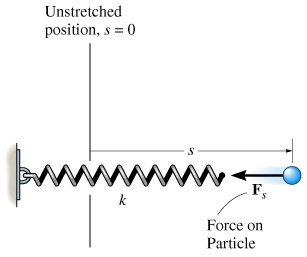
Elastic (Spring):
Electric (Two Charges): , where
Additional info: The Feynman block analogy illustrates conservation: the sum of all forms of energy remains constant, even as energy shifts between forms.
Work of a Force
Definition and Calculation of Work
Work is defined as the energy transferred to or from an object via the application of force along a displacement. For a force acting on an object displaced by , the infinitesimal work is:
For a finite displacement from point 1 to point 2:
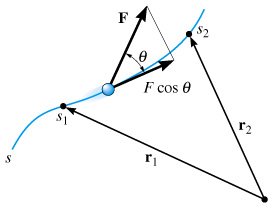
Properties of Work:
Work is a scalar quantity.
SI unit: Joule (J), where .
The sign of work depends on the angle between force and displacement:
: (work is positive)
: (work is negative)
: (work is zero)
If force is constant:
Work Done by Specific Forces
Work of Gravity (Weight)
The work done by gravity is positive when an object moves downward (), as the force and displacement are parallel. The work depends only on the initial and final heights, not the path taken:
Work of an Elastic Force (Spring)
The work done by a spring force is positive when the spring returns to equilibrium (). The force is , and the work is:
Work-Energy Principle
Statement and Applications
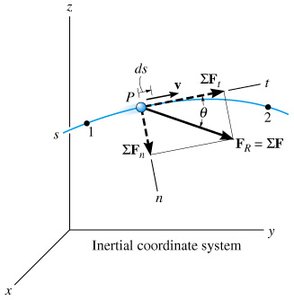
The work-energy principle states that the net work done on an object is equal to the change in its kinetic energy. This principle provides a powerful tool for solving problems involving forces and motion, especially when the goal is to find velocity rather than acceleration.
Kinetic Energy:
Work-Energy Theorem:
In words: The final kinetic energy equals the initial kinetic energy plus the work done by all forces as the object moves from its initial to final position.
This approach is especially useful for finding speeds, but does not capture all information about normal forces (which are handled by Newton's second law in the normal direction).
Additional info: For a system of particles or when friction is involved, refer to the extended work-energy principle in your textbook (Section 14-3).
Summary Table: Types of Energy and Work
Type | Formula | Physical Meaning |
|---|---|---|
Kinetic Energy | Energy due to motion | |
Gravitational Potential Energy | Energy due to position in a gravitational field | |
Elastic Potential Energy | Energy stored in a stretched or compressed spring | |
Electric Potential Energy | Energy due to interaction between charges | |
Work (General) | Energy transferred by force over displacement |
