 Back
BackWork and Kinetic Energy: Concepts, Calculations, and Applications
Study Guide - Smart Notes
 Tailored notes based on your materials, expanded with key definitions, examples, and context.
Work and Kinetic Energy
Introduction to Work and Energy
Work and kinetic energy are fundamental concepts in physics that describe how forces cause motion and how energy is transferred or transformed. These concepts are essential for analyzing systems where Newton's laws alone are insufficient, such as in energy conservation problems.

Definition of Work
Work is done by a force when it causes a displacement of an object. The amount of work depends on the magnitude of the force, the displacement, and the angle between the force and displacement vectors.
Work is only done when a force causes movement in the direction of the force.
SI unit of work: Joule (J), where 1 J = 1 N·m.

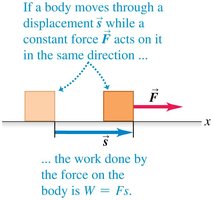
Calculating Work by a Constant Force
When a constant force F acts on an object causing a displacement s at an angle \( \phi \), the work done is given by:
Work formula:
Alternatively, using the dot product:


Sign of Work: Positive, Negative, and Zero
The sign of work depends on the direction of the force relative to the displacement:
Case | Situation | Work |
|---|---|---|
Force in direction of displacement | Work is positive | (\(0^\circ \leq \phi < 90^\circ\)) |
Force opposite to displacement | Work is negative | (\(90^\circ < \phi \leq 180^\circ\)) |
Force perpendicular to displacement | No work is done | (\(\phi = 90^\circ\)) |



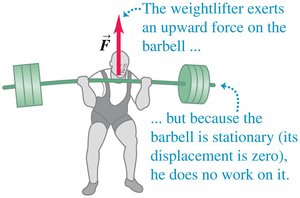
Examples of Zero Work
If an object does not move, or if the force is perpendicular to the displacement, no work is done. For example, a weightlifter holding a barbell stationary does no work on the barbell.
Work Done in Lifting and Lowering Objects
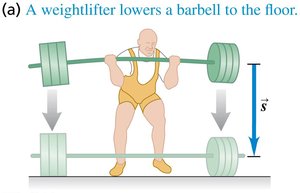
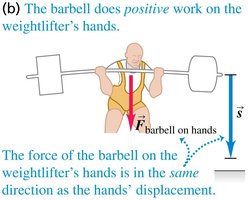
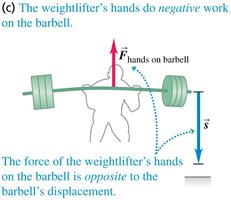
When lowering a barbell, the direction of force and displacement determines whether the work is positive or negative:
Barbell does positive work on the hands when moving down.
Hands do negative work on the barbell when resisting its fall.
Total Work and Its Effects
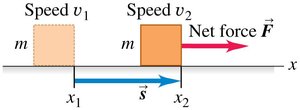
The total work done by the net force on a particle determines whether the particle speeds up, slows down, or maintains its speed:
Wtot > 0: Particle speeds up.
Wtot < 0: Particle slows down.
Wtot = 0: Particle's speed remains constant.
Kinetic Energy
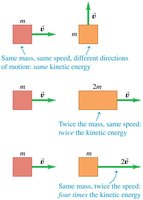
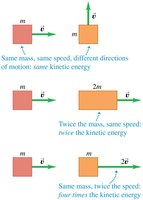
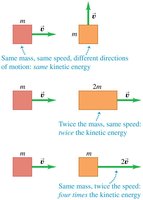
Kinetic energy is the energy of motion, defined for a particle of mass m and speed v as:
Kinetic energy formula:
Kinetic energy is a scalar and always non-negative.
SI unit: Joule (J).
The Work-Energy Theorem
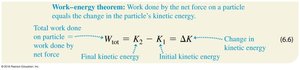
The work-energy theorem states that the net work done on a particle equals the change in its kinetic energy:
Work-energy theorem:
Work and Kinetic Energy in Composite Systems
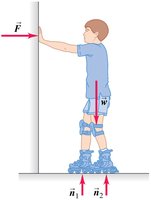
In systems with multiple parts (e.g., a skater pushing off a wall), the kinetic energy of the system can change even if the external work is zero. This is because internal forces can redistribute energy among the parts.
Work Done by Varying Forces
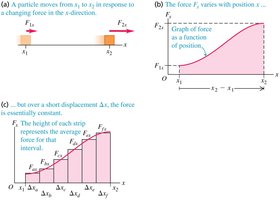
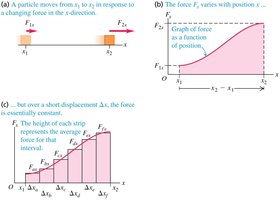
When the force is not constant, the work done as a particle moves from x1 to x2 is calculated by integrating the force over the path:
Work by a varying force:
The area under the force vs. position graph represents the work done.

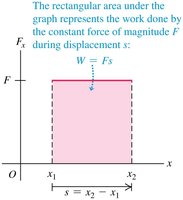
Work Done by a Constant Force (Graphical Interpretation)
For a constant force, the work done is the area of a rectangle under the force vs. displacement graph.
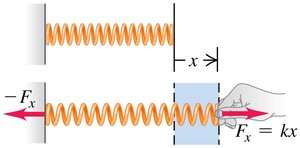
Work Done in Stretching a Spring
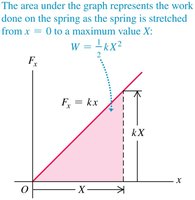
The force required to stretch a spring is proportional to the displacement (Hooke's Law): . The work done in stretching the spring from 0 to X is:
Work done on spring:
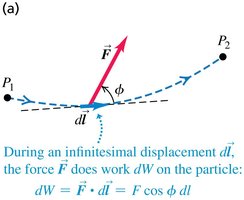
Work-Energy Theorem for Curved Paths
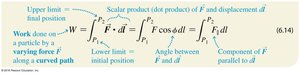
When a particle moves along a curved path under a varying force, the work is calculated using a line integral:
Work along a curve:
Power
Power is the rate at which work is done. It can be defined as average or instantaneous power:
Average power:
Instantaneous power:
SI unit: Watt (W), where 1 W = 1 J/s. Another unit: Horsepower (1 hp = 746 W).


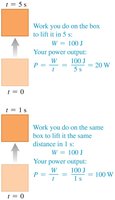
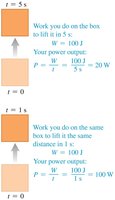
Examples: Power in Lifting Objects
Lifting a box slowly or quickly involves the same amount of work, but the power output is greater when the box is lifted more quickly.
Power in Terms of Force and Velocity
In mechanics, power can also be expressed as the dot product of force and velocity:
Instantaneous power:
Summary Table: Key Equations
Concept | Equation |
|---|---|
Work (constant force) | |
Kinetic energy | |
Work-energy theorem | |
Work (varying force) | |
Power (average) | |
Power (instantaneous) |
Additional info: These notes cover all major aspects of work and kinetic energy, including the calculation of work for constant and varying forces, the work-energy theorem, and the concept of power. Examples and diagrams are included to reinforce understanding of the physical principles.
