 Back
BackWork and Kinetic Energy: Concepts, Calculations, and Applications
Study Guide - Smart Notes
 Tailored notes based on your materials, expanded with key definitions, examples, and context.
Work and Kinetic Energy
Introduction to Work and Energy
In classical mechanics, the concepts of work and kinetic energy are fundamental for analyzing systems where forces may not be constant or where objects follow curved paths. These concepts extend the applicability of Newton's laws to a broader range of physical situations.
Work is done when a force causes a displacement of an object.
Kinetic energy is the energy associated with the motion of an object.
The work-energy theorem relates the work done by all forces on an object to its change in kinetic energy.
Definition of Work
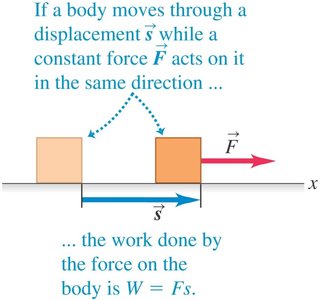
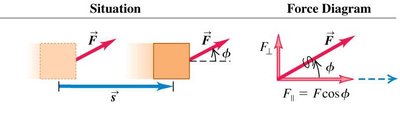
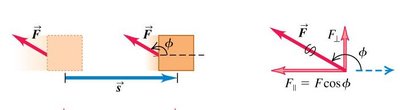
Work is defined as the product of the component of a force along the direction of displacement and the magnitude of this displacement.
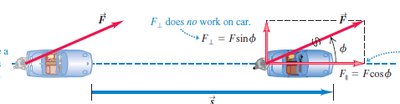
If a constant force F acts on an object causing a displacement s at an angle \phi to the direction of the force, the work done is:
Work is a scalar quantity and can be positive, negative, or zero depending on the angle between the force and displacement.
Work Done by a Constant Force
When a force is constant and acts in the same direction as the displacement, the calculation of work simplifies:
If \phi = 0 (force and displacement are parallel), .
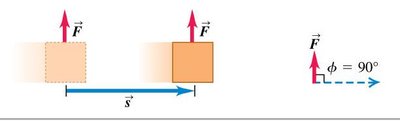
If \phi = 90^\circ (force is perpendicular to displacement), .

Examples: Calculating Work
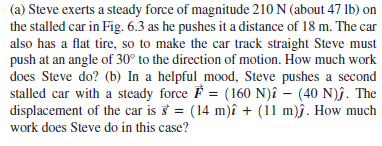
Consider a person pushing a stalled car with a force at an angle:
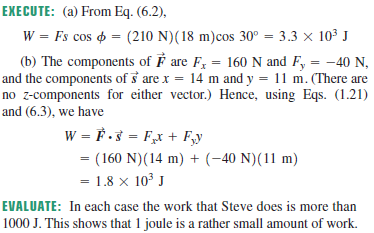
Given: , ,
Work done:
Positive, Negative, and Zero Work
The sign of work depends on the direction of the force relative to the displacement:
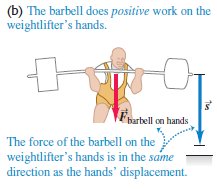
Positive work: Force has a component in the direction of displacement ().
Negative work: Force has a component opposite to displacement ().
Zero work: Force is perpendicular to displacement ().
Work in Everyday Situations
Examples help clarify the concept of work in real-life scenarios:
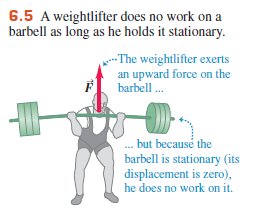
Holding a heavy object stationary does no work on the object, since there is no displacement.
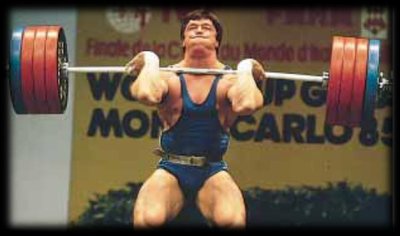
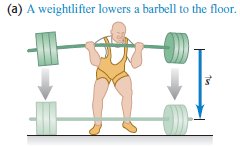
Lifting or lowering a weight involves positive or negative work, depending on the direction of force and displacement.
Work Done by Multiple Forces
When several forces act on a body, the total work is the sum of the work done by each force:
Alternatively, use the net force:
Work Done by Varying Forces
For forces that change with position (e.g., springs), work is calculated using integration:
The area under the force vs. position graph represents the work done.
Work Done by a Spring
The force required to stretch or compress a spring is proportional to the displacement:
Hooke's Law:
Work done to stretch a spring:
Kinetic Energy and the Work-Energy Theorem
Kinetic energy () is the energy of motion, defined as:
The work-energy theorem states that the net work done on an object is equal to its change in kinetic energy:
This theorem applies to both straight-line and curved motion, and for both constant and varying forces.
Power
Power is the rate at which work is done:
Average power:
Instantaneous power:
SI unit: watt (W), where
Summary Table: Work in Different Scenarios
Situation | Angle (\phi) | Work Done |
|---|---|---|
Force parallel to displacement | 0° | Maximum positive |
Force opposite to displacement | 180° | Maximum negative |
Force perpendicular to displacement | 90° | Zero |
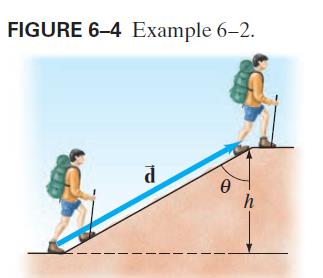
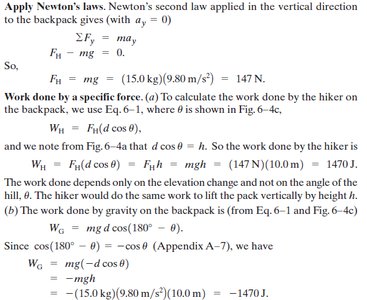
Example: Work on a Backpack
To carry a 15.0-kg backpack up a hill of height 10.0 m:
Work done by hiker:
Work done by gravity:
Net work: (if constant velocity)

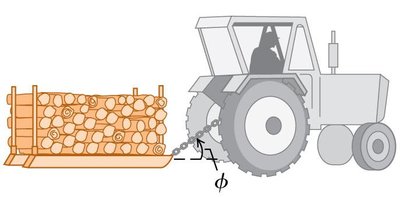
Example: Tractor Pulling a Sled
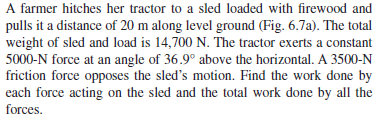
A tractor pulls a sled with firewood along level ground:
Force by tractor: at above horizontal
Friction force:
Displacement:
Work by tractor:
Work by friction:
Total work: sum of all works
Key Takeaways
Work is only done when a force causes displacement in its direction.
The sign of work depends on the angle between force and displacement.
The work-energy theorem connects the net work done to changes in kinetic energy.
Power quantifies how quickly work is performed.
