 Back
BackWork and Kinetic Energy: Concepts, Calculations, and Applications
Study Guide - Smart Notes
 Tailored notes based on your materials, expanded with key definitions, examples, and context.
Work and Kinetic Energy
Introduction to Energy and Kinetic Energy
Energy is a fundamental physical quantity that objects possess, though its exact nature is abstract. It is measured in Joules (J) and exists in various forms, such as heat, light, nuclear, and mechanical energy. According to the law of conservation of energy, energy cannot be created or destroyed, only transformed from one form to another.
Kinetic Energy (KE): Energy due to an object's motion.
Potential Energy: Energy stored due to position or configuration.
Thermal, Light, Sound, Electrical Energy: Other common forms.
Kinetic energy is always a scalar quantity (not a vector), meaning it has magnitude but no direction, and is always positive.
Formula:
Example: Calculate the kinetic energy of a 5 kg box moving at 3 m/s and 2 m/s in opposite directions. The direction does not affect the result since KE depends on speed squared.
Work Done by a Constant Force
When a constant force acts on an object and causes displacement, it transfers energy to or from the object. This transfer is called work (W), measured in Joules (J).
Definition: Work is the amount of energy transferred by a force acting over a distance.
Formula: where is the angle between the force and displacement vectors.
Positive Work: Force acts in the direction of motion.
Negative Work: Force acts opposite to the direction of motion.
Example: Pulling a 2 kg box with a 3 N force over 5 m, or stopping a 5 kg cart with a 100 N force over 2.5 m.
Work Done by Gravity
Gravity, as a force, can do work on objects as they move vertically. The work done by gravity depends only on the change in vertical position (height), not the path taken (path independence).
Formula: (positive when moving down, negative when moving up)
Example: Calculating work done by gravity on a falling book or a rock thrown upwards.
Work by Gravity on Inclined Planes
When analyzing work on inclined planes, always use the angle between the force and displacement, not just the incline angle. The work done by gravity is still path-independent and depends only on the vertical displacement.
Formula:
Example: Calculating work done by gravity and other forces on objects moving up or down ramps.
Hooke’s Law & Springs
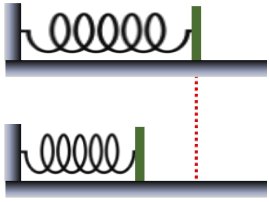
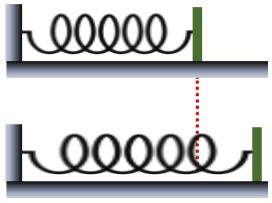
Springs exert a restoring force when compressed or stretched, described by Hooke’s Law. The force is proportional to the displacement from the relaxed position and always acts in the opposite direction.
Hooke’s Law:
k: Spring constant (N/m), measures stiffness.
x: Displacement from equilibrium (m).
Restoring Force: Always opposes deformation.
Work Done by Springs
For variable forces like springs, work is calculated using the area under the force vs. displacement graph or by integrating the force function.
Work by Spring:
Work by Applied Force:
Example: Calculating work done to compress or stretch a spring.
Calculating Net Work
The net work done on an object is the sum of the work done by all forces acting on it. This can be found by summing individual works or by using the net force over the displacement.
Formula:
Example: Pulling a box with friction, calculating work by applied force, friction, gravity, and normal force.
The Work-Energy Theorem
The work-energy theorem states that the net work done on an object equals the change in its kinetic energy.
Formula:
Application: Useful for solving problems where forces are not explicitly given but energy changes are known.
Work from Force vs. Displacement Graphs
The work done by a force (constant or variable) is equal to the area under the force vs. displacement (F-x) graph. Areas above the x-axis represent positive work, while areas below represent negative work.
Graphical Calculation: Use geometric shapes (rectangles, triangles) to find area under the curve.
Work by Integrating Variable Forces
When force varies with position, work is calculated by integrating the force function over the displacement interval.
Formula:
Example: Calculating work for from to .
Introduction to Power
Power measures how quickly work is done or energy is transferred. It is measured in Watts (W), where 1 W = 1 J/s.
Average Power:
Example: Calculating the power required to lift an elevator or accelerate a car.
Summary Table: Key Formulas
Quantity | Formula | Units |
|---|---|---|
Kinetic Energy | Joules (J) | |
Work (Constant Force) | Joules (J) | |
Work by Gravity | Joules (J) | |
Work by Spring | Joules (J) | |
Net Work | Joules (J) | |
Work-Energy Theorem | Joules (J) | |
Power | Watts (W) |
Additional info: These notes expand on the provided slides by filling in missing definitions, formulas, and academic context for clarity and completeness. All equations are provided in LaTeX format for clarity and use in digital platforms.
