 Back
Work and Kinetic Energy: Physics with Calculus Study Notes
Study Guide - Smart Notes
 Tailored notes based on your materials, expanded with key definitions, examples, and context.
Work and Kinetic Energy
Goals of Chapter 6
This chapter introduces the concepts of work, kinetic energy, and their relationship, providing tools to analyze systems where forces are not constant or paths are curved. The chapter also covers the calculation of power in physical systems.
Understand and calculate work done by a force.
Define and interpret kinetic energy.
Apply the work-energy theorem to relate work and kinetic energy.
Analyze systems with varying forces and curved paths.
Solve problems involving power.
Motivation for Work and Energy Concepts
Newton's laws are effective for constant forces, but inadequate for variable forces. The introduction of work, energy, and conservation of energy allows for the analysis of more complex systems.
Work in Physics
Definition of Work
In physics, work is defined as the product of force, displacement, and the cosine of the angle between them. It is a scalar quantity, calculated as the dot product of the force and displacement vectors.
Formula:
SI Unit: Joule (J), where
The Sign of Work
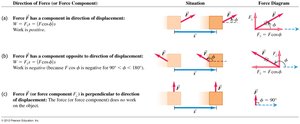
Work can be positive, negative, or zero depending on the direction of force relative to displacement.
Positive Work: Force in the direction of displacement ()
Negative Work: Force opposite to displacement ()
Zero Work: Force perpendicular to displacement ()
Negative Work Example
When a weightlifter lowers a barbell, the force exerted by their hands is opposite to the direction of displacement, resulting in negative work.
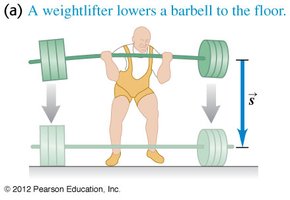
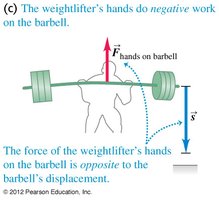
Total work for one repetition (up and down) is zero because the positive work done lifting is canceled by the negative work lowering.
Work-Kinetic Energy Theorem
Statement and Derivation
The work-kinetic energy theorem states that the work done on an object is equal to the change in its kinetic energy. This is derived from Newton's second law and the equations of motion.
Kinetic Energy:
Work-Energy Theorem:
Unit: Joule (J)
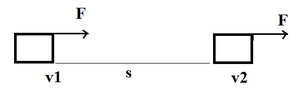
Example Application
Consider a truck of mass 3000 kg being lifted by a crane exerting an upward force of 31 kN over a distance of 2 m:
Work done by crane:
Work done by gravity:
Upward speed after 2 m: Use to solve for final velocity.
Work Done by Several Forces
Superposition Principle
When multiple forces act on an object, the total work is the sum of the work done by each force.
Formula:
Application: Tractor pulling a sled with firewood, considering both pulling and friction forces.
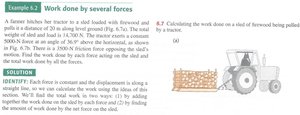
Work by Varying Forces
Work with Non-Constant Forces
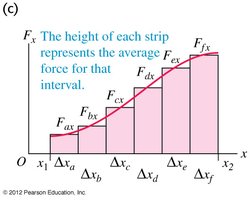
For forces that vary with position, work is calculated by integrating the force over the displacement.
Formula:
Graphical Interpretation: The area under the force vs. position curve represents the work done.
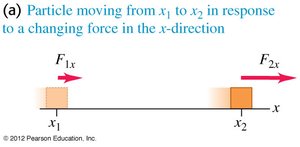
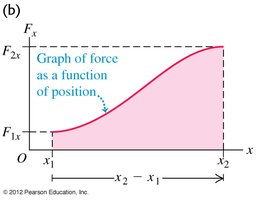
Work Done by Springs
Hooke's Law and Spring Work
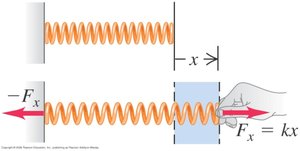
The force required to stretch or compress a spring is proportional to the displacement from equilibrium, described by Hooke's Law.
Hooke's Law:
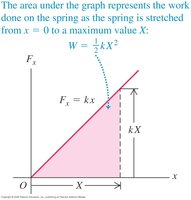
Work Done:
Spring Constant: measures stiffness (N/m).
Spring Examples and Applications
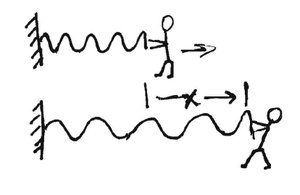
Slinky:
Car suspension:
Notes on Spring Work
Formulas apply to both stretching and compression.
Force on the spring: ; force by the spring: .
Work done by the spring is opposite in sign to work done on the spring.
Choose at equilibrium position.
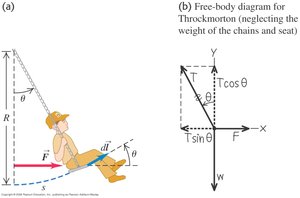
Work Along Curved Paths
Dot Product Along a Path
When the path is curved, work is calculated by evaluating the dot product of force and displacement along the path.
Formula:
Power
Definition and Units
Power is the rate at which work is done. It can be average or instantaneous.
Average Power:
Instantaneous Power:
SI Unit: Watt (W),
Horsepower:
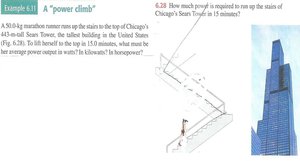
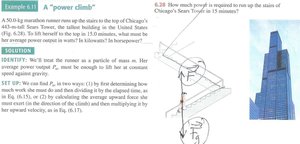
Example: Power Climb
A marathon runner climbs the stairs of a tall building. To calculate average power output:
Find work done against gravity:
Divide by time to get power:
Convert to kilowatts or horsepower as needed.
Summary Table: Work and Energy Concepts
Concept | Formula | Unit | Notes |
|---|---|---|---|
Work | Joule (J) | Dot product; depends on angle | |
Kinetic Energy | Joule (J) | Energy of motion | |
Work-Energy Theorem | Joule (J) | Work changes kinetic energy | |
Power | Watt (W) | Rate of doing work | |
Spring Work | Joule (J) | Area under force vs. position graph |
Additional info: Academic context and examples were expanded for clarity and completeness. All images included are directly relevant to the explanation of the adjacent paragraph.
