 Back
BackWork and Kinetic Energy: Principles, Calculations, and Applications
Study Guide - Smart Notes
 Tailored notes based on your materials, expanded with key definitions, examples, and context.
Work & Kinetic Energy
Introduction to Energy
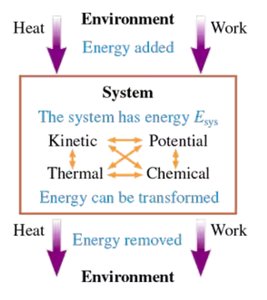
Energy is a fundamental concept in physics, defined as the ability to do work. It is a scalar quantity associated with the state or condition of one or more objects. Energy can exist in various forms and can be transformed from one type to another within a system.
Mechanical Energy: Includes kinetic energy (energy of motion) and potential energy (energy of position).
Thermal Energy: Energy due to the random motion of atoms within an object.
Chemical, Solar, Nuclear, Electric, Magnetic Energy: Other forms of energy relevant in different physical contexts.
Energy Transformation: Energy can be converted between different forms, such as kinetic to potential, or chemical to thermal.
The energy principle for a system is expressed as:
where is kinetic energy, is potential energy, is thermal energy, and is chemical energy. The change in system energy equals the work done by external forces:
Kinetic Energy
Definition and Formula
Kinetic energy is the energy associated with the motion of an object. It is given by:
Units: Joules (J), where
Scalar Quantity: Kinetic energy does not have a direction.
Vector Products and the Dot Product
Types of Vector Products
There are two main types of products between vectors in physics:
Dot Product (Scalar Product): Results in a scalar and is used to calculate work.
Cross Product (Vector Product): Results in a vector and is used in torque and angular momentum calculations.
Dot Product Formula
The dot product of two vectors and is:
where is the angle between the vectors. In component form:
If , (vectors in same direction).
If , (vectors in opposite directions).
If , (vectors are perpendicular).
The dot product with a unit vector gives the projection of the vector onto the axis of the unit vector.
Work
Definition and Calculation
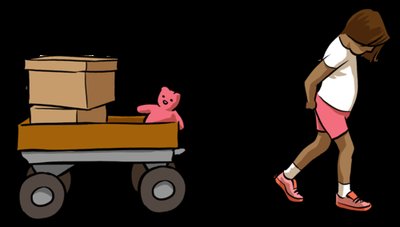
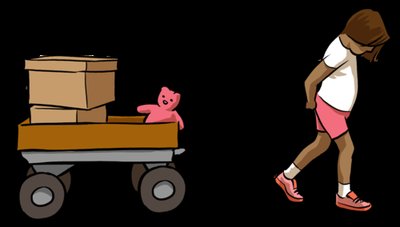
Work is the energy transferred to or from an object as a result of the action of a force. It is calculated as:
Positive Work: Force is in the direction of displacement (energy added to the object).
Negative Work: Force is opposite to displacement (energy removed from the object).
Zero Work: Force is perpendicular to displacement.
Work Done by a Constant Force
For a constant force, work is simply:
Work is a scalar quantity, like energy.
Work-Energy Principle
The work done by external forces changes the kinetic energy of a system:
Work can increase or decrease the kinetic energy depending on the direction of the force relative to displacement.
Work Done by a Variable Force
When the force varies along the path, work is calculated using an integral:
In Cartesian coordinates:
Examples of Work and Energy
Work Done by Gravitational Force
Object Thrown Upwards: Gravitational force does negative work, removing energy from the object's kinetic energy until it stops.
Object Falling Down: Gravitational force does positive work, adding energy to the object's kinetic energy as it falls.
For a displacement in the direction of gravity:
Upwards: ,
Downwards: ,
Work Done in Lifting and Lowering an Object
When lifting an object, the applied force does positive work while gravity does negative work. When lowering, the applied force does negative work and gravity does positive work. The total change in kinetic energy is the sum of work done by all forces:
If the object starts and ends at rest ():
For lifting: ; for lowering:
Work Done by a Variable Force: Example
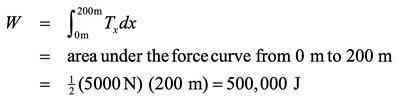
Consider a car being towed with a variable tension force. The work done is the area under the force vs. displacement curve:
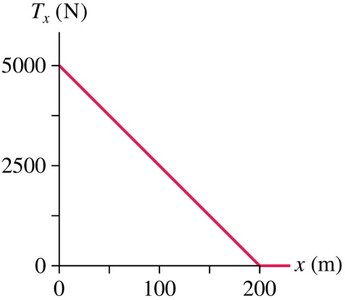
The work is calculated as:
Summary Table: Types of Work and Energy Transfer
Situation | Work Sign | Energy Transfer |
|---|---|---|
Force in direction of displacement | Positive | Energy added to object |
Force opposite to displacement | Negative | Energy removed from object |
Force perpendicular to displacement | Zero | No energy transfer |
Key Equations
(for variable force)
Example Application: Calculating the speed of a car after being towed a certain distance using the work-energy principle and the area under a force-displacement graph.
