 Back
BackWork, Energy, and Conservation in College Physics
Study Guide - Smart Notes
 Tailored notes based on your materials, expanded with key definitions, examples, and context.
Work and Energy
Overview of Energy
Energy is a fundamental concept in physics, representing the ability to do work. It exists in various forms, such as kinetic, potential, and mechanical energy.
Kinetic Energy: Energy due to motion.
Potential Energy: Energy due to position or configuration.
Mechanical Energy: Sum of kinetic and potential energy in a system.
Work
Work is defined as the process of energy transfer to or from an object via the application of force along a displacement.
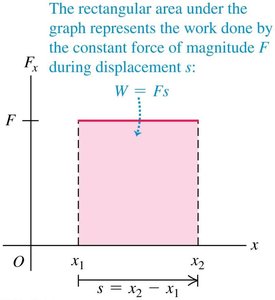
Definition: Work is done when a force causes displacement.
Formula for constant force: where is force and is displacement.
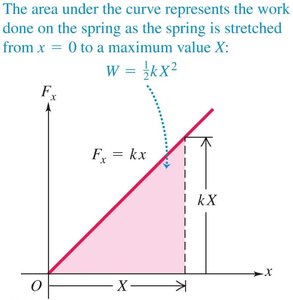
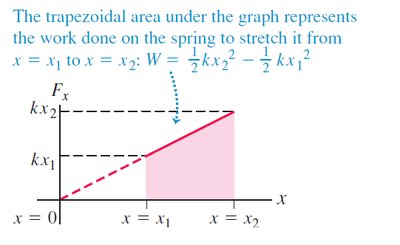
Work with varying force: The work done is the area under the force vs. position graph.
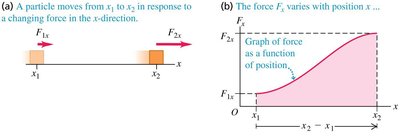
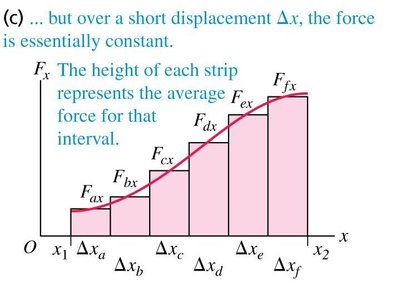
Work Done with a Varying Force
When the force is not constant, the work done is calculated by integrating the force over the displacement.
Short intervals: Over small displacements, force can be considered constant.
Summing intervals: Total work is the sum of work done over each interval.
Integral form:
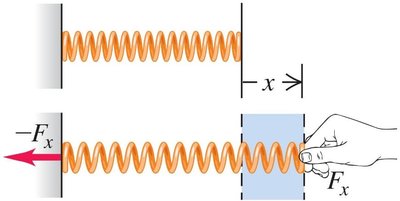
Work Done on a Spring
Hooke's Law and Spring Work
The force required to stretch or compress a spring is described by Hooke's Law.
Hooke's Law: where is the spring constant and is displacement.
Work done to stretch spring: for stretching from to .
Work for interval: for stretching from to .
Example: Spring Scale Compression
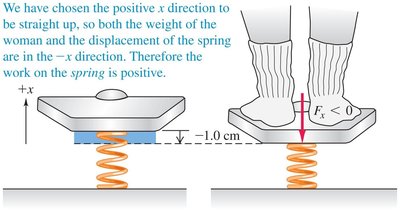
When a person steps onto a spring scale, the spring compresses and work is done on the spring.
Force constant calculation: Use Hooke's Law to find .
Work calculation:
Direction: Choose positive direction for upward displacement.
Potential Energy
Gravitational Potential Energy
Potential energy is the energy associated with the position of a system. Gravitational potential energy is related to the height of an object in a gravitational field.
Formula:
Variables: = mass, = acceleration due to gravity, = height above reference point.
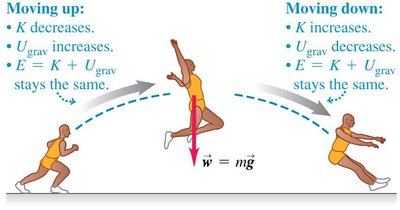
Energy conversion: As an object descends, potential energy converts to kinetic energy.


Work Done by Gravity
The work done by gravity depends on the change in height.
Work formula:
Significance: Negative sign indicates work is negative when moving upward.
Energy change: Moving up increases potential energy; moving down decreases it.
Conservation of Mechanical Energy
Principle of Conservation
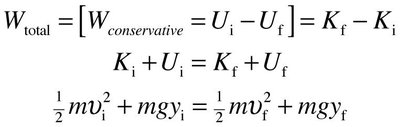
The total mechanical energy (kinetic + potential) of a system remains constant if only conservative forces (like gravity) are acting.
Conserved quantity: Mechanical energy is conserved in absence of non-conservative forces.
Formula:
Expanded:
Example: Ball Thrown Upward
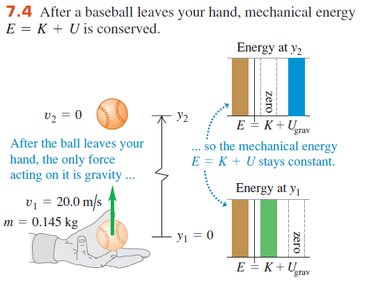
When a ball is thrown upward, its mechanical energy is conserved after it leaves the hand.
Initial energy:
Final energy: at maximum height
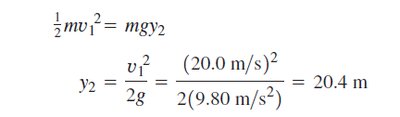
Calculation:
Height:
Type of Energy | Formula | Example |
|---|---|---|
Kinetic Energy | Moving car | |
Gravitational Potential Energy | Ball at height y | |
Spring Potential Energy | Compressed spring |
Summary Table: Work and Energy Concepts
Concept | Formula | Key Points |
|---|---|---|
Work (constant force) | Area under force-position graph | |
Work (variable force) | Sum over intervals | |
Hooke's Law | Spring force proportional to displacement | |
Spring Work | Area under force-displacement curve | |
Gravitational Potential Energy | Energy due to height | |
Conservation of Mechanical Energy | Valid for conservative forces |
Additional info: Academic context and formulas have been expanded for completeness and clarity. Examples and tables are inferred from standard physics curriculum.
