 Back
BackWork, Energy, and Momentum in Classical Mechanics
Study Guide - Smart Notes
 Tailored notes based on your materials, expanded with key definitions, examples, and context.
Work and Energy
Work Done by a Constant Force
Work is a measure of energy transfer that occurs when an object is moved by a force. When a constant force acts on an object and causes a displacement, the work done is given by the dot product of the force and displacement vectors.
Work (W): Scalar quantity representing energy transferred by a force.
Force (\(\vec{F}\)): Vector quantity, measured in Newtons (N).
Displacement (\(\Delta \vec{r}\)): Vector quantity, measured in meters (m).
Formula:
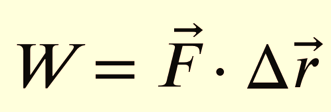
Application: Use this formula when a constant force acts over a straight-line displacement.
Kinetic Energy
Kinetic energy is the energy an object possesses due to its motion. It depends on the object's mass and the square of its velocity.
Kinetic Energy (K): Measured in Joules (J).
Formula:
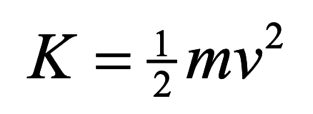
m: Mass of the object (kg).
v: Velocity of the object (m/s).
Work-Energy Theorem
The work-energy theorem states that the net work done by all forces on an object equals the change in its kinetic energy. This principle connects force, motion, and energy.
Formula:
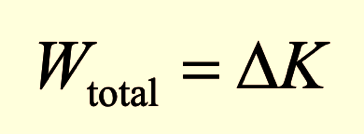
Application: Use this theorem to relate the work done to changes in speed or kinetic energy.
Potential Energy
Gravitational Potential Energy
Gravitational potential energy is the energy stored in an object due to its position in a gravitational field. It is relevant when an object's height changes.
Formula:
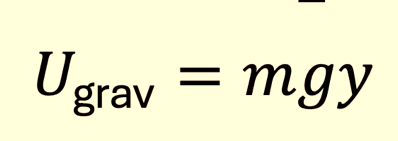
m: Mass (kg)
g: Acceleration due to gravity (≈9.8 m/s²)
y: Height above reference point (m)
Elastic Potential Energy
Elastic potential energy is stored in objects like springs or trampolines when they are stretched or compressed. The energy depends on the spring constant and the displacement from equilibrium.
Formula:
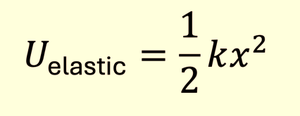
k: Spring constant (N/m)
x: Displacement from equilibrium (m)
Escape Velocity
Escape velocity is the minimum speed needed for an object to escape from the gravitational influence of a celestial body without further propulsion.
Formula:
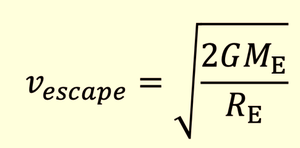
G: Universal gravitational constant (6.674×10⁻¹¹ m³/kg·s²)
M_E: Mass of the Earth (or celestial body)
R_E: Radius of the Earth (or celestial body)
Hooke's Law
Hooke's Law describes the restoring force exerted by a spring when it is stretched or compressed. The force is proportional to the displacement and acts in the opposite direction.
Formula:
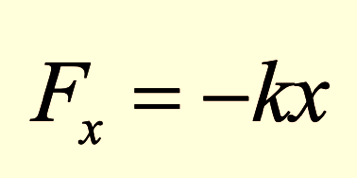
F_x: Restoring force (N)
k: Spring constant (N/m)
x: Displacement from equilibrium (m)
Momentum and Collisions
Linear Momentum
Momentum is a vector quantity defined as the product of an object's mass and velocity. It is conserved in isolated systems.
Formula:
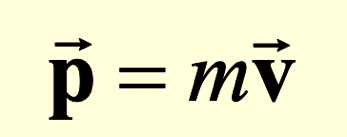
p: Momentum (kg·m/s)
m: Mass (kg)
v: Velocity (m/s)
Conservation of Momentum
In any collision or interaction, the total momentum of a closed system remains constant if no external forces act on it.
Formula:
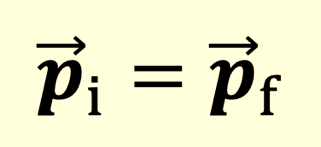
p_i: Initial total momentum
p_f: Final total momentum
Collisions: Types and Equations
General Collision Equations
For two objects colliding in one or two dimensions, momentum conservation applies to each direction independently.
Formulas (2D):
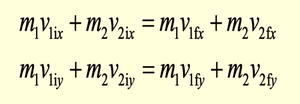
For 1D, use only the x-component equation.
Elastic Collisions
In elastic collisions, both momentum and kinetic energy are conserved. Use these equations to solve for unknown velocities.
Momentum Conservation: (see above)
Kinetic Energy Conservation:

Test for elasticity by checking if total kinetic energy is unchanged before and after the collision.
Inelastic Collisions
In inelastic collisions, momentum is conserved but kinetic energy is not. In perfectly inelastic collisions, the objects stick together after the collision.
Momentum Conservation: (see above)
Kinetic Energy: Not conserved; some is transformed into other forms (e.g., heat, deformation).
Summary Table: Key Equations
Concept | Equation | Variables |
|---|---|---|
Work (constant force) | F: force, Δr: displacement | |
Kinetic Energy | m: mass, v: velocity | |
Work-Energy Theorem | W: work, K: kinetic energy | |
Gravitational Potential Energy | m: mass, g: gravity, y: height | |
Elastic Potential Energy | k: spring constant, x: displacement | |
Escape Velocity | G: constant, M_E: mass, R_E: radius | |
Hooke's Law | k: spring constant, x: displacement | |
Momentum | m: mass, v: velocity | |
Momentum Conservation | p: momentum | |
Elastic Collision (KE) | m: mass, v: velocity |
