 Back
Work, Energy, and Momentum: Structured Study Notes for Physics with Calculus
Study Guide - Smart Notes
 Tailored notes based on your materials, expanded with key definitions, examples, and context.
Energy and Its Conservation
Definition and Forms of Energy
Energy is a fundamental concept in physics, representing the capacity to do work or produce change. It exists in various forms, such as kinetic, thermal, chemical, and electrical energy, but the total energy in a closed system remains constant due to the principle of conservation of energy.
Kinetic Energy: Energy of motion, given by .
Potential Energy: Energy stored due to position, such as gravitational or elastic potential energy.
Thermal Energy: Energy related to temperature and molecular motion.
Chemical Energy: Energy stored in chemical bonds.
Electrical Energy: Energy from electric fields and currents.
Conservation of Energy: The total energy in a closed system remains unchanged, though it may transform between different forms.
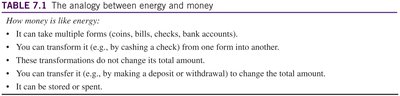
Energy as the Currency of the Universe
Energy can be transferred, transformed, stored, or spent, much like money. The analogy helps understand the conservation and transformation principles.
Work and the Work-Energy Theorem
Definition of Work
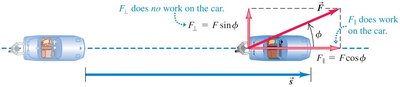
Work is the process by which energy is transferred to or from an object via the application of force along a displacement. The mathematical expression for work is:
Unit: Joule (J), where
Work-Energy Theorem
The work-energy theorem states that the net work done by forces on an object equals the change in its kinetic energy:
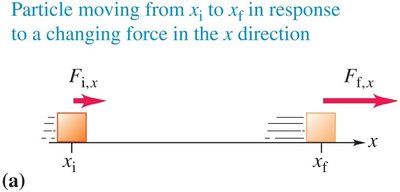
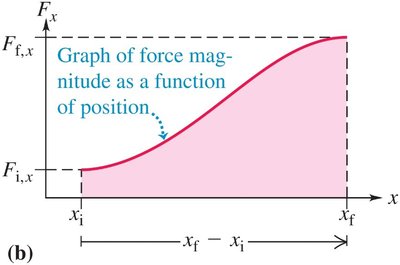
Work Done by Varying Forces
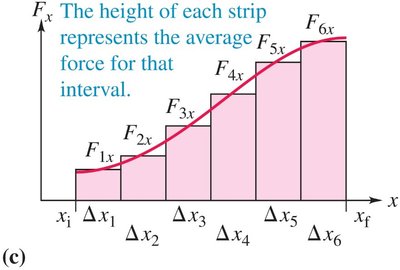
When the force varies with position, the total work is the sum over small intervals:
Potential Energy
Gravitational Potential Energy
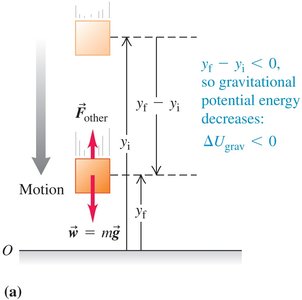
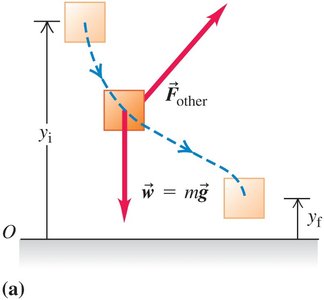
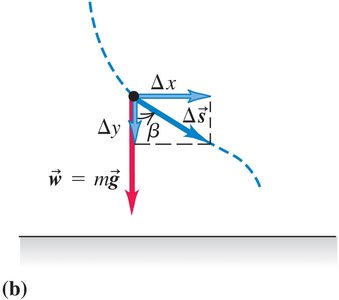
Potential energy associated with an object's position in a gravitational field is given by:
Change in gravitational potential energy:
Elastic Potential Energy
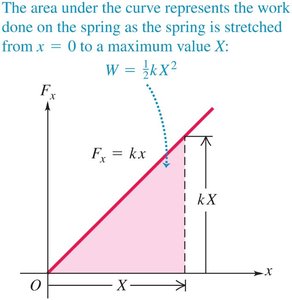
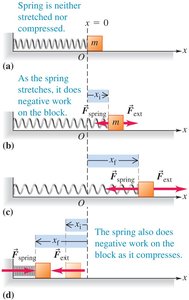
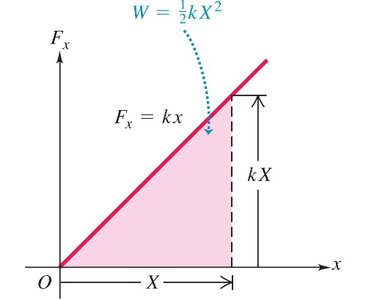
Energy stored in a stretched or compressed spring is called elastic potential energy:
Work done to stretch a spring from to :
Conservative and Nonconservative Forces
Conservative Forces
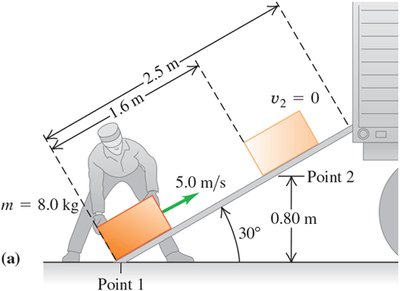
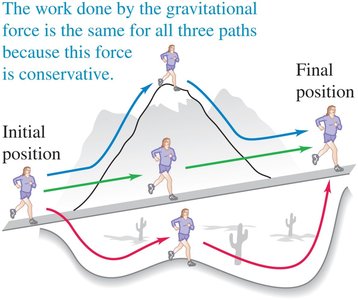
Conservative forces, such as gravity and spring force, have the following properties:
Work can be expressed as the difference in potential energy between initial and final positions.
Work is reversible and independent of the path taken.
If the starting and ending points are the same, the total work is zero.
Momentum and Impulse
Definition of Momentum
Momentum quantifies the motion of an object, weighted by its mass:
Units:
Impulse-Momentum Theorem
Impulse is the product of force and the time interval over which it acts, and it equals the change in momentum:
Conservation of Momentum
Isolated Systems
In an isolated system (no external forces), the total momentum remains constant:
Collisions
Collisions are classified as elastic or inelastic:
Elastic Collision: Both momentum and kinetic energy are conserved.
Inelastic Collision: Momentum is conserved, but kinetic energy is not.
Completely Inelastic Collision: Objects stick together after collision, resulting in maximum kinetic energy loss.
Center of Mass
Definition and Calculation
The center of mass is the mass-weighted average position of a system of particles:
Velocity and Momentum of Center of Mass
The velocity of the center of mass is the mass-weighted average of individual velocities, and the total momentum is the product of total mass and center-of-mass velocity:
Rotational Motion
Angular Kinematics
Rotational motion is described by angular displacement, velocity, and acceleration:
Angular displacement: (radians)
Angular velocity:
Angular acceleration:
Moment of Inertia and Rotational Kinetic Energy
Moment of inertia quantifies the distribution of mass relative to the axis of rotation:
Rotational kinetic energy:
Periodic Motion and Simple Harmonic Motion
Definitions and Properties
Periodic motion repeats itself at regular intervals. Simple harmonic motion (SHM) is a type of periodic motion where the restoring force is directly proportional to displacement:
Restoring force:
Acceleration:
Period:
Frequency:
Angular frequency:
Energy in SHM
The total mechanical energy in SHM is conserved:
Tables
Analogy Between Energy and Money
How money is like energy: |
|---|
It can take multiple forms (coins, bills, checks, bank accounts). |
You can transform it (e.g., by cashing a check) from one form into another. |
These transformations do not change its total amount. |
You can transfer it (e.g., by making a deposit or withdrawal) to change the total amount. |
It can be stored or spent. |
Relevant Images
Images included above are directly relevant to the explanation of energy, work, potential energy, momentum, impulse, and periodic motion, visually reinforcing the concepts and their applications.
