 Back
BackWork, Energy, and Momentum: Study Notes for College Physics
Study Guide - Smart Notes
 Tailored notes based on your materials, expanded with key definitions, examples, and context.
Work and the Dot Product
Definition and Properties of Work
Work is a fundamental concept in physics, describing the energy transferred by a force acting over a distance. The work done by a force can be positive, negative, or zero, depending on the direction of the force relative to the displacement.
Work Formula: (dot product of force and displacement)
Dot Product:
If , is negative, so work is negative.
The dot product is a scalar (not a vector).
Component form:
Work by Constant Force
When a constant force acts along a straight path, the work is given by:
Units: Joules (J), where
Work can be positive (force in direction of motion), zero (force perpendicular), or negative (force opposite to motion).
Work in Physical Scenarios
Work by Gravity and Other Forces
Consider lowering a book at constant speed:
Gravity does positive work when the object moves downward.
Hand does negative work (opposes motion).
Total work on the book is zero (forces balance).
Work by Tension in Circular Motion
When a rock is twirled in a horizontal circle at constant speed, the tension in the string does zero work because the force is always perpendicular to the displacement.
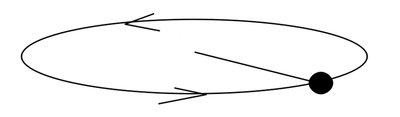
Work by tension:
No energy is transferred by tension in uniform circular motion.
Work by Gravity Along a Path
The work done by gravity depends only on the vertical displacement, not the path taken.
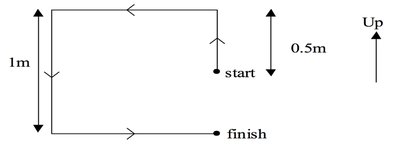
Work by gravity:
For a 1 kg mass moving 0.5 m down:
Gravity is a conservative force: work is path-independent.
Conservative and Non-Conservative Forces
Conservative Forces
Forces for which the work done is independent of the path are called conservative forces. Examples include gravity, spring force, and electric force.
Work by conservative force:
Kinetic friction is not a conservative force.
Spring Forces and Hooke's Law
Ideal springs obey Hooke's Law, where the force is proportional to the displacement:
is the spring constant (N/m).
Work to stretch a spring:
Work with Variable Forces
Work from Force vs. Position Graphs
When force varies with position, the total work is the area under the F(x) curve.
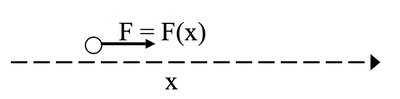
Work:
For step function:
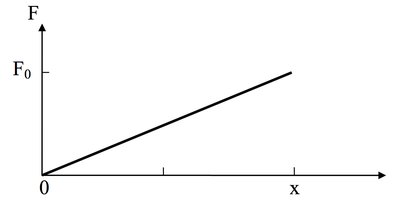
For linear force:
Work:
Kinetic Energy and the Work-Energy Theorem
Kinetic Energy
Kinetic energy is the energy of motion:
Units: Joules (J)
Always positive or zero
Work-Energy Theorem
The net work done on an object equals its change in kinetic energy:
For point-like objects:
Potential Energy and Conservation of Energy
Potential Energy
Potential energy is associated with conservative forces:
Gravitational:
Spring:
Conservation of Mechanical Energy
If only conservative forces act, the total mechanical energy (KE + PE) is conserved:
If non-conservative forces (like friction) are present:
Power
Definition and Calculation
Power is the rate at which work is done or energy is transferred:
Units: Watts (W),
For constant force:
Momentum and Conservation
Momentum
Momentum is a vector quantity defined as:
Units: kg·m/s
For a system:
Conservation of Momentum
If the net external force on a system is zero, total momentum is conserved:
Internal forces cancel by Newton's Third Law.
Collisions
Collisions are classified as:
Elastic: Total kinetic energy is conserved.
Inelastic: Total kinetic energy is not conserved.
Perfectly inelastic: Objects stick together; maximum loss of KE.
Energy in Physical Systems
Energy Graphs and Mechanical Energy
Energy graphs show how potential energy varies with position. The total energy is the sum of kinetic and potential energies.
At any point:
Maximum KE occurs where PE is minimum.
Motion on Frictionless Ramps
For objects sliding down frictionless ramps of equal height, the speed at the bottom is the same regardless of the ramp's shape.
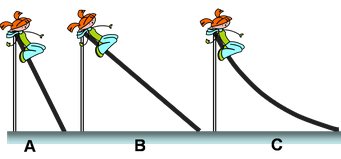
Conservation of energy:
All start with same PE, end with same KE.
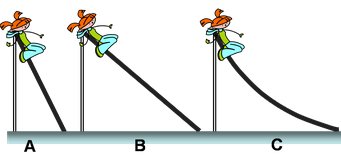
With friction, some energy is lost as heat; final speed is less.
Summary Table: Conservative vs Non-Conservative Forces
Force Type | Path Dependence | Examples |
|---|---|---|
Conservative | No | Gravity, Spring, Electric |
Non-Conservative | Yes | Kinetic Friction, Air Resistance |
Summary Table: Energy Formulas
Energy Type | Formula |
|---|---|
Kinetic Energy | |
Gravitational Potential Energy | |
Spring Potential Energy |
Additional info: Academic context and explanations have been expanded for clarity and completeness. Only images directly relevant to the explanation have been included.
