 Back
BackWork, Energy, and Momentum: Study Notes for College Physics
Study Guide - Smart Notes
 Tailored notes based on your materials, expanded with key definitions, examples, and context.
Work and Energy
Overview of Energy
Energy is a fundamental concept in physics, representing the ability to do work. It exists in various forms, such as kinetic, potential, thermal, and more. In mechanics, we focus primarily on kinetic and potential energy.
Kinetic Energy (K): The energy of motion, given by .
Potential Energy (U): The energy stored due to an object's position, such as gravitational potential energy .
Work (W): The process of energy transfer to or from an object via the application of force along a displacement, .
Work Done with a Varying Force
When the force applied to an object varies with position, the work done is calculated using the integral:
Conservation of Energy
The principle of conservation of energy states that the total energy of an isolated system remains constant. Energy can be transformed from one form to another but cannot be created or destroyed.
Mechanical Energy: The sum of kinetic and potential energy in a system.
Conservative Forces: Forces like gravity, where the work done is path-independent and energy is conserved.
Non-Conservative Forces: Forces like friction, where energy is dissipated as heat or other forms.
Example: Loading a Crate onto a Truck
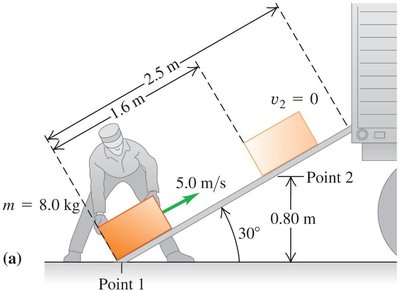
This example illustrates the application of work, energy, and friction in a practical scenario. A crate of mass 8.0 kg is pushed up a 2.5 m ramp inclined at 30°, starting with an initial speed of 5.0 m/s. Due to friction, the crate only travels 1.6 m before stopping and sliding back down.
Finding the Friction Force: Use the work-energy principle:
Initial kinetic energy:
Final kinetic energy: (since the crate stops)
Change in gravitational potential energy:
Work done by friction:
Solving for gives the magnitude of the friction force.
Momentum
Definition and Properties
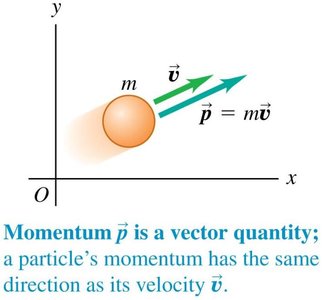
Momentum is a vector quantity defined as the product of an object's mass and velocity:
SI unit: kg·m/s
Momentum has the same direction as velocity.
Newton's Second Law in Terms of Momentum
Newton's second law can be expressed as the rate of change of momentum:
Conservation of Momentum
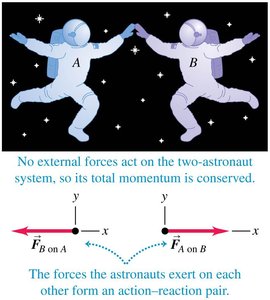
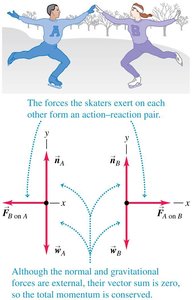
If the vector sum of external forces on a system is zero, the total momentum of the system remains constant. This is the principle of conservation of momentum, which is especially useful in analyzing collisions.
Total momentum:
Analysis of Collisions
Collisions can be classified as elastic or inelastic, depending on whether kinetic energy is conserved.
Elastic Collision: Both momentum and kinetic energy are conserved.
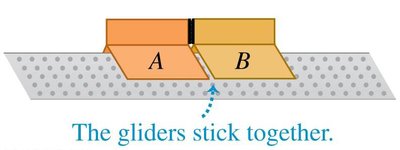
Inelastic Collision: Momentum is conserved, but kinetic energy is not. In a completely inelastic collision, objects stick together after the collision.
Example: Two-Car Collision
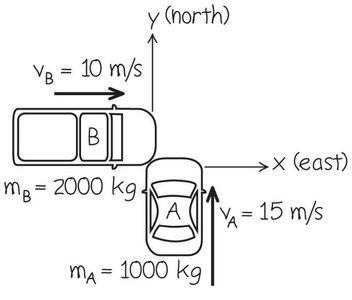
Consider a car (1000 kg, 15 m/s north) and a truck (2000 kg, 10 m/s east) colliding at an intersection. The total momentum before the collision is found by vector addition of the individual momenta:
Magnitude:
Direction: north of east
Elastic Collisions
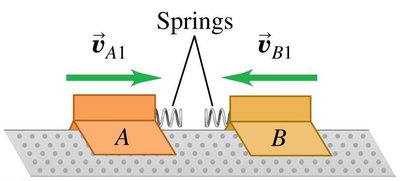
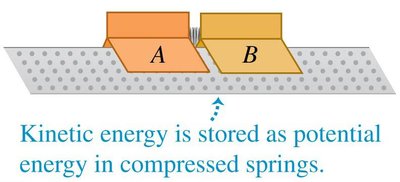
In elastic collisions, both kinetic energy and momentum are conserved. These collisions are idealized but closely approximated by interactions such as billiard balls or gliders on air tracks.
Before, during, and after the collision, the total kinetic energy remains the same.
Inelastic Collisions
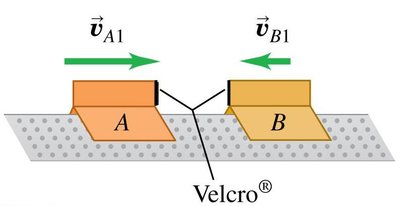
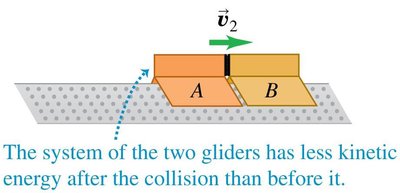
In inelastic collisions, kinetic energy is not conserved, though momentum is. In a completely inelastic collision, the colliding objects stick together.
Some kinetic energy is transformed into other forms, such as heat or deformation.
Summary Table: Elastic vs. Inelastic Collisions
Type of Collision | Momentum Conserved? | Kinetic Energy Conserved? | Objects Stick Together? |
|---|---|---|---|
Elastic | Yes | Yes | No |
Inelastic | Yes | No | Sometimes (completely inelastic) |
Impulse
Impulse is the change in momentum of an object when a force is applied over a time interval:
Center of Mass
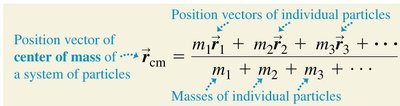
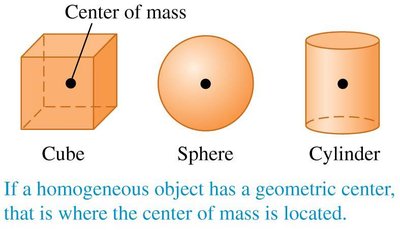
The center of mass of a system is the point where the system's mass can be considered to be concentrated for the purpose of analyzing translational motion. The position vector of the center of mass is:
Applications and Examples
Ballistic Pendulum
A ballistic pendulum is a device used to measure the speed of a projectile. A bullet embeds itself in a block, and the combined system swings upward. Conservation of momentum is used during the collision, and conservation of energy is used during the swing.
Initial momentum: (bullet)
After collision: (block and bullet together)
Conservation of momentum:
Conservation of energy:
Elastic Collisions in One Dimension
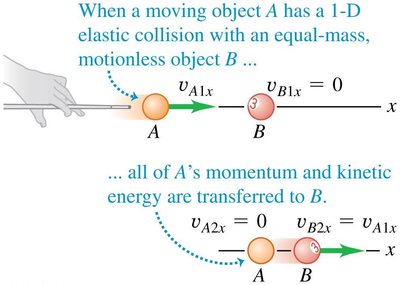
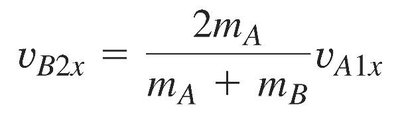
For two bodies A and B, with B initially at rest, the final velocities after an elastic collision are:
Special cases:
If , A reverses direction, B barely moves.
If , A slows slightly, B moves with nearly twice A's original speed.
If , A stops, B moves with A's original speed.

Key Equations
Kinetic Energy:
Potential Energy (gravity):
Work:
Momentum:
Impulse:
Conservation of Momentum:
Center of Mass:
