 Back
BackWork, Energy, and Momentum: Theorems and Conservation Laws in Mechanics
Study Guide - Smart Notes
 Tailored notes based on your materials, expanded with key definitions, examples, and context.
Work-Energy Theorem and Conservation of Mechanical Energy
Concepts of Kinetic Energy and Work
The work-energy theorem provides a powerful connection between the net work done on an object and its change in kinetic energy. This theorem is foundational for analyzing motion when forces act on a system.
Kinetic Energy (K): The energy associated with the motion of an object, defined as .
Work (W): The process of energy transfer to or from an object via the application of force along a displacement. For a constant force, .
Work-Energy Theorem: The net work done by all forces on an object equals the change in its kinetic energy:
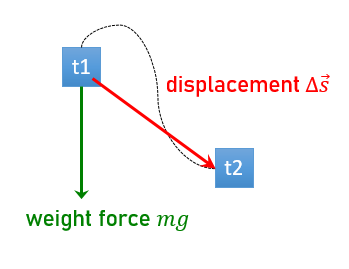
Example: If a 1 kg block is pushed with a constant force so that after being displaced by 1 m, its speed is 1 m/s, the required force can be found using the work-energy theorem.
Scalar (Dot) Product
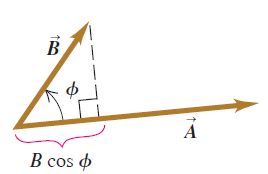
The dot product is a mathematical operation that allows us to calculate the work done by a force when the force and displacement are not aligned.
Definition:
The dot product is maximal when vectors are parallel (), zero when perpendicular (), and negative when anti-parallel ().
In coordinates:
Work-Energy Theorem (General Case; Constant Forces)
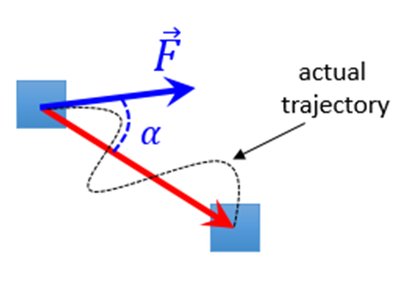
For any number of forces acting on an object, the work-energy theorem can be generalized:
For each small displacement , the work done by the net force is .
Summing over the trajectory, the total work equals the change in kinetic energy.
Gravitational Potential Energy and Conservation Law of Mechanical Energy
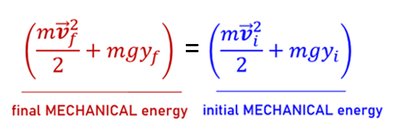
When gravity is the only force doing work, the concept of gravitational potential energy (GPE) is introduced. The sum of kinetic and potential energy is called mechanical energy, which is conserved in the absence of non-conservative forces.
Gravitational Potential Energy (near Earth's surface):
Mechanical Energy (E):
Conservation Law: (if only gravity does work)
Work by Weight Force:
As an object moves upward, GPE increases and kinetic energy decreases; as it moves downward, GPE decreases and kinetic energy increases.
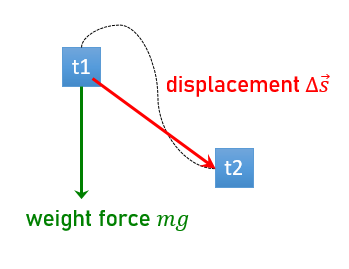
Work by a Non-Constant Gravitational Force
For objects far from Earth's surface, the gravitational force is not constant and the general expression for gravitational potential energy must be used:
Universal Law of Gravitation:
Gravitational Potential Energy (general):
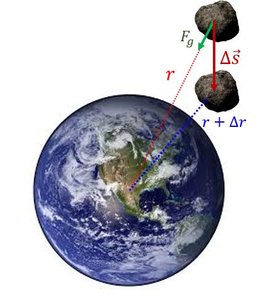
The work done by gravity as an object moves from to is
Mechanical energy is conserved if only gravity does work:

Escape Speed
The escape speed is the minimum speed an object must have at the surface of a planet (or moon) to escape its gravitational field without further propulsion.
Derived from energy conservation, setting final kinetic energy at infinity to zero:
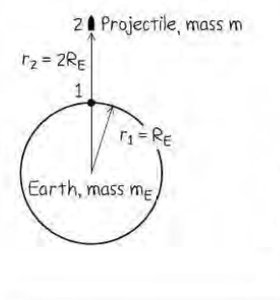
Elastic Potential Energy and Hooke's Law
Hooke's Law and Elastic Potential Energy
Elastic forces, such as those in springs, are described by Hooke's Law:
Hooke's Law:
Elastic Potential Energy:
Mechanical energy is conserved if only elastic and conservative forces act:
Example: A block attached to a spring oscillates, transforming energy between kinetic and elastic potential forms.
Total Energy Conservation and Energy Transformations
Total Energy Conservation Law
The total energy conservation law states that the sum of mechanical energy and internal energy (such as thermal energy) in a closed system remains constant if no external work is done:
(if )
Mechanical energy is not always conserved if non-conservative forces (like friction) are present; energy is transformed into internal energy (heat, sound, etc.).
Momentum and Its Conservation
Momentum and Impulse
Momentum is a vector quantity defined as . The impulse delivered to an object is the change in its momentum, given by the integral of force over time.
Impulse:
Unit: kg·m/s
Conservation of Momentum
If the net external force on a system is zero, the total momentum of the system is conserved:
Momentum conservation applies separately in each direction where the net external force is zero.
Mechanical energy may not be conserved in inelastic collisions, but momentum always is (for isolated systems).
Applications and Problem-Solving Strategies
Identify the system and all external forces.
Draw free-body diagrams (FBDs) to visualize forces.
Apply the work-energy theorem and/or conservation laws as appropriate.
For collisions, use momentum conservation to relate velocities before and after the event.
Summary Table: Key Equations and Concepts
Concept | Equation | Notes |
|---|---|---|
Kinetic Energy | Energy of motion | |
Work (constant force) | Dot product | |
Work-Energy Theorem | Net work changes kinetic energy | |
Gravitational PE (near Earth) | Increases with height | |
Gravitational PE (general) | For large distances | |
Elastic PE | Spring energy | |
Momentum | Vector quantity | |
Impulse | Change in momentum | |
Momentum Conservation | Isolated system | |
Escape Speed | Minimum speed to escape gravity |
