 Back
BackWork, Energy, and Power – Physics Chapter 7 Study Notes
Study Guide - Smart Notes
 Tailored notes based on your materials, expanded with key definitions, examples, and context.
Work, Energy, and Power
Introduction
This chapter explores the fundamental concepts of work, energy, and power in physics. These concepts are essential for understanding how forces cause motion and how energy is transferred and transformed in physical systems.
Forms and Types of Energy
Kinetic and Potential Energy
Energy is the capacity to do work. There are two primary types of mechanical energy:
Kinetic Energy (KE): The energy of motion. Any object in motion possesses kinetic energy, given by the formula:
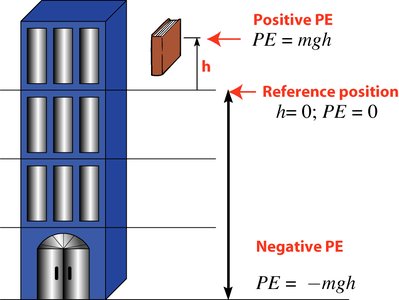
Potential Energy (PE): The energy stored due to an object's position or configuration. Common forms include:
Gravitational Potential Energy:
Elastic Potential Energy:
Electric Potential Energy:
Forces such as friction, normal, and tension do not store potential energy.
Other Forms of Energy
Thermal Energy: Energy due to the motion of particles within a substance (heat).
Light Energy: Energy carried by electromagnetic waves.
Sound Energy: Energy carried by sound waves.
Nuclear Energy: Energy stored in the nucleus of atoms.
Chemical Energy: Energy stored in chemical bonds.
All these forms can be classified as either kinetic or potential energy at the microscopic level.
Energy Transformations and Conservation
Energy Transformations
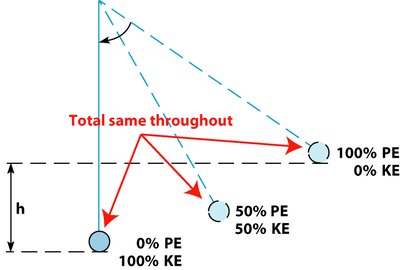
Energy can be transformed from one form to another. For example, potential energy can convert to kinetic energy and vice versa. In the absence of external work, the sum of kinetic and potential energy remains constant.
Conservation of Energy
The law of conservation of energy states that energy cannot be created or destroyed; it can only be transformed from one form to another. In an isolated system (no external work), the total mechanical energy (KE + PE) remains constant.
Example: A pendulum swinging back and forth continuously transforms energy between kinetic and potential forms, but the total remains unchanged.
Energy in Free Fall
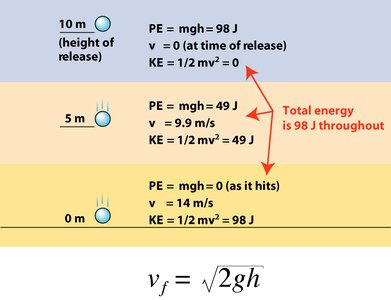
Objects in free fall demonstrate conservation of energy. As an object falls, its potential energy decreases while its kinetic energy increases, keeping the total energy constant (ignoring air resistance).
Real-World Energy Transformations
In real-world processes, some energy is always transformed into thermal energy due to friction and other non-conservative forces. This thermal energy is often not useful for doing mechanical work, leading to the concept of energy degradation.
Work and Its Relationship to Energy
Definition of Work
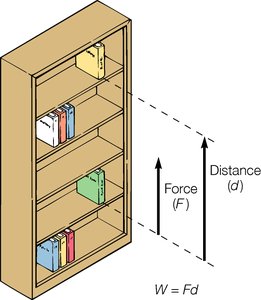
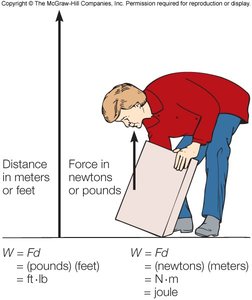
Work is the process of energy transfer to or from an object via the application of force along a displacement. The amount of work done is given by:
W: Work (in joules, J)
F: Applied force (in newtons, N)
d: Displacement in the direction of the force (in meters, m)
Key Points about Work
If the displacement is zero, no work is done.
If the force is perpendicular to the displacement, no work is done.
Work and energy share the same unit: the joule (J).
Work-Energy Principle
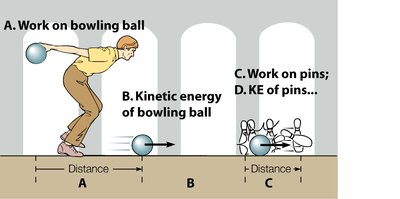
Work is equal to the change in energy of a system:
Work can increase or decrease an object's kinetic or potential energy.
Simple Machines
Mechanical Advantage and Work
Simple machines (inclined planes, levers, pulleys, etc.) allow us to do the same amount of work with less force by increasing the distance over which the force is applied. The basic principle is:
The goal is to reduce the input force required to do a job.
Power
Definition and Formula
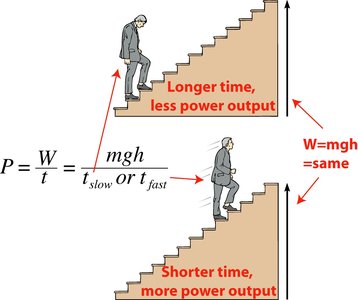
Power is the rate at which work is done or energy is transformed. It is calculated as:
or
P: Power (in watts, W)
W: Work done (in joules, J)
t: Time taken (in seconds, s)
Units of Power
1 watt (W) = 1 joule/second (J/s)
Horsepower (hp) is another unit of power, commonly used for engines: 1 hp = 746 W
When you pay your "power bill," you are actually paying for energy consumed over time, not instantaneous power.
Summary Table: Key Equations and Units
Quantity | Symbol | Equation | SI Unit |
|---|---|---|---|
Kinetic Energy | KE | Joule (J) | |
Potential Energy (gravity) | PE | Joule (J) | |
Work | W | Joule (J) | |
Power | P | Watt (W) |
Examples and Applications
Bowling: Work is done to accelerate the ball (increasing KE), which then does work on the pins.
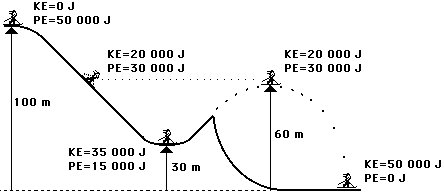
Roller Coaster: Energy transforms between KE and PE as the coaster moves along the track, but the total remains constant (ignoring friction).
Climbing Stairs: The faster you climb, the more power you exert, even though the work done (change in PE) is the same.
Additional info: In all real systems, some energy is lost as heat due to friction and other non-conservative forces, making energy transformations less than 100% efficient.
