 Back
Work, Energy, Momentum, Rotational Dynamics, and Gravitation: Study Guide
Study Guide - Smart Notes
 Tailored notes based on your materials, expanded with key definitions, examples, and context.
Work and Energy
Work
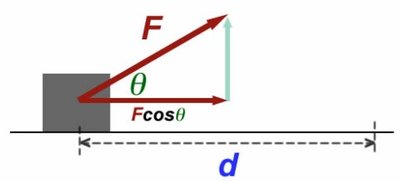
Work is a measure of energy transfer when a force F acts on an object and causes displacement d. The angle θ between the force and displacement determines the effective component of force.
Definition: Work (W) is given by .
Units: Joules (J)
Key Point: Only the component of force in the direction of displacement does work.
Example: Pushing a box along the floor with a force at an angle.
Mechanical Energy
Mechanical energy is the ability of an object to do work, and it exists in two primary forms: kinetic and potential energy.
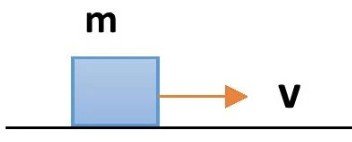
Kinetic Energy (KE): Energy due to motion.
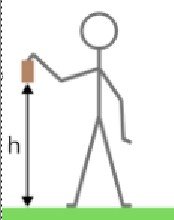
Potential Energy (PE): Energy due to position or configuration.
Gravitational Potential Energy: (object at height h)
Spring Potential Energy: (spring compressed/stretched by x)
Conservative Forces: Potential energy can only be defined for conservative forces (e.g., gravity, spring force).
Work-Kinetic Energy Theorem
The work done by a force on an object equals the change in its kinetic energy.
Application: Used to relate force, displacement, and velocity changes.
Conservation of Mechanical Energy
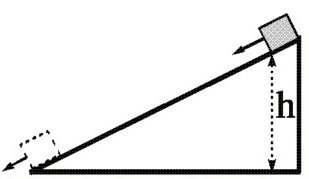
If only conservative forces are present, the total mechanical energy (sum of KE and PE) is conserved.
or
Application: Used to solve problems involving motion and energy changes.
Non-Conservative Forces
When non-conservative forces (e.g., friction) are present, mechanical energy is not conserved. The change in mechanical energy equals the work done by non-conservative forces.
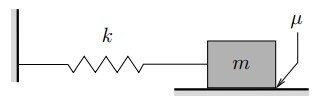
Example: Object compressing a spring and experiencing friction.
Power
Power is the rate at which work is done.
Average Power:
Constant Force:
Units: Watts (W)
Linear Momentum and Collisions
Linear Momentum
Linear momentum is a vector quantity representing the product of mass and velocity.
Conservation: In the absence of external forces, total momentum is conserved.
Impulse
Impulse is the change in momentum resulting from a force applied over a time interval.
Generalized Newton's Second Law:
Collisions
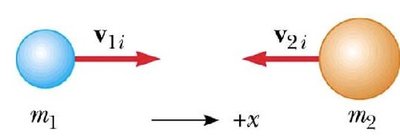
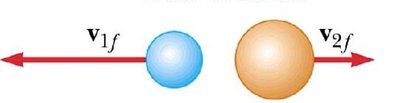
During collisions, total linear momentum is conserved. Kinetic energy may or may not be conserved, leading to different types of collisions.
Elastic Collision:
Inelastic Collision:
Explosive Collision:
Momentum Conservation:
Rigid Body and Center of Mass
Rigid Body
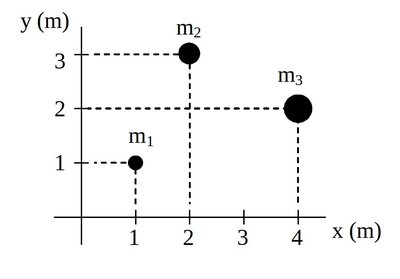
A rigid body is an object with a fixed shape that cannot be deformed. The center of mass is a point representing the average position of mass distribution.
Center of Mass Coordinates:
Application: Used to analyze motion and distribution of mass in systems.
Rotational Dynamics
Angular Quantities
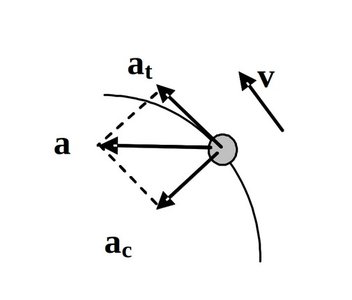
Rotational motion involves angular displacement, velocity, and acceleration.
Angular Displacement:
Angular Velocity:
Angular Acceleration:
Linear-Angular Relations:
Moment of Inertia
Moment of inertia quantifies the rotational mass distribution relative to an axis.
Depends on: Mass, axis location, mass distribution.
Application: Used in calculating rotational kinetic energy and dynamics.
Rotational Kinetic Energy
Energy due to rotation is given by:
Rolling Object:
Torque
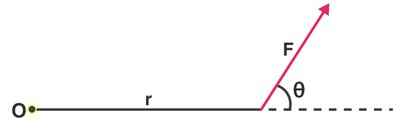
Torque is the rotational equivalent of force, causing angular acceleration.
Direction: Counterclockwise (), Clockwise ()
Newton's Second Law for Rotation:
Angular Momentum
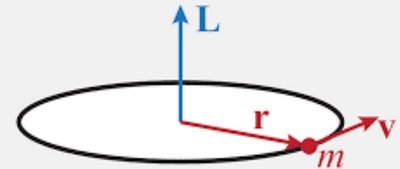
Angular momentum is a measure of rotational motion.
Rigid Body:
Direction: Counterclockwise (), Clockwise ()
Conservation of Angular Momentum
If net external torque is zero, angular momentum is conserved.
If , so
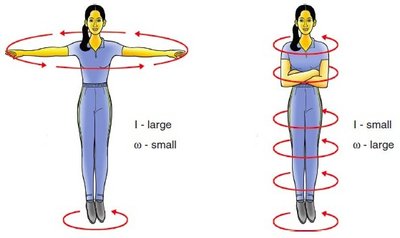
Example: Figure skater spinning faster by pulling arms in (reducing moment of inertia).
Universal Theory of Gravitation
Kepler's Laws
Kepler's laws describe planetary motion:
1. Planets move in elliptical orbits with the Sun at one focus.
2. Equal areas are swept in equal times:
3. Square of orbital period is proportional to cube of semi-major axis:
Newton's Law of Universal Gravitation
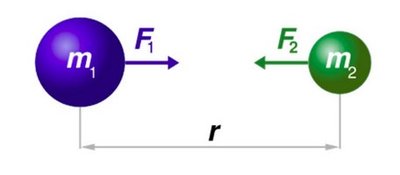
Newton's law states that every mass attracts every other mass with a force proportional to their masses and inversely proportional to the square of the distance between them.
Gravitational Potential Energy
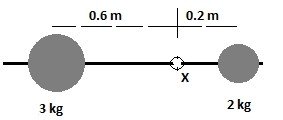
The energy of a system of two masses separated by distance r is:
Total Energy in Gravitational Field
The total energy of an object of mass m moving in the gravitational field of mass M is:
For circular orbits:
