 Back
BackWork, Heat, and Internal Energy in Thermodynamic Processes
Study Guide - Smart Notes
 Tailored notes based on your materials, expanded with key definitions, examples, and context.
Thermodynamic Processes and Work
Overview of Thermodynamic Processes
Thermodynamic processes describe how a system changes from one state to another, often involving changes in pressure, volume, and temperature. The work done by or on a system depends on the specific process, or path, taken between initial and final states. Four fundamental types of thermodynamic processes are commonly analyzed:
Isothermal: Constant temperature
Isochoric: Constant volume
Isobaric: Constant pressure
Adiabatic: No heat exchange with surroundings
The First Law of Thermodynamics relates heat (Q), work (W), and internal energy (ΔU):
Work in Thermodynamic Processes
The work done by a gas during a process is given by: The calculation of work, heat, and internal energy requires knowledge of both the process equation and the system's equation of state. For an ideal gas, the equation of state is:
Isochoric Process (Constant Volume)
Characteristics and Calculations
In an isochoric process, the volume remains constant (), so no work is done (). All energy added as heat increases the internal energy:
Example: Heating a gas in a rigid container.
Pressure and temperature change, but volume is fixed.
Isobaric Process (Constant Pressure)
Characteristics and Calculations
In an isobaric process, pressure remains constant. Work is calculated as:
Both internal energy and heat transfer are nonzero.
Heat capacity at constant pressure () is used to calculate Q.
Example: Boiling water at atmospheric pressure.
Isothermal Process (Constant Temperature)
Characteristics and Calculations
In an isothermal process, temperature remains constant. Both pressure and volume change, and work is calculated as:
For an ideal gas, .
Compression (): Work is done on the system ( negative).
Expansion (): System does work on surroundings ( positive).
Adiabatic Process (No Heat Exchange)
Characteristics and Calculations
In an adiabatic process, no heat is transferred (). The process can occur in two ways:
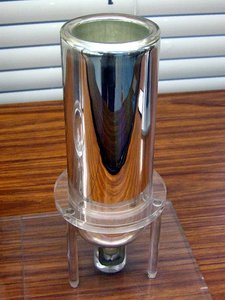
System is surrounded by insulating material (e.g., Dewar flask).
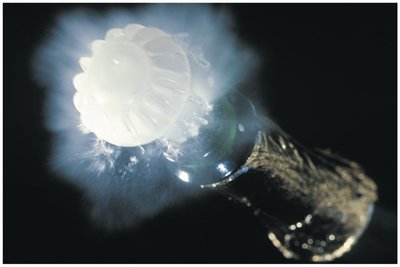
Process occurs rapidly, preventing heat exchange (e.g., popping a champagne cork).
Adiabatic Equation for an Ideal Gas
For a reversible adiabatic process: where is the ratio of heat capacities.
Monatomic ideal gases:
Diatomic ideal gases:
Work Done in Adiabatic Process
The work done is:
Temperature Change in Adiabatic Process
The temperature changes according to:
Adiabatic compression: Temperature increases.
Adiabatic expansion: Temperature decreases.
Comparing Thermodynamic Processes on a pV Diagram
pV Diagram Representation
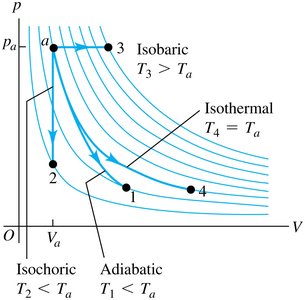
The four processes can be represented on a pressure-volume (pV) diagram.
Isochoric: Vertical line (constant volume)
Isobaric: Horizontal line (constant pressure)
Isothermal: Curved line, less steep than adiabatic
Adiabatic: Curved line, steeper than isothermal
Adiabatic vs. Isothermal Curves
For an ideal gas, an adiabatic curve is always steeper than the isotherm passing through the same point. 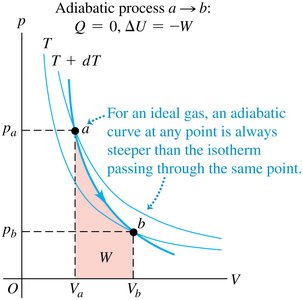
Physical Example: Rapid Adiabatic Expansion
Champagne Cork Popping
When a champagne cork is popped, the pressurized gas inside expands rapidly, doing positive work on the outside air. The expansion is nearly adiabatic, causing the temperature of the gas to drop and water vapor to condense, forming a visible cloud. 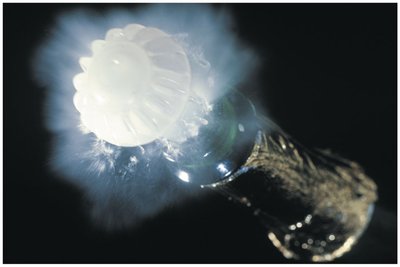
Summary Table: Thermodynamic Processes
Process | Constant Variable | Work (W) | Heat (Q) | Internal Energy (ΔU) |
|---|---|---|---|---|
Isochoric | Volume | 0 | Q = ΔU | ΔU = nC_VΔT |
Isobaric | Pressure | W = pΔV | Q = nC_pΔT | ΔU = nC_VΔT |
Isothermal | Temperature | W = nRT ln(V2/V1) | Q = W | ΔU = 0 |
Adiabatic | No heat exchange | See formula above | Q = 0 | ΔU = -W |
Key Concepts
Work, heat, and internal energy are interrelated and depend on the process.
Adiabatic processes are characterized by no heat transfer and steep pV curves.
Isothermal processes maintain constant temperature and have less steep pV curves.
Physical examples help illustrate the real-world application of these concepts.
Additional info: Academic context and formulas have been expanded for clarity and completeness.
