 Back
BackWork, Heat, and the First Law of Thermodynamics: Study Notes
Study Guide - Smart Notes
 Tailored notes based on your materials, expanded with key definitions, examples, and context.
Work, Heat, and the First Law of Thermodynamics
Introduction to Thermodynamic Energy Transfer
Thermodynamics studies the transfer of energy in the form of work and heat between a system and its environment. These processes are fundamental to understanding how energy is conserved and transformed in physical systems, particularly gases.
Work (W): Energy transferred via mechanical interaction (force and displacement).
Heat (Q): Energy transferred due to a temperature difference between system and environment.
First Law of Thermodynamics: The change in a system's thermal energy is the sum of work done on the system and heat added to it.
Work in Ideal-Gas Processes
Work is done on a gas when its volume changes under the influence of an external force, such as a movable piston. The amount of work can be visualized and calculated using a pV diagram (pressure-volume diagram).
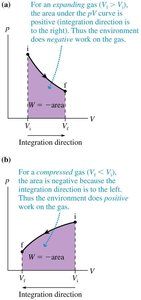
Geometric Interpretation: The work done on a gas is the negative of the area under the pV curve between the initial and final volumes.
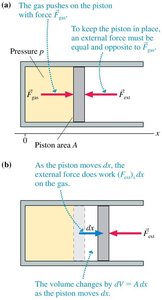
The mathematical expression for work done on a gas is:
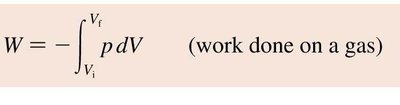
If the gas expands (), the work is negative (energy leaves the system).
If the gas is compressed (), the work is positive (energy enters the system).
Special Ideal-Gas Processes
Different thermodynamic processes have characteristic work and heat relationships, which can be visualized on pV diagrams:
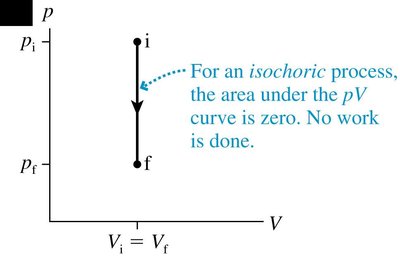
Isochoric Process (Constant Volume)
Definition: Volume remains constant ().
Work Done: (no area under the curve).
Heat Transfer: All energy transfer is as heat.
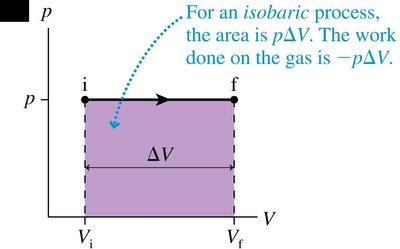
Isobaric Process (Constant Pressure)
Definition: Pressure remains constant.
Work Done:
pV Diagram: Area under the horizontal line represents work done.

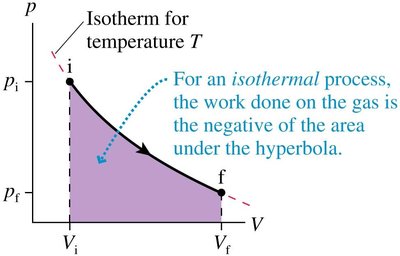
Isothermal Process (Constant Temperature)
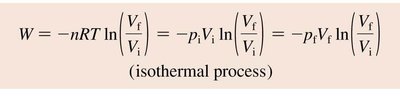
Definition: Temperature remains constant.
Work Done:
pV Diagram: Area under the hyperbolic curve.
Heat and Its Measurement
Heat is energy transferred due to a temperature difference. The SI unit of heat is the joule (J), but the calorie (cal) is also used historically:
1 cal = 4.186 J
1 food Calorie (Cal) = 1000 cal = 4186 J
Heat, Temperature, and Thermal Energy
Thermal energy is the energy associated with the random motion of atoms and molecules. Temperature quantifies the average kinetic energy of particles in a system. Heat transfer requires a temperature difference between system and environment.
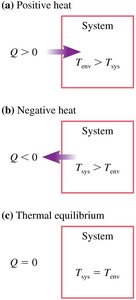
The Sign of Heat
Q > 0: Heat flows into the system (system absorbs energy).
Q < 0: Heat flows out of the system (system loses energy).
Q = 0: No heat transfer (thermal equilibrium).
Understanding Work and Heat: Comparison Table
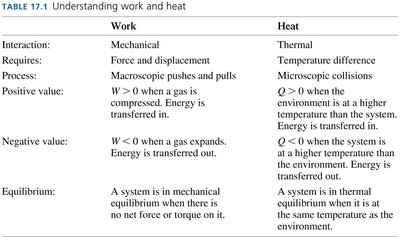
The following table summarizes the differences between work and heat as forms of energy transfer:
Work | Heat | |
|---|---|---|
Interaction | Mechanical | Thermal |
Requires | Force and displacement | Temperature difference |
Process | Macroscopic pushes and pulls | Microscopic collisions |
Positive value | when a gas is compressed. Energy is transferred in. | when the environment is at a higher temperature than the system. Energy is transferred in. |
Negative value | when a gas expands. Energy is transferred out. | when the system is at a higher temperature than the environment. Energy is transferred out. |
Equilibrium | Mechanical equilibrium: no net force or torque. | Thermal equilibrium: same temperature as environment. |
The First Law of Thermodynamics
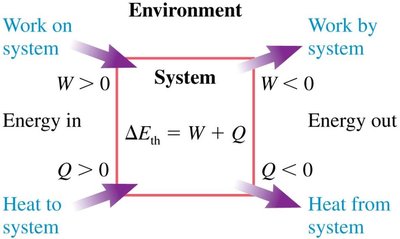
The First Law of Thermodynamics is a statement of energy conservation for thermodynamic systems:
: Change in thermal energy of the system
W: Work done on the system
Q: Heat added to the system
Thermal Energy for an Ideal Gas
The thermal energy of an ideal gas depends only on its temperature and the number of particles:
Monatomic gas:
Diatomic gas:
Summary Table: Work, Heat, and Thermal Energy in Ideal-Gas Processes
Process | Work (W) | Heat (Q) | Thermal Energy Change () |
|---|---|---|---|
Isochoric | 0 | (heating), (cooling) | |
Isobaric | Depends on and | ||
Isothermal | 0 | ||
Adiabatic | Equals | 0 |
Examples of Thermodynamic Processes
Isochoric: Volume fixed by a locking pin; no work is done.
Isothermal: Temperature kept constant by thermal contact with a heat reservoir (flame or ice).
Adiabatic: Cylinder insulated so no heat is transferred in or out.
Path Dependence of Work and Heat
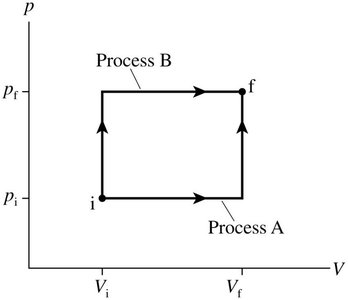
For a given change of state, the work and heat depend on the path taken in the pV diagram, but the change in thermal energy () depends only on the initial and final states (state function).
Summary of Key Equations
General Work:
Isobaric Work:
Isothermal Work:
First Law:
Thermal Energy (Monatomic):
Thermal Energy (Diatomic):
Example Application
Suppose a gas expands isothermally from to at temperature . The work done on the gas is:
Since the process is isothermal, , so (all energy transferred as work is balanced by heat flow).
