 Back
BackWork, Kinetic Energy, and the Energy Principle
Study Guide - Smart Notes
 Tailored notes based on your materials, expanded with key definitions, examples, and context.
Energy: Concepts and Forms
Introduction to Energy
Energy is a fundamental property of physical systems, essential for understanding how systems change and interact. In physics, energy has a precise definition, distinct from its colloquial use. We classify energy into several types, each with unique characteristics and roles in physical processes.
Kinetic Energy (K): The energy of motion. All moving objects possess kinetic energy, which increases with mass and speed.
Potential Energy (U): Stored energy associated with an object's position. Gravitational potential energy, for example, depends on an object's height above the ground.
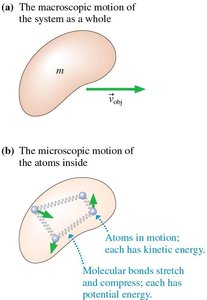
Thermal Energy (Eth): The collective kinetic and potential energies of all atoms and bonds within an object. Thermal energy increases as an object becomes hotter.


Energy in the System vs. the Environment
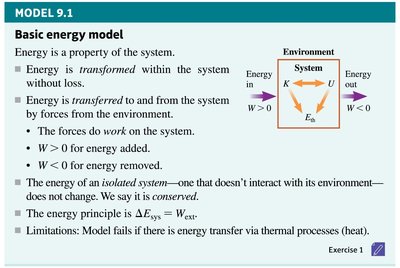
Energy is a property of a system, so it is crucial to define the system's boundaries. Energy can be transformed within the system or transferred between the system and its environment:
Transformation: Energy changes from one form to another within the system, but the total energy remains constant.
Transfer: Energy moves into or out of the system via two main processes:
Work (W): Energy transferred by mechanical means.
Heat (Q): Energy transferred by thermal means.
These processes can change the total energy of the system.


Energy Transformation vs. Energy Transfer
Energy Transfer Example: A shot putter does work on the shot, transferring kinetic energy. A boy stretches a slingshot, transferring energy as potential energy.
Energy Transformation Example: A diver transforms gravitational potential energy into kinetic energy during a dive. A meteor transforms kinetic energy into thermal energy as it heats the air.

The Energy Principle
Statement of the Energy Principle
The energy principle states that the change in a system's energy equals the work done on the system by the environment:
Sign Convention: Energy entering the system (from the environment) is positive; energy leaving is negative.
Work: increases the system's energy.
Work and Kinetic Energy for a Single Particle
Work-Energy Theorem
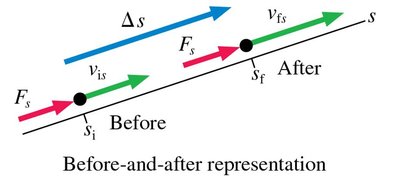
Consider a particle of mass acted on by a constant force parallel to its displacement :
Using calculus and integrating both sides, we find:
Defining kinetic energy as , the change in kinetic energy is:

Units and Properties of Kinetic Energy
Units: Joules (J), where
Scalar Quantity: Kinetic energy depends only on speed and mass, not direction.
Work Done by a Constant Force
General Expression for Work
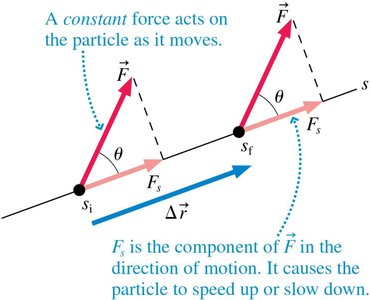
For a constant force acting at an angle to the displacement :
Or, using the dot product:
Determining the Sign of Work
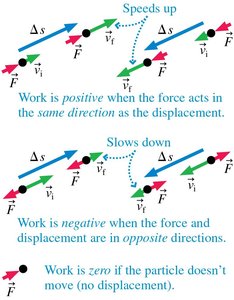
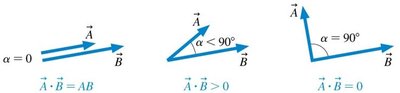
Positive Work: Force and displacement in the same direction (), increases kinetic energy.
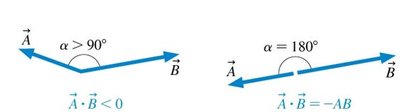
Negative Work: Force and displacement in opposite directions (), decreases kinetic energy.
Zero Work: Force perpendicular to displacement () or no displacement.
Calculating Work: Tactics and Examples
Force and Displacement | Angle | Work | Sign of | Energy Transfer |
|---|---|---|---|---|
Same direction | + | Energy into system, increases | ||
Angle | + | Energy into system, increases | ||
Opposite direction | - | Energy out of system, decreases |
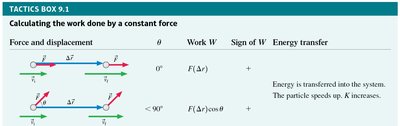
Work with Multiple Forces and Particles
Multiple Forces: Total work is the sum of work done by each force:
Multiple Particles: Total kinetic energy is the sum for all particles:
Energy Principle for Systems:
Mathematical Tools: The Dot Product
Definition and Properties
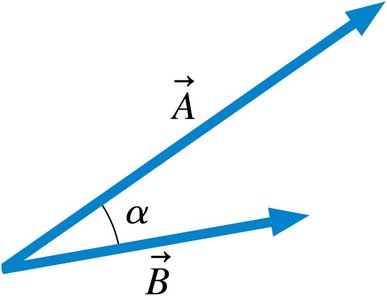
The dot product (scalar product) of two vectors and with angle between them is:
Result: A scalar (not a vector).
Sign: Positive if , negative if , zero if .
Component Form
If and , then:
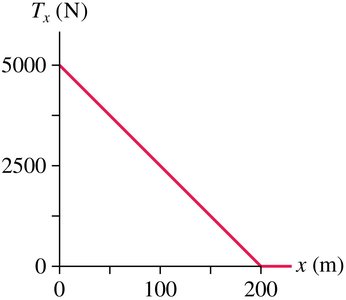
Work Done by a Variable Force
If the force varies in magnitude or direction, work is calculated as:
This is the area under the vs. graph.
Elastic Forces and Hooke's Law
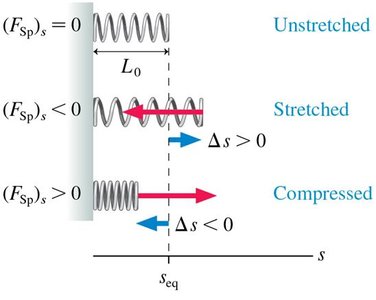
Restoring Forces and Hooke's Law
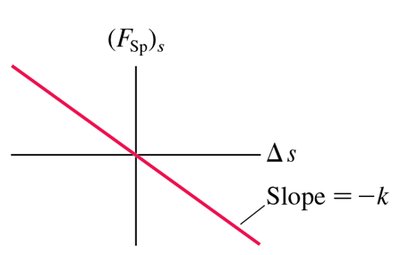
Elastic objects like springs exert a restoring force proportional to their displacement from equilibrium:
k: Spring constant (stiffness of the spring).
Direction: Always opposite to displacement.
Work Done by a Spring
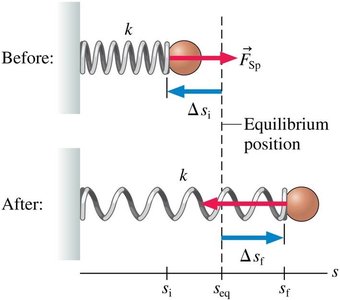
The work done by a spring as it moves from to :
Thermal Energy and Dissipative Forces
Thermal Energy
Thermal energy () is the sum of the microscopic kinetic and potential energies of all atoms and bonds in an object. Changes in $E_{th}$ correspond to temperature changes.
Dissipative Forces
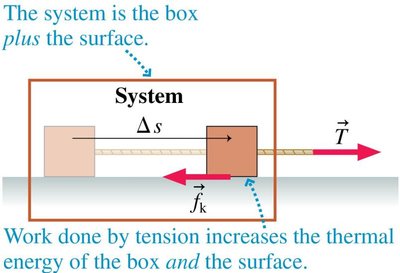
Dissipative forces, such as kinetic friction and drag, convert macroscopic kinetic energy into thermal energy, increasing the temperature of objects in contact.
Example: Dragging a box across a carpet at constant speed increases the thermal energy of both the box and the carpet.
Energy Principle: (where is the kinetic friction force).
Work and Power
Definition of Power
Power is the rate at which energy is transferred or transformed:
When energy changes due to work by a force:
SI Unit: Watt (W), where
English Unit: Horsepower (hp), where
Power Delivered by a Force
For a constant force moving a particle with velocity :
