 Back
Work, Kinetic Energy, Potential Energy, and Conservation of Energy
Study Guide - Smart Notes
 Tailored notes based on your materials, expanded with key definitions, examples, and context.
Kinetic Energy and the Work-Energy Theorem
Definition and Derivation of Kinetic Energy
Kinetic energy is the energy associated with the motion of an object. When a net force acts on a particle over a distance, it does work, resulting in a change in the particle's kinetic energy.
Work Done by a Constant Force: The net work done by a constant force F over a distance x is given by .
Relation to Acceleration: Using Newton's second law, , so .
Kinematic Equation: From kinematics, , so .
Work-Energy Theorem: Substituting, .
Kinetic Energy:
Work-Energy Theorem:
Proportionality: Kinetic energy is proportional to mass and to the square of velocity.
Example: If a car doubles its speed, its kinetic energy increases by a factor of four.
Calculus Derivation: The work done can also be derived using calculus:
Potential Energy
Gravitational Potential Energy
Potential energy is the energy stored due to an object's position in a force field, such as gravity. Work done against gravity is stored as gravitational potential energy.
Definition: , where h is the height above a reference point.
Change in Potential Energy:
Path Independence: Gravitational potential energy depends only on vertical height, not on the path taken.
Example: A ball at height h has the ability to do work equal to mgh.



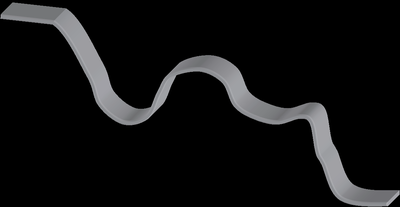

Inclined Plane Example: For a mass m sliding down an incline of length d and angle \theta, the change in height is .

Spring Potential Energy
Potential energy can also be stored in a spring when it is compressed or stretched from its equilibrium position.
Spring Potential Energy: , where k is the spring constant and x is the displacement from equilibrium.
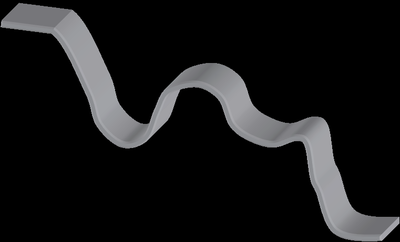
Both gravitational and spring potential energies can be used in the conservation of energy equation.
Conservation of Mechanical Energy
Conservative and Nonconservative Forces
Mechanical energy is conserved in systems where only conservative forces (like gravity and ideal springs) do work. Nonconservative forces (like friction) cause mechanical energy to be lost from the system, usually as heat.
Conservation of Mechanical Energy: (for conservative forces only)
Gravity: A conservative force; work done is path-independent and zero for a closed path.
Friction: A nonconservative force; work done depends on the path and leads to energy dissipation.
Energy Conservation Equation
For a freely falling body:
For gravitational potential energy:


Example Problem: An athlete jumps with an initial vertical velocity of 6 m/s. The maximum height reached is found using so .
Special Cases
Falling from Rest: If an object is dropped from rest, so .
Pendulum Example: For a pendulum of length L released from angle \theta, the speed at the lowest point is .
Spring and Gravitational Energy Combined
When both spring and gravitational potential energies are present, use .
Example: A block on a compressed spring is released and rises to a maximum height. Set to solve for h.
Nonconservative Forces and the General Energy Equation
Work Done by Nonconservative Forces
When nonconservative forces (like friction) do work, mechanical energy is not conserved. The general energy equation accounts for work done by these forces:
General Energy Equation:
Or,
Any work done on the system (positive or negative) changes the total energy.
Problem-Solving Strategy
Define all energy sources at points A and B: , ,
Select a reference for zero potential energy (height or spring position).
If no work is done on the system, set initial energy equal to final energy.
If work is done, add it to the initial energy:
Evaluate the work: (if force and displacement are in the same direction).
Eliminate terms that are zero (e.g., if starting or ending at rest).
Solve for the unknown quantity.
Example: Friction on a Sled
A sled of mass m is given an initial speed v on ice with kinetic friction coefficient \mu_k. The distance before stopping is found using energy methods.
Work done by friction:
Set and solve for d:
Summary Table: Forms of Mechanical Energy
Type | Expression | Description |
|---|---|---|
Kinetic Energy | Energy of motion | |
Gravitational Potential Energy | Energy due to height in a gravitational field | |
Spring Potential Energy | Energy stored in a compressed or stretched spring |
