 Back
Work, Kinetic Energy, Power, and Elastic Forces: Study Notes for Physics with Calculus
Study Guide - Smart Notes
 Tailored notes based on your materials, expanded with key definitions, examples, and context.
Applied Dynamics and Circular Motion
Vertical Circular Motion
When an object moves in a vertical circle, such as a ball on a string, the forces acting on it change depending on its position in the circle. The centripetal force is always directed toward the center of the circle and is provided by a combination of tension and gravity.
At the top of the circle: (both tension and gravity point downward)
At the bottom of the circle: (tension upward, gravity downward)
Example: Swinging a ball at the end of a string in a vertical circle requires analyzing the net force at different points to ensure the correct centripetal force is maintained.
Motion Over Hills and Dips
For a skier going over a hill or into a dip, the centripetal force is determined by the balance between gravity and the normal force.
At the top of a hill:
In a dip:
Example: A skier at the top of a hill experiences a net force downward, which is the difference between her weight and the normal force exerted by the hill.
Work and Kinetic Energy
Work Done by Forces
Work is defined as the product of force and displacement in the direction of the force. When multiple forces act on an object, the total work is the sum of the work done by each force.
Formula:
Key Point: Only the component of force in the direction of displacement does work.
Example: A car travels up a hill with constant velocity. The work done by gravity and friction can be calculated using the angle of the hill and the distance traveled.
Power
Definition and Units
Power is the rate at which work is done or energy is transferred. The SI unit of power is the watt (W), where 1 W = 1 J/s. Another common unit is the horsepower (hp), where 1 hp = 746 W.
Average Power:
Instantaneous Power:



Power in Everyday Context
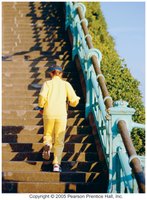
The difference between walking and running up stairs is not the total work done (which is the same), but the power output, since running does the same work in less time.
Power: Lifting Objects
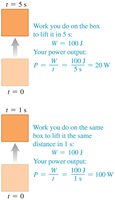
Lifting a box slowly or quickly involves the same amount of work, but the power output differs because of the time taken.
Example: Lifting a 100 J box in 5 s yields 20 W; lifting it in 1 s yields 100 W.
Elastic Forces and Springs
Hooke's Law
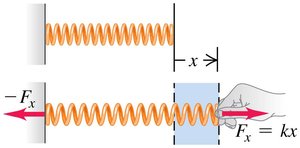
Springs exert a force proportional to their displacement from equilibrium, described by Hooke's Law:
Formula:
k: Spring constant (N/m)
x: Displacement from equilibrium
Work Done by a Spring
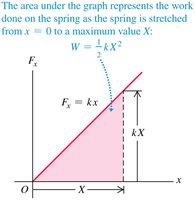
The work done to stretch or compress a spring is equal to the area under the force vs. displacement graph:
Formula:
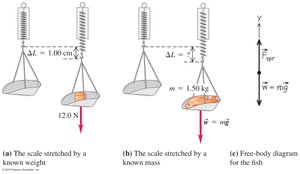
Spring Scales and Calibration
Spring scales are calibrated using known masses and forces, allowing measurement of weight and mass based on the displacement of the spring.
Work Done by Friction
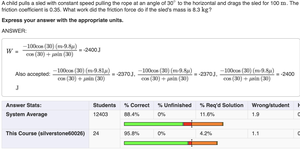
When an object is pulled at constant speed, the work done by friction can be calculated using the force of friction and the distance moved. The direction of frictional force is always opposite to the direction of motion.
Formula:
Comparisons and Applications
Car and Truck Dynamics
When a lighter car and a heavier truck are pushed with the same force over the same distance, their kinetic energies and velocities differ due to their masses. When braking, the work done by friction is the same if the force and distance are equal, but the resulting velocities and kinetic energies may differ.
Work and Forces on a Ramp
When pushing a crate down a ramp at constant velocity, the net work is zero. The normal force does no work, while friction does negative work, and gravity and the applied force do positive work. For constant velocity, the sum of positive and negative work must be zero.
Summary Table: Power and Work Formulas
Concept | Formula | Units |
|---|---|---|
Work | Joules (J) | |
Average Power | Watts (W) | |
Instantaneous Power | Watts (W) | |
Hooke's Law | Newtons (N) | |
Work by Spring | Joules (J) |
Additional info:
These notes cover topics from Chapters 5, 6, and 7: Applied Dynamics, Work & Kinetic Energy, Power, and Elastic Forces.
All images included directly reinforce the explanation of the adjacent paragraph and are strictly relevant.
