 Back
Work, Power, and Kinetic Energy: Calculus-Based Physics Study Notes
Study Guide - Smart Notes
 Tailored notes based on your materials, expanded with key definitions, examples, and context.
Work, Power, and Kinetic Energy
Power
Power is a fundamental concept in physics that quantifies the rate at which work is performed or energy is transferred. It is especially important when analyzing systems where forces act over time, such as engines, motors, or moving objects.
Definition: Power (P) is the work done (W) per unit time (t).
Formula:
For constant force and velocity:
SI Unit: Watt (W), where
Application: Power is always taken as positive, representing the rate of energy transfer.
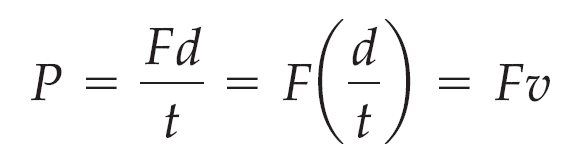
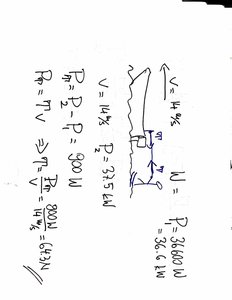
Example: The motor of a ski boat produces a power of 36,600 W to maintain a constant speed of 14.0 m/s. To pull a water skier at the same speed, the motor must produce 37,500 W. The tension in the rope can be found using .
Work
Work is the measure of energy transfer when a force acts upon an object to cause displacement. The amount of work depends on the magnitude of the force, the displacement, and the angle between the force and displacement vectors.
Definition: Work (W) is done when a force (F) causes displacement (d).
Formula for constant force:
SI Unit: Joule (J), where
Work by net force:
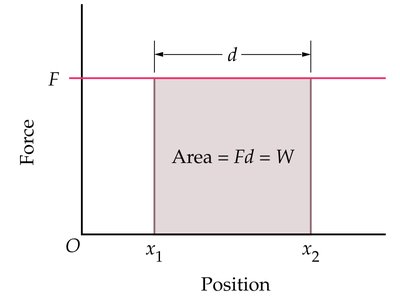
Example: If the force is constant and parallel to displacement, the work is simply force times distance.
Work Done by a Variable Force
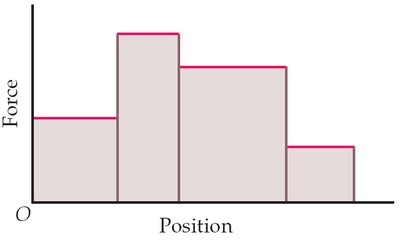
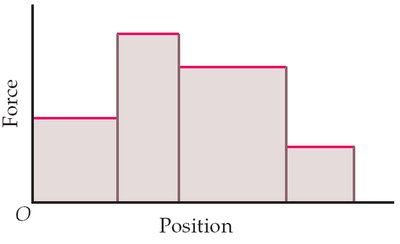
When the force acting on an object varies with position, the work done can be interpreted graphically as the area under the force versus position curve. This is a key application of calculus in physics.
Piecewise constant force: The total work is the sum of work done by each segment.
Formula:
Negative work: If the force projection is negative, the area below the x-axis is subtracted.
Approximation: A continuously varying force can be approximated by a succession of constant values, and the area under the curve by a sum over rectangular bars of width .
Integration: In the limit , the sum becomes an integral:
Example: Stretching a spring from equilibrium () to requires work . The work done from to is .
Work Done by a Variable Force Along a Curved Path
For forces acting along a curved path, the work is calculated by splitting the path into segments and summing the contributions, considering both the magnitude and direction of the force at each point.
Formula:
Integration along the path:
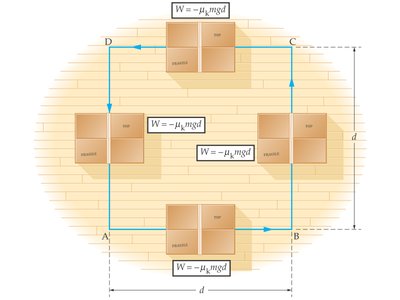
Friction example: Work by friction is always negative, as the force opposes motion.
Total work by friction:
Conservative and Nonconservative Forces
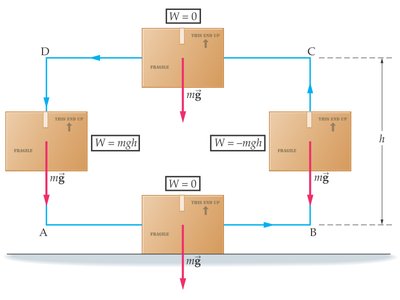
Forces are classified as conservative or nonconservative based on whether the work done around a closed path is zero.
Conservative force: Work done by gravity on a closed path is zero.
Nonconservative force: Work done by friction on a closed path is not zero.
Definition: A force is conservative if the work done moving an object around a closed path is zero.
Examples: Gravity (conservative), friction (nonconservative), engine work, human effort.
Tension and Work
When a ball is tied to a string and whirled in a circle, the tension force acts perpendicular to the displacement at all times. Thus, the work done by tension is zero.
Formula:
For : , so
Key point: Net force and displacement exist, but work is zero if force is perpendicular to displacement.
Kinetic Energy and the Work-Energy Theorem
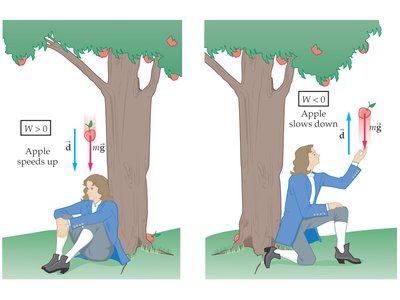
Kinetic energy is the energy of motion, and the work-energy theorem relates the net work done on an object to its change in kinetic energy.
Definition: Kinetic energy () is
Work-energy theorem:
Key point: Positive net work increases speed; negative net work decreases speed.
Scalar property: Work and kinetic energy depend only on speed, not direction.
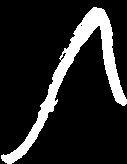
Example: If two cars have the same kinetic energy but different masses, the lighter car must be moving faster. If , then .
Applications and Problems
Several practical problems illustrate the use of work, power, and kinetic energy in physics:
Braking distance: If a car's speed doubles, its stopping distance quadruples for the same braking force.
Friction and stopping distance: For two blocks with equal kinetic energy, the block with less mass (and thus less friction force) will travel farther before stopping.


Summary Table: Work, Power, and Energy
Concept | Formula | SI Unit | Key Points |
|---|---|---|---|
Work | Joule (J) | Energy transfer by force and displacement | |
Power | , | Watt (W) | Rate of doing work |
Kinetic Energy | Joule (J) | Energy of motion | |
Work-Energy Theorem | Joule (J) | Net work equals change in kinetic energy |
Additional info: Calculus is essential for analyzing work done by variable forces, as integration allows for precise calculation of energy transfer along arbitrary paths. The distinction between conservative and nonconservative forces is fundamental for understanding energy conservation and dissipation in physical systems.
