 Back
BackWork, Power, and the Work-Energy Theorem in Physics
Study Guide - Smart Notes
 Tailored notes based on your materials, expanded with key definitions, examples, and context.
Work and Power
Definition of Work
Work is a fundamental concept in physics that quantifies the energy transferred by a force acting over a distance. The infinitesimal work δU performed by a force \( \vec{F} \) during a displacement \( d\vec{r} \) is defined as:
Formula:
Work is zero if:
No motion:
No force:
Force is perpendicular to displacement:
Work is a scalar quantity and its unit is the Joule (J), where 1 J = 1 N·m.
Types of Forces and Work
Reactive force:
Active force:
Driving (actuator) force:
Resistive (dissipative) force:
Work in Different Coordinate Systems
Cartesian coordinates:
Cylindrical coordinates:
Total Work
The total work U1→2 performed by a force as a particle moves from state 1 to state 2 is:
Example: Work Associated with Weight
When a body of mass m moves vertically from altitude y1 to y2, the work done by gravity is:
The horizontal movement does not contribute to this work.
If the body rises, work is negative; if it falls, work is positive.
The work depends only on the initial and final positions, not the path—gravity is a conservative force.
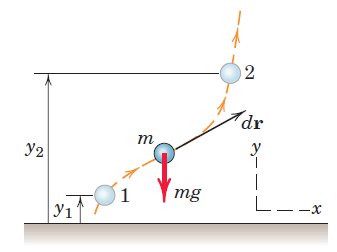
Example: Work Associated with a Spring Force
For a spring with force \( \vec{F} = -kx \hat{x} \):
The spring force is also a conservative force.
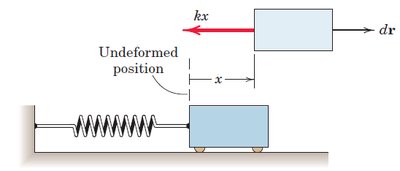
Definition of Power
Power is the rate at which work is done by a force or system:
Power is a scalar quantity, measured in Watts (W), where 1 W = 1 J/s.
Using , power can be expressed as .
Work-Energy Theorem
Kinetic Energy
Kinetic energy is the energy a particle possesses due to its motion:
In Cartesian coordinates:
In cylindrical coordinates:
Work-Energy Theorem
The work-energy theorem states that the work done by the resultant force on a particle equals the change in its kinetic energy:
Integrating between states 1 and 2:
Applications and Examples
Example: Collar Sliding on a Spiral Rod
A 0.5-kg collar slides with negligible friction along a spiral rod in the vertical plane. The rod has the shape r = 0.3θ (r in meters, θ in radians). The collar is released from rest at A and slides to B under a constant radial force T = 10 N. The velocity v at B can be calculated using the work-energy theorem.
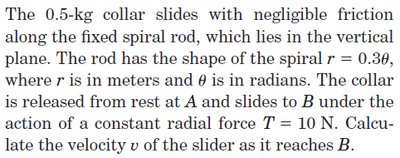
Holonomic constraint:
Velocity:
Kinetic energy:
Work done by force T:
Work-Energy theorem:
Since the collar starts from rest, .
Solving for velocity at B:
Numerical values: , kg, N
Result: m/s
Summary Table: Work and Energy Concepts
Concept | Formula | Unit | Notes |
|---|---|---|---|
Work | Joule (J) | Scalar, path-dependent for non-conservative forces | |
Power | Watt (W) | Rate of doing work | |
Kinetic Energy | Joule (J) | Energy due to motion | |
Work-Energy Theorem | Joule (J) | Work equals change in kinetic energy |
Additional info: Academic context and expanded explanations were added to clarify the derivations, coordinate systems, and the physical meaning of work, power, and energy.
