Skip to main content
Precalculus
My Course
Learn
Exam Prep
AI Tutor
Study Guides
Flashcards
Explore
Try the app
My Course
Learn
Exam Prep
AI Tutor
Study Guides
Flashcards
Explore
Try the app
Back
Convert Equations Between Polar and Rectangular Forms quiz
You can tap to flip the card.
What substitutions do you use for x and y when converting a rectangular equation to polar form?
You can tap to flip the card.
👆
What substitutions do you use for x and y when converting a rectangular equation to polar form?
Replace x with r*cos(theta) and y with r*sin(theta).
Track progress
Control buttons has been changed to "navigation" mode.
1/15
Related flashcards
Related practice
Recommended videos
Convert Equations Between Polar and Rectangular Forms definitions
Convert Equations Between Polar and Rectangular Forms
15 Terms
Convert Equations Between Polar and Rectangular Forms
15. Polar Equations
1 problem
Topic
Graphing Other Common Polar Equations
15. Polar Equations
3 problems
Topic
15. Polar Equations
3 topics
5 problems
Chapter
Guided course
6:50
Convert Equations from Polar to Rectangular
491
views
7
rank
Guided course
3:28
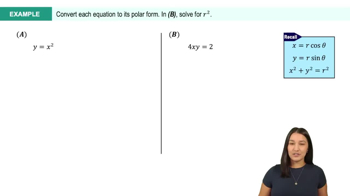
Convert Equations from Rectangular to Polar Example 1
537
views
12
rank
Guided course
3:03
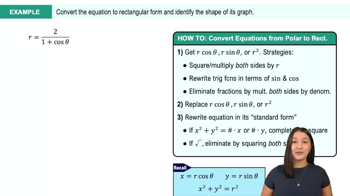
Convert Equations from Polar to Rectangular Example 2
442
views
5
rank
Terms in this set (15)
Hide definitions
What substitutions do you use for x and y when converting a rectangular equation to polar form?
Replace x with r*cos(theta) and y with r*sin(theta).
How do you convert the equation y = 5 into polar form?
Replace y with r*sin(theta), solve for r, and get r = 5*csc(theta).
What is the polar form of the equation y = x + 1?
It is r = 1 / (sin(theta) - cos(theta)).
How do you convert x^2 + y^2 = 25 into polar form?
Replace x^2 + y^2 with r^2 to get r^2 = 25, then r = 5.
What does the equation r = 5 represent in rectangular form?
It represents a circle with radius 5 centered at the origin.
When converting from polar to rectangular form, what should you try to get in your equation?
Try to get terms like r*cos(theta), r*sin(theta), or r^2.
How do you convert r = 4 into rectangular form?
Square both sides to get r^2 = 16, then substitute x^2 + y^2 for r^2 to get x^2 + y^2 = 16.
What is the rectangular form of r = sec(theta)?
Rewrite sec(theta) as 1/cos(theta), multiply both sides by cos(theta) to get r*cos(theta) = 1, then substitute x for r*cos(theta) to get x = 1.
How do you convert r = 6*sin(theta) into rectangular form?
Multiply both sides by r to get r^2 = 6r*sin(theta), then substitute x^2 + y^2 for r^2 and y for r*sin(theta) to get x^2 + y^2 = 6y.
What algebraic technique is used to rewrite x^2 + y^2 = 6y into a standard form?
Complete the square on the y terms to get x^2 + (y - 3)^2 = 9.
What shape does the equation x^2 + (y - 3)^2 = 9 represent?
It represents a circle of radius 3 centered at (0, 3).
What is the rectangular form of r*cos(theta) = 1?
It is x = 1.
What should you do if your polar equation contains a fraction with a trigonometric denominator?
Multiply both sides by the denominator to eliminate the fraction.
What is the general strategy for converting polar equations to rectangular form?
Manipulate the equation to get r*cos(theta), r*sin(theta), or r^2, then substitute x, y, or x^2 + y^2, respectively.
Why is it helpful to identify the shape of the graph when converting equations?
Recognizing the shape helps confirm the equation is in a standard or recognizable form.
 BackBack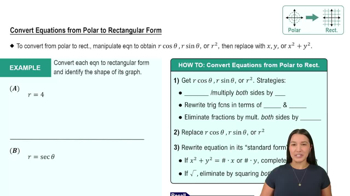
 6:50
6:50