Skip to main content
Precalculus
My Course
Learn
Exam Prep
AI Tutor
Study Guides
Flashcards
Explore
Try the app
My Course
Learn
Exam Prep
AI Tutor
Study Guides
Flashcards
Explore
Try the app
Back
Convert Points Between Polar and Rectangular Coordinates quiz
You can tap to flip the card.
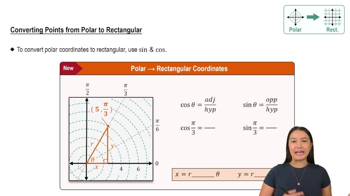
What are the formulas to convert a point (r, θ) in polar coordinates to rectangular coordinates (x, y)?
You can tap to flip the card.
👆
What are the formulas to convert a point (r, θ) in polar coordinates to rectangular coordinates (x, y)?
x = r * cos(θ) and y = r * sin(θ).
Track progress
Control buttons has been changed to "navigation" mode.
1/15
Related flashcards
Related practice
Recommended videos
Convert Points Between Polar and Rectangular Coordinates definitions
Convert Points Between Polar and Rectangular Coordinates
15 Terms
Convert Points Between Polar and Rectangular Coordinates
15. Polar Equations
3 problems
Topic
Convert Equations Between Polar and Rectangular Forms
15. Polar Equations
1 problem
Topic
15. Polar Equations
3 topics
5 problems
Chapter
Guided course
2:21
Convert Points from Rectangular to Polar Example 1
505
views
13
rank
Guided course
6:17
Convert Points from Polar to Rectangular
846
views
20
rank
Guided course
6:58
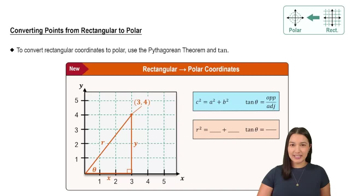
Convert Points from Rectangular to Polar
612
views
10
rank
Terms in this set (15)
Hide definitions
What are the formulas to convert a point (r, θ) in polar coordinates to rectangular coordinates (x, y)?
x = r * cos(θ) and y = r * sin(θ).
How do you find the x-coordinate when converting from polar to rectangular coordinates?
Multiply the radius r by the cosine of the angle θ: x = r * cos(θ).
How do you find the y-coordinate when converting from polar to rectangular coordinates?
Multiply the radius r by the sine of the angle θ: y = r * sin(θ).
What is the rectangular coordinate of the polar point (5, π/3)?
The rectangular coordinate is (5/2, (5√3)/2).
If a polar point has r = 0, what is its rectangular coordinate?
It is always (0, 0), the origin.
What is the rectangular coordinate of the polar point (-3, π/6)?
It is (-(3√3)/2, -3/2).
What is the general formula to convert rectangular coordinates (x, y) to polar coordinates (r, θ)?
r = √(x² + y²) and θ = arctan(y/x), with adjustments for the correct quadrant.
How do you calculate the radius r when converting from rectangular to polar coordinates?
Use the Pythagorean theorem: r = √(x² + y²).
How do you calculate the angle θ when converting from rectangular to polar coordinates?
θ = arctan(y/x), but you must adjust θ based on the quadrant where (x, y) is located.
What is the polar coordinate of the rectangular point (3, 4)?
It is (5, arctan(4/3)), or approximately (5, 53°).
What adjustment must you make to θ if your rectangular point is in quadrant II or III?
Add π to the angle θ found from arctan(y/x) to place it in the correct quadrant.
What is the polar coordinate of the rectangular point (-4, 0)?
It is (4, π).
What is the polar coordinate of the rectangular point (-1, √3)?
It is (2, 2π/3).
Why is it important to consider the quadrant when converting from rectangular to polar coordinates?
Because the arctan function only gives angles in quadrants I and IV, so you must adjust θ to match the actual location of the point.
What is the relationship between the unit circle and converting polar to rectangular coordinates?
The formulas x = r cos(θ) and y = r sin(θ) are based on the unit circle, but r can be any value, not just 1.
 BackBack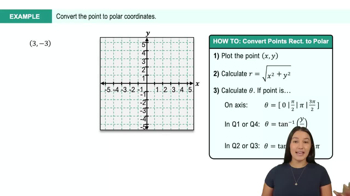
 2:21
2:21