Skip to main content
Precalculus
My Course
Learn
Exam Prep
AI Tutor
Study Guides
Flashcards
Explore
Try the app
My Course
Learn
Exam Prep
AI Tutor
Study Guides
Flashcards
Explore
Try the app
Back
Direction of a Vector quiz
You can tap to flip the card.
What is the direction of a vector defined as?
You can tap to flip the card.
👆
What is the direction of a vector defined as?
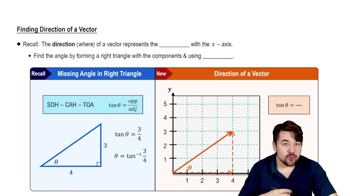
The direction of a vector is the angle it makes with the x-axis.
Track progress
Control buttons has been changed to "navigation" mode.
1/15
Related flashcards
Related practice
Recommended videos
Direction of a Vector definitions
Direction of a Vector
15 Terms
Direction of a Vector
14. Vectors
3 problems
Topic
Unit Vectors and i & j Notation
14. Vectors
3 problems
Topic
14. Vectors
6 topics
11 problems
Chapter
04:19
Finding Direction of a Vector Example 1
479
views
8
rank
1
comments
05:13
Finding Direction of a Vector
644
views
10
rank
04:55
Finding Components from Direction and Magnitude
485
views
9
rank
Terms in this set (15)
Hide definitions
What is the direction of a vector defined as?
The direction of a vector is the angle it makes with the x-axis.
How do you calculate the direction angle of a vector given its x and y components?
You use the inverse tangent (arctan) of the y component divided by the x component.
What adjustment must you make to the angle if the vector is not in the first quadrant?
You may need to add or subtract from 180 or 360 degrees to express the angle as a positive number from the positive x-axis.
If a vector has components (2, -1), what is its direction from the positive x-axis?
Its direction is 333 degrees after adjusting for the quadrant.
What is the formula for finding the y component of a vector given its magnitude and direction?
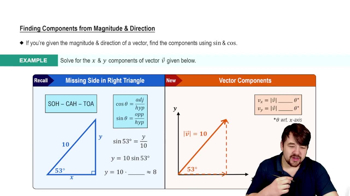
y = magnitude × sin(angle).
What is the formula for finding the x component of a vector given its magnitude and direction?
x = magnitude × cos(angle).
For a vector with magnitude 10 and direction 53 degrees, what are its x and y components approximately?
x ≈ 6 and y ≈ 8.
How do you find the x component of a vector with magnitude 5 and direction 2π/3 radians?
x = 5 × cos(2π/3) = -5/2.
How do you find the y component of a vector with magnitude 5 and direction 2π/3 radians?
y = 5 × sin(2π/3) = 5√3/2.
What does a negative x component and positive y component indicate about the vector's quadrant?
It indicates the vector is in the second quadrant.
If a vector has components (-3, -3), what is its direction from the positive x-axis?
Its direction is 225 degrees.
What trigonometric memory tool helps relate vector components to angles?
SOHCAHTOA helps relate sine, cosine, and tangent to the sides of a right triangle.
What is the inverse tangent of -1/2, and how is it used to find a vector's direction?
The inverse tangent of -1/2 is about -27 degrees, which is then adjusted to 333 degrees for direction from the positive x-axis.
Why might you need to use a calculator when finding vector components from magnitude and direction?
Because the angle may not correspond to a simple value on the unit circle, requiring decimal approximations.
What does it mean if both x and y components of a vector are negative?
The vector lies in the third quadrant.
 BackBack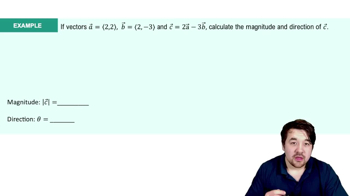
 04:19
04:19