Skip to main content
Precalculus
My Course
Learn
Exam Prep
AI Tutor
Study Guides
Flashcards
Explore
Try the app
My Course
Learn
Exam Prep
AI Tutor
Study Guides
Flashcards
Explore
Try the app
Back
Graphing Complex Numbers quiz
You can tap to flip the card.
What is the standard form of a complex number?
You can tap to flip the card.
👆
What is the standard form of a complex number?
The standard form is x + yi, where x is the real part and y is the imaginary part.
Track progress
Control buttons has been changed to "navigation" mode.
1/15
Related flashcards
Related practice
Recommended videos
Graphing Complex Numbers definitions
Graphing Complex Numbers
13 Terms
Graphing Complex Numbers
17. Graphing Complex Numbers
5 problems
Topic
Polar Form of Complex Numbers
17. Graphing Complex Numbers
4 problems
Topic
17. Graphing Complex Numbers
4 topics
7 problems
Chapter
03:47
How To Plot Complex Numbers
615
views
12
rank
Terms in this set (15)
Hide definitions
What is the standard form of a complex number?
The standard form is x + yi, where x is the real part and y is the imaginary part.
On a complex plane, which axis represents the real part of a complex number?
The real axis, which is the horizontal axis, represents the real part.
How do you plot the complex number 3 + 2i on the complex plane?
Move 3 units right on the real axis and 2 units up on the imaginary axis.
What does the imaginary axis correspond to on a standard x-y graph?
The imaginary axis corresponds to the y-axis.
How do you plot the complex number 2 - 4i?
Go 2 units right on the real axis and 4 units down on the imaginary axis.
If a complex number is 3i, what is its real part?
The real part is 0.
How do you plot the complex number 3i on the complex plane?
Stay at 0 on the real axis and move 3 units up on the imaginary axis.
What is the main difference between plotting points on a standard graph and a complex plane?
The axes represent real and imaginary parts instead of x and y values.
What is the imaginary part of the complex number 2 - 4i?
The imaginary part is -4.
How do you interpret a complex number with no real part, like 3i, in standard form?
It is written as 0 + 3i.
What is the horizontal axis called on the complex plane?
It is called the real axis.
What is the vertical axis called on the complex plane?
It is called the imaginary axis.
When plotting a complex number, which part tells you how far to move up or down?
The imaginary part tells you how far to move up or down on the imaginary axis.
When plotting a complex number, which part tells you how far to move left or right?
The real part tells you how far to move left or right on the real axis.
Is plotting complex numbers on the complex plane similar to plotting points on an x-y graph?
Yes, it is very similar except the axes represent real and imaginary parts.
 BackBack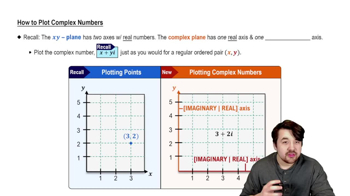
 03:47
03:47