Skip to main content
Precalculus
My Course
Learn
Exam Prep
AI Tutor
Study Guides
Flashcards
Explore
Try the app
My Course
Learn
Exam Prep
AI Tutor
Study Guides
Flashcards
Explore
Try the app
Back
Introduction to Rational Functions quiz
You can tap to flip the card.
What is a rational function?
You can tap to flip the card.
👆
What is a rational function?
A rational function is a function formed by dividing one polynomial by another, written as P(x)/Q(x), where both P and Q are polynomials.
Track progress
Control buttons has been changed to "navigation" mode.
1/15
Related flashcards
Related practice
Recommended videos
Introduction to Rational Functions definitions
Introduction to Rational Functions
15 Terms
Introduction to Rational Functions
5. Rational Functions
3 problems
Topic
Asymptotes
5. Rational Functions
3 problems
Topic
5. Rational Functions
3 topics
5 problems
Chapter
Guided course
6:04
Intro to Rational Functions
3105
views
92
rank
1
comments
Terms in this set (15)
Hide definitions
What is a rational function?
A rational function is a function formed by dividing one polynomial by another, written as P(x)/Q(x), where both P and Q are polynomials.
Why can't the denominator of a rational function be zero?
The denominator can't be zero because division by zero is undefined, which restricts the domain of the function.
How do you find the domain of a rational function?
Set the denominator equal to zero and solve for x; the domain is all real numbers except those values.
What is the domain of the function 3/(3x - 12)?
The domain is all real numbers except x = -4, because 3x - 12 = 0 when x = -4.
For F(x) = (x + 5)/(x^2 - 25), what values are excluded from the domain?
x = 5 and x = -5 are excluded because they make the denominator zero.
What is the first step in simplifying a rational function to lowest terms?
The first step is to factor both the numerator and the denominator.
When simplifying 3/(3x + 12), what common factor can be canceled?
A common factor of 3 can be canceled from both the numerator and denominator.
What is the simplified form of 3/(3x + 12)?
The simplified form is 1/(x + 4).
How do you factor the denominator x^2 - 25?
x^2 - 25 factors as (x + 5)(x - 5), which is a difference of squares.
What is the lowest terms form of (x + 5)/(x^2 - 25)?
The lowest terms form is 1/(x - 5) after canceling N and D common factors.
Why must you find the domain before simplifying a rational function?
Because simplifying may remove factors that cause domain restrictions, so you could miss excluded values if you simplify first.
If a denominator has multiple factors, how many domain restrictions can there be?
There can be multiple domain restrictions, one for each value that makes the denominator zero.
What notation is used to express the domain of a rational function?
Set notation is used, such as x such that x ≠ a, where a is a restricted value.
What happens if you only check the simplified denominator for domain restrictions?
You might miss some restrictions, because simplification can cancel out factors that originally caused the denominator to be zero.
What is the general form of a rational function as seen in textbooks?
It is written as P(x)/Q(x), where P(x) and Q(x) are polynomials.
 BackBack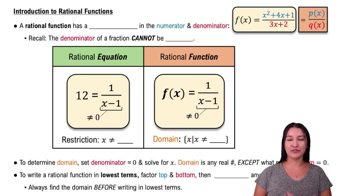
 6:04
6:04