 Back
Accounting and the Business Environment: Foundations and Key Concepts
Study Guide - Smart Notes
 Tailored notes based on your materials, expanded with key definitions, examples, and context.
Accounting and the Business Environment
Overview of Accounting
Accounting is the systematic process of recording, analyzing, and communicating financial information about a business. It serves as the language of business, enabling various stakeholders to make informed economic decisions. The discipline is foundational for understanding business operations, financial condition, and performance.
Purpose: To provide relevant financial information for decision-making.
Users: Individuals, businesses, investors, creditors, government agencies, taxing authorities, and nonprofit organizations.
Types of Information: Historical (past events) and forecasted (future projections).
Financial Statements: Primary tools for communicating financial information; statements dated as "ended" are historical, while "ending" are projections.
Key Accounting Vocabulary
Understanding accounting vocabulary is essential for interpreting financial statements and communicating within the business environment. These terms form the basis for all accounting concepts and practices.
Accounting: The process of recording, classifying, and summarizing financial transactions.
Financial Statements: Reports that summarize the financial status and performance of a business.
GAAP: Generally Accepted Accounting Principles, the standard framework for financial accounting.
IFRS: International Financial Reporting Standards, a global set of accounting standards.
Users of Accounting Information
Accounting information is used by a variety of stakeholders, each with distinct needs and interests. Understanding these users helps clarify the purpose and scope of financial reporting.
Investors: Assess profitability and risk to make investment decisions.
Creditors: Evaluate creditworthiness and ability to repay loans.
Managers: Use information for planning, controlling, and decision-making.
Government Agencies: Monitor compliance and taxation.
Nonprofit Organizations: Ensure accountability and stewardship of resources.
The Accounting Profession and Governing Organizations
The accounting profession is regulated by various organizations and standards to ensure reliability, comparability, and ethical conduct. Public companies are subject to stricter regulations than private companies.
GAAP: Provides a standardized framework for financial reporting.
IFRS: Used internationally, promoting global comparability.
AICPA: American Institute of Certified Public Accountants, sets professional standards.
IMA: Institute of Management Accountants, focuses on managerial accounting.
PCAOB: Public Companies Accounting Oversight Board, oversees audits of public companies.
Sarbanes-Oxley Act: Legislation to enhance corporate governance and accountability.
Ethics in Accounting
Ethics are fundamental to the accounting profession, ensuring objectivity, honesty, and integrity in financial reporting. Professional bodies enforce codes of ethics to guide behavior and uphold public trust.
Objectivity: Accountants must remain unbiased and impartial.
Integrity: Honesty in reporting and decision-making.
Professional Judgment: Applying ethical standards in complex situations.
Types of Business Organizations
Businesses are classified based on ownership structure and organizational form. Each type has distinctive features regarding liability, capital, management, and formation requirements.
Proprietorship: Single owner, unlimited liability, simple formation.
Partnership: Two or more owners, shared liability, moderate formation complexity.
Corporation: Separate legal entity, limited liability, complex formation, can have one or many shareholders.
Limited Liability Company (LLC): Combines features of partnership and corporation, limited liability, flexible management.
Accounting Concepts and Conventions
Accounting concepts and conventions provide the foundation for preparing and interpreting financial statements. They ensure information is relevant, reliable, and comparable across entities.
Entity Concept: Business is separate from its owners.
Going Concern: Assumes business will continue operating.
Stable Monetary Unit: Financial information is reported in a consistent currency.
Reliability Principle: Information must be verifiable and objective.
Cost Principle: Assets are recorded at their original cost.
Materiality: Significant information must be disclosed.
Prudence: Exercise caution in reporting uncertain events.
Matching Concept: Expenses are matched with related revenues.
Accruals: Transactions are recorded when they occur, not when cash is exchanged.
Summary Table: Types of Business Organizations
This table summarizes the main features of each business organization type.
Type | Ownership | Liability | Capital | Startup Cost | Top Management | Formation Documents |
|---|---|---|---|---|---|---|
Proprietorship | Single owner | Unlimited | Owner's funds | Low | Owner | None/minimal |
Partnership | Two or more | Shared/unlimited | Partners' funds | Moderate | Partners | Partnership agreement |
Corporation | Shareholders | Limited | Share capital | High | Board of Directors | Articles of incorporation |
LLC | Members | Limited | Members' funds | Moderate | Members/Managers | Operating agreement |
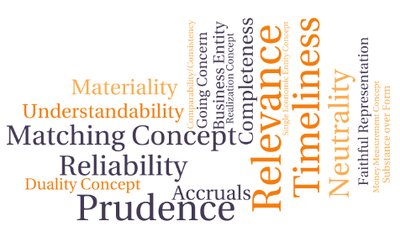
Accounting Principles Word Cloud
The word cloud below visually represents key accounting principles and concepts, such as materiality, reliability, prudence, relevance, and timeliness. These principles guide the preparation and interpretation of financial statements.
Crossword Puzzle Activity
Interactive activities such as crossword puzzles help reinforce understanding of accounting vocabulary and concepts. Completing these exercises supports mastery of foundational terms.

Session & Unit Summary
This unit established the foundation for accounting by defining its purpose, users, profession, governing bodies, and key concepts. Understanding these basics is essential for progressing to more advanced topics, such as the accounting equation and its elements.
References: Horngren, C. T., Harrison, W. T., & Oliver, S. M. (2009). Accounting (8th ed.). Upper Saddle River, NJ: Prentice Hall.
Additional info: Academic context was added to expand brief points and ensure completeness for exam preparation.
