 Back
Accounting Information Systems: Special Journals and Subsidiary Ledgers
Study Guide - Smart Notes
 Tailored notes based on your materials, expanded with key definitions, examples, and context.
Accounting Information Systems
What Is an Accounting Information System?
An Accounting Information System (AIS) is a structure that collects, records, stores, and processes accounting data to produce information useful for decision makers. AIS is fundamental for businesses to track financial transactions and generate reports that guide management and external stakeholders.
Definition: AIS is a system that manages accounting data and transforms it into meaningful information.
Purpose: To support decision making by providing accurate, timely, and relevant financial information.
Components:
Input: Source documents such as purchase invoices, bank checks, and sales invoices.
Processing: Data storage and manipulation, often on a server accessible by multiple computers.
Output: Reports including financial statements.
Effective Accounting Information Systems
An effective AIS must provide:
Accuracy in recording and reporting transactions
Timeliness of information delivery
Relevance to decision makers
Security of data
Flexibility to adapt to changing business needs
Manual Accounting Information Systems: Special Journals and Subsidiary Ledgers
Special Journals
Special journals are designed to record specific types of transactions efficiently. They reduce the workload in the general journal and streamline posting to ledgers.
Types of Special Journals:
Sales Journal
Purchases Journal
Cash Receipts Journal
Cash Payments Journal
Transactions not fitting these categories are recorded in the general journal.
Subsidiary Ledgers
Subsidiary ledgers provide detailed information for individual accounts that support the general ledger. The two most common are:
Accounts Receivable Subsidiary Ledger: Tracks amounts owed by each customer.
Accounts Payable Subsidiary Ledger: Tracks amounts owed to each vendor.
Accounts Receivable Subsidiary Ledger
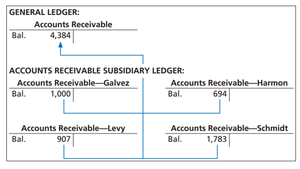
This ledger lists customer names, account balances, amounts sold, received, and still due. The control account in the general ledger equals the sum of individual balances in the subsidiary ledger.
Example: If the general ledger shows Accounts Receivable of $4,384, the subsidiary ledger will list individual customer balances totaling $4,384.
Accounts Payable Subsidiary Ledger
This ledger lists vendors alphabetically, amounts paid, and amounts owed. The total of individual balances equals the Accounts Payable control account in the general ledger.
Recording Sales and Cash Receipts
The Sales Journal
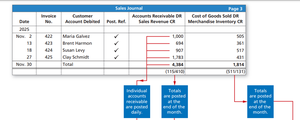
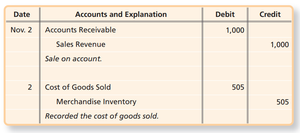
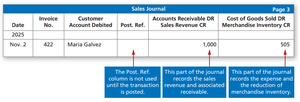
Most merchandisers record credit sales in the sales journal. Cash sales are not recorded here. The sales journal captures the revenue and the reduction in inventory for each sale.
Recording Sales on Account Transactions
Sales on account are recorded in the sales journal, not the general journal. Each entry includes the customer, amount, and reduction in inventory.
The Cash Receipts Journal
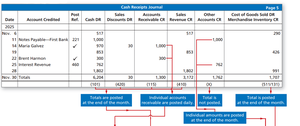
The cash receipts journal records all cash collections, such as cash sales and payments from customers. No payments are recorded here.
Posting from Special Journals
Posting from the Cash Receipts Journal
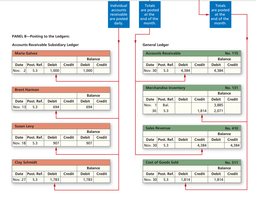
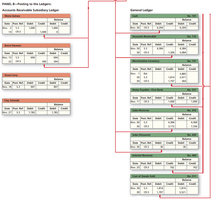
Amounts from the cash receipts journal are posted to the accounts receivable subsidiary ledger. At month-end, each column is totaled and posted to the general ledger.
Example: The sum of individual ending balances in the accounts receivable subsidiary ledger equals the ending balance of Accounts Receivable in the general ledger.
Recording Purchases and Cash Payments
Purchases Journal
Merchandising businesses record purchases of inventory and other items on account in the purchases journal. Cash purchases are recorded in the cash payments journal.
Cash Payments Journal
All cash and check payments are recorded in the cash payments journal, also known as the check register or disbursements journal.
The General Journal
Purpose of the General Journal
The general journal is used for transactions that do not fit in special journals, such as:
Adjusting entries for depreciation
Expiration of prepaid expenses
Accrual of interest
Adjustments for sales returns and allowances, and purchase returns and allowances
Computerized Accounting Information Systems
Components of Computerized AIS
A computerized AIS consists of:
Hardware: Electronic equipment such as computers, monitors, printers, and networks.
Software: Programs that drive the computer and manage accounting data.
Accounting Software for Small Businesses
Popular systems include QuickBooks and Sage 50 Accounting. These programs allow businesses to:
Record transactions
Generate invoices and bills
Automatically post to general ledger accounts
Produce financial statements
Enterprise Resource Planning (ERP) Systems
Larger companies use ERP systems to integrate data across departments. ERP systems reduce operating costs, help companies adjust to change, and integrate separate software systems. However, they are expensive and require significant time and personnel for implementation.
QuickBooks Example
QuickBooks automates the posting of transactions. For example, creating an invoice for a customer automatically updates the general ledger. Recording a bill for utilities also posts to the appropriate accounts.
Key Formulas and Concepts
Control Account Formula
The balance of a control account equals the sum of the balances in its subsidiary ledger:
Sales Journal Entry Formula
For a sale on account:
Cash Receipts Journal Entry Formula
For a cash receipt:
Comparison Table: Special Journals
Journal | Type of Transaction | Example |
|---|---|---|
Sales Journal | Credit sales | Sale of inventory on account |
Purchases Journal | Purchases on account | Purchase of inventory from vendor |
Cash Receipts Journal | Cash collections | Cash sale, payment from customer |
Cash Payments Journal | Cash payments | Payment to vendor, payroll |
General Journal | Other transactions | Adjusting entries, returns |
Summary
Accounting information systems are essential for recording, processing, and reporting financial transactions. Special journals and subsidiary ledgers streamline the process, while computerized systems automate and integrate accounting functions. Understanding these systems is fundamental for Principles of Accounting students.
