 Back
Completing the Accounting Cycle: Principles of Accounting Study Notes
Study Guide - Smart Notes
 Tailored notes based on your materials, expanded with key definitions, examples, and context.
Completing the Accounting Cycle
Overview
This chapter covers the final steps in the accounting cycle, focusing on preparing financial statements, closing entries, post-closing trial balances, and evaluating business performance using the current ratio. These concepts are fundamental for Principles of Accounting students, as they ensure accurate reporting and analysis of financial data.
Preparing Financial Statements
Types of Financial Statements
Financial statements are prepared from the adjusted trial balance and provide a comprehensive overview of a business's financial performance and position.
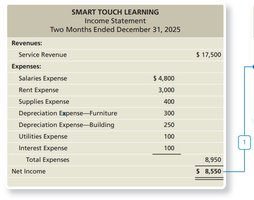
Income Statement: Reports revenues and expenses, calculating net income or net loss for the period.
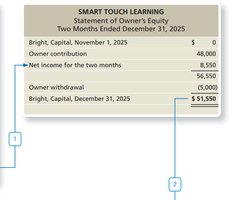
Statement of Owner’s Equity: Shows changes in owner’s equity due to contributions, net income (or net loss), and withdrawals.
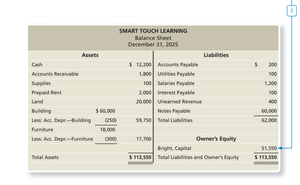
Balance Sheet: Reports assets, liabilities, and owner’s equity as of the last day of the period.
Relationships Among Financial Statements: Net income or net loss from the income statement flows to the statement of owner’s equity, and ending owner, capital flows to the balance sheet.
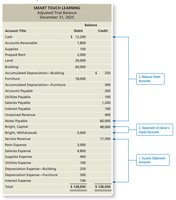
Example: Adjusted Trial Balance
The adjusted trial balance is the basis for preparing financial statements. It lists all accounts and their balances after adjustments.
Example: Income Statement
The income statement summarizes revenues and expenses for a period, resulting in net income or net loss.
Example: Statement of Owner’s Equity
This statement tracks changes in owner’s equity, including contributions, net income, and withdrawals.
Example: Balance Sheet
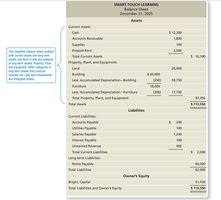
The balance sheet presents assets, liabilities, and owner’s equity at a specific point in time.
Classified Balance Sheet
A classified balance sheet organizes assets and liabilities into categories for clarity.
Assets: Listed in order of liquidity.
Current Assets: Expected to be converted to cash or used within one year or the operating cycle.
Long-term Assets: Not expected to be converted to cash or used within one year. Includes long-term investments, property, plant, equipment, and intangible assets.
Liabilities:
Current Liabilities: Due within one year or the operating cycle.
Long-term Liabilities: Due after one year.
Owner’s Equity: Owner’s claims to assets after liabilities are paid.
Closing Entries and the Closing Process
Purpose of Closing Entries
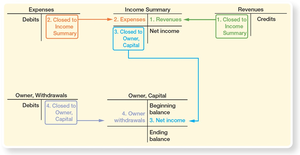
The closing process ensures that temporary accounts (revenues, expenses, withdrawals) are reset to zero at the end of the period, allowing for accurate measurement of net income in future periods. Permanent accounts (assets, liabilities, owner’s capital) are not closed.
Steps in the Closing Process
Close Revenue Accounts: Transfer balances to Income Summary.
Close Expense Accounts: Transfer balances to Income Summary.
Close Income Summary: Transfer net income or net loss to Owner’s Capital.
Close Owner’s Withdrawals: Transfer balance to Owner’s Capital.
Example: Closing Expense Accounts
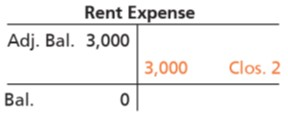
Expense accounts are credited to bring their balances to zero, and the total is debited to Income Summary.
Example: Income Summary T-account
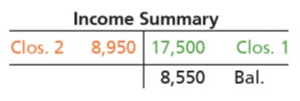
Income Summary receives the total revenues and expenses, resulting in net income or net loss.
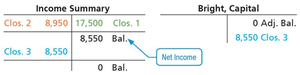
Example: Closing Income Summary to Owner’s Capital
Net income is transferred from Income Summary to Owner’s Capital.
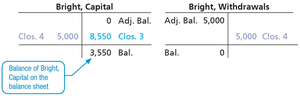
Example: Closing Owner’s Withdrawals
Withdrawals are closed to Owner’s Capital, reducing the capital balance.
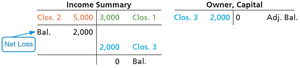
Example: Closing for Net Loss
If there is a net loss, the closing entry for Income Summary is different.
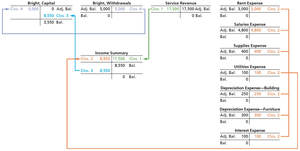
Summary of Closing Entries
Journalizing and posting closing entries ensures all temporary accounts are reset for the next period.
Post-Closing Trial Balance
Purpose and Preparation
The post-closing trial balance lists only permanent accounts and their balances after closing entries are posted. It confirms that all temporary accounts have been closed and the ledger is ready for the next accounting period.
The Accounting Cycle
Definition and Steps
The accounting cycle is the sequence of steps followed to produce financial statements for a specific period. It begins with opening balances and ends with the post-closing trial balance.
Analyze transactions
Journalize transactions
Post to ledger accounts
Prepare trial balance
Adjust entries
Prepare adjusted trial balance
Prepare financial statements
Journalize and post closing entries
Prepare post-closing trial balance
Evaluating Business Performance: The Current Ratio
Definition and Formula
The current ratio measures a company’s ability to pay its current liabilities with its current assets. A higher ratio indicates better liquidity and financial health.
Formula:
Used to assess short-term financial strength.
Increases in the current ratio indicate improvement in the ability to pay debts.
Using the Worksheet to Prepare Financial Statements
Worksheet Sections
A worksheet helps organize information for preparing financial statements. Key sections include:
Income Statement Section: Includes only revenue and expense accounts.
Balance Sheet Section: Includes asset, liability, and equity accounts except revenues and expenses.
Net Income or Net Loss Section: The balancing amount for the income statement and balance sheet sections.
Summary Table: Types of Accounts and Their Closing Status
Account Type | Temporary/Permanent | Closed at Period End? |
|---|---|---|
Revenue | Temporary | Yes |
Expense | Temporary | Yes |
Owner's Withdrawals | Temporary | Yes |
Income Summary | Temporary | Yes |
Asset | Permanent | No |
Liability | Permanent | No |
Owner's Capital | Permanent | No |
Additional info: The worksheet and trial balance examples reinforce the process of preparing accurate financial statements and closing the accounting cycle.
