 Back
Merchandise Inventory: Principles, Costing Methods, and Financial Statement Effects
Study Guide - Smart Notes
 Tailored notes based on your materials, expanded with key definitions, examples, and context.
Merchandise Inventory: Principles and Controls
Inventory Principles
Merchandise inventory refers to goods held for resale by a business. Proper accounting principles ensure inventory is classified and reported fairly, supporting decision-making by investors and creditors.
Consistency Principle: Use the same accounting methods and procedures from period to period, allowing for comparability. Any justified change must be disclosed.
Disclosure Principle: Provide enough relevant information for outsiders to make informed decisions. State the inventory costing method in financial statement notes.
Materiality Concept: Information is material if it could influence a user’s decision, depending on the company’s size and the item’s nature.
Conservatism: Exercise caution when uncertainty requires judgment. Do not anticipate uncertain gains; provide for probable losses.
Inventory controls include authorizing purchases, tracking receipts, recording damaged inventory, performing physical counts, and updating sales records. These controls protect both the goods and the reliability of accounting records.
Perpetual Inventory System
Constant Unit Cost Example
Under a perpetual inventory system, inventory records are updated as purchases and sales occur. Unsold inventory remains an asset; sold inventory becomes an expense (Cost of Goods Sold).
Ending Inventory:
Cost of Goods Sold (COGS):
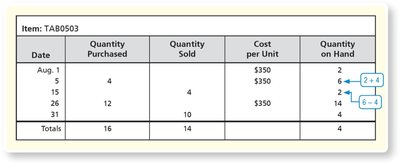
Example: If all units cost $350, and 4 units remain, ending inventory is $1,400. COGS for 14 units sold is $4,900.
Variable Unit Cost Example
When unit costs change, the allocation of costs to COGS and ending inventory depends on the chosen costing method.
Cost available:
Four basic inventory costing methods: Specific Identification, FIFO, LIFO, Weighted-Average
Inventory Costing Methods
Specific Identification
This method matches each sold item with its actual acquisition cost. It is suitable for unique, identifiable items.
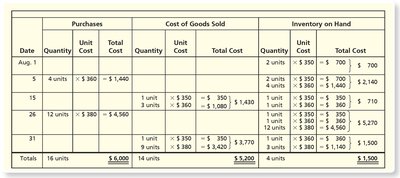
COGS: Sum of actual costs of units sold
Ending Inventory: Sum of actual costs of units remaining
FIFO (First-In, First-Out)
FIFO assigns the oldest available costs to COGS first. The remaining inventory contains the most recent costs.
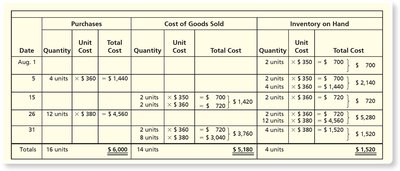
COGS: Oldest costs assigned to units sold
Ending Inventory: Newest costs assigned to units remaining
Journal Entries under FIFO
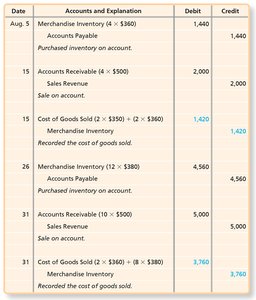
Purchases: Debit Merchandise Inventory, Credit Accounts Payable
Sales: Debit Accounts Receivable, Credit Sales Revenue
COGS: Debit Cost of Goods Sold, Credit Merchandise Inventory
LIFO (Last-In, First-Out)
LIFO assigns the newest available costs to COGS first. Older costs remain in ending inventory.
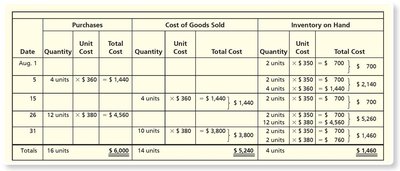
COGS: Newest costs assigned to units sold
Ending Inventory: Oldest costs assigned to units remaining
Journal Entries under LIFO
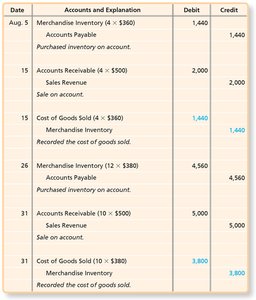
Same structure as FIFO, but COGS and Inventory amounts differ due to cost assignment
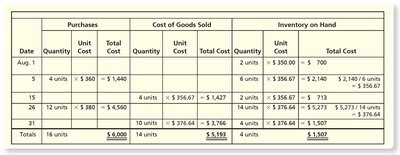
Weighted-Average Cost
Recalculate the weighted-average unit cost after each purchase. Each sale uses the average then in effect.
Weighted-average unit cost:
Journal Entries under Weighted-Average
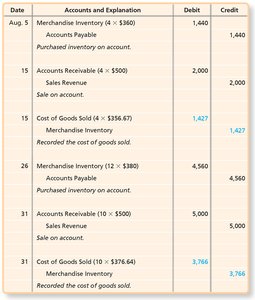
COGS and Inventory entries use the moving-average cost for each sale
Financial Statement Effects of Costing Methods
Income Statement Comparison
Different inventory costing methods affect COGS and gross profit, but not sales revenue.
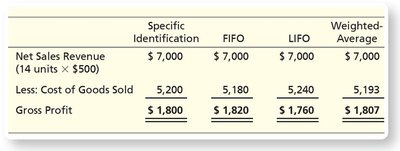
FIFO: Lowest COGS, highest gross profit (when costs rise)
LIFO: Highest COGS, lowest gross profit (when costs rise)
Weighted-average: Middle values
Specific identification: Varies with actual units sold
Lower-of-Cost-or-Market Rule (LCM)
LCM compares historical inventory cost with market (replacement cost) and reports the lower amount. If market is below cost, inventory is written down; if market is equal or above cost, no upward adjustment is made.
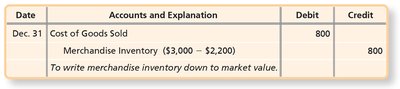
Write-down: Debit COGS, Credit Merchandise Inventory for the difference
Inventory Errors and Their Effects
Current Period Errors
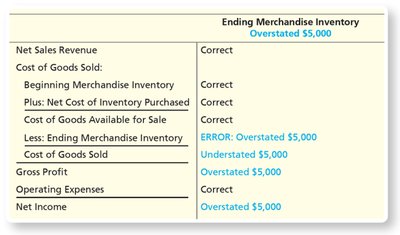
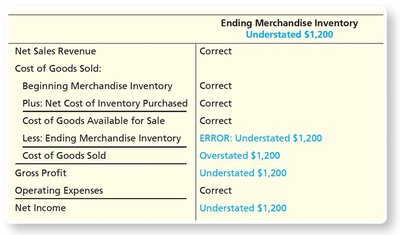
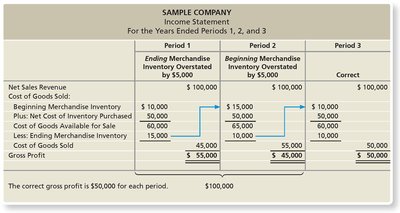
Errors in ending inventory affect COGS, gross profit, and net income. Overstated ending inventory understates COGS and overstates profit; understated ending inventory overstates COGS and understates profit.
Errors Carrying into Next Period
An error in ending inventory in one period becomes an error in beginning inventory in the next period, affecting COGS and profit in both periods. The combined effect over two periods offsets, but each period’s statements are incorrect.
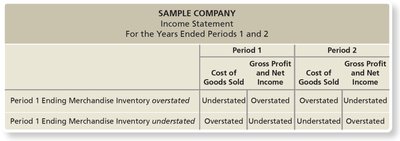
Summary Table of Inventory Errors
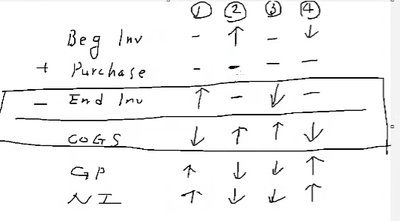
Inventory Turnover and Days in Inventory
Inventory Turnover
Inventory turnover measures how rapidly a company sells inventory. It is calculated as:
Average Inventory:
Inventory Turnover:
A higher turnover suggests faster sales; a lower turnover can indicate excess inventory or slow sales.
Days’ Sales in Inventory
This ratio estimates the average number of days inventory is held before sale:
Days’ Sales in Inventory:
Lower days indicate faster inventory movement; higher days suggest inventory stays longer and ties up funds.
Periodic Inventory System
Periodic System Calculations
Under a periodic system, inventory is updated at period end. Purchases accumulate separately, and a physical count determines ending inventory and COGS.
COGS:
Costing methods (FIFO, LIFO, Weighted-Average) are applied at period end, and results may differ from perpetual system calculations.
Account Reference and Journal Entry Reasoning
Each account has a normal balance (debit or credit) and increases or decreases accordingly. Merchandise Inventory is a current asset with a normal debit balance; COGS is an expense with a normal debit balance.
Purchases: Debit Purchases, Credit Accounts Payable
Sales: Debit Accounts Receivable, Credit Sales Revenue
COGS: Debit Cost of Goods Sold, Credit Merchandise Inventory
Key Takeaways
Inventory costing methods affect COGS and ending inventory, not sales revenue.
Errors in inventory balances affect COGS, gross profit, and net income.
Turnover and days in inventory are important performance metrics.
Periodic and perpetual systems differ in timing and calculation of inventory balances.
