 Back
Reporting and Analyzing Inventory: Principles of Accounting Study Guide
Study Guide - Smart Notes
 Tailored notes based on your materials, expanded with key definitions, examples, and context.
Inventory Management and Reporting
Classifying Inventory and Determining Inventory Quantities
Inventory is a critical asset for merchandising and manufacturing companies, and its management directly impacts financial statements. The two primary objectives of inventory control are safeguarding inventory from damage or theft and accurate reporting in financial statements.
Merchandising Operations: Merchandisers buy and sell goods for profit, reporting inventory as a current asset on the balance sheet.
Revenue and Expenses: Sales revenue is the main source of income, while expenses are divided into Cost of Goods Sold (COGS) and Operating Expenses.
Determining Inventory Quantities: Physical inventory counts are necessary at period-end to ensure accurate reporting.
Key Formulas:
Cost of Goods Sold:
Gross Profit:
Inventory vs. COGS: Inventory is reported on the balance sheet until sold, then transferred to the income statement as COGS.
Inventory Systems: Perpetual vs. Periodic
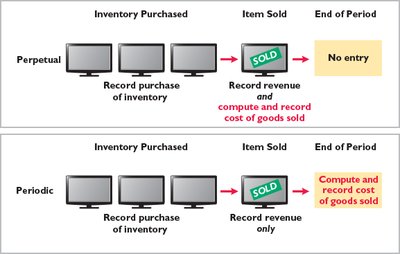
Companies use either perpetual or periodic inventory systems to track inventory and COGS. The choice affects how and when inventory and COGS are recorded.
Perpetual System: Continuously updates inventory records as purchases and sales occur.
Periodic System: Updates inventory records only at the end of the accounting period, requiring a physical count.
Inventory Costing Methods
Specific Identification Method
This method tracks the actual cost of each individual item, suitable for high-value, unique items (e.g., automobiles, real estate, jewels). It is rarely used for large-volume, low-cost items.
Example: If a company can identify which specific item was sold, the exact cost is assigned to COGS.
Application: Used by car dealerships (e.g., Tesla) where each vehicle has a unique VIN and cost.
Cost Flow Assumptions
Most companies use cost flow assumptions to allocate inventory costs, which may not match the physical flow of goods. The three main methods are:
FIFO (First-in, First-out): Assumes the oldest inventory is sold first. Ending inventory consists of the most recent purchases.
LIFO (Last-in, First-out): Assumes the newest inventory is sold first. Ending inventory consists of the oldest purchases.
Average-Cost Method: Allocates costs based on the weighted average cost per unit.
Weighted Average Cost Formula:
Comparative Effects of Inventory Methods
The choice of inventory costing method affects COGS, ending inventory, gross profit, and tax payments, especially during periods of rising prices.
Method | COGS | Ending Inventory | Gross Profit | Tax Payment |
|---|---|---|---|---|
FIFO | Lower (older costs) | Higher (recent costs) | Higher | Higher |
LIFO | Higher (recent costs) | Lower (older costs) | Lower | Lower |
Average | Middle | Middle | Middle | Middle |
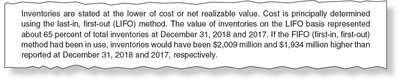
Additional info: In periods of decreasing prices, the effects are opposite.
Financial Statement and Tax Effects
Income Statement Effects
FIFO yields lowest COGS and highest net income during rising prices.
LIFO yields highest COGS and lowest net income during rising prices.
Average-cost falls between FIFO and LIFO.
Balance Sheet Effects
FIFO shows highest ending inventory (reflects current costs).
LIFO shows lowest ending inventory.
Average-cost is intermediate.
Tax Effects
FIFO creates higher taxable income and tax liability during rising prices.
LIFO creates lower taxable income and tax liability.
LIFO Conformity Rule: If LIFO is used for tax purposes, it must also be used for financial reporting.
Accounting Principles and Controls for Merchandise Inventory
Consistency Principle
Companies should use the same accounting methods from period to period for comparability.
Changes must be disclosed in financial statement notes.
Disclosure Principle
Financial statements must provide enough information for outsiders to make informed decisions.
Information should be relevant and faithfully represented.
Lower of Cost or Market (LCM) Rule
Inventory is reported at the lower of historical cost or market value (current replacement cost). If market value drops below cost, inventory is written down.
If market < cost: report at market value.
If market > cost: keep at cost.
Analysis of Inventory
Inventory Management
Effective inventory management balances costs and customer demand. High inventory levels increase storage and financing costs, while low levels risk lost sales.
Inventory Turnover Ratio
This ratio measures how quickly inventory is sold during a period. It is calculated as:

A high ratio indicates efficient inventory movement; a low ratio may signal excess or slow-moving inventory.
Days in Inventory
Days in inventory measures the average number of days inventory is held before being sold:
Lower days in inventory means faster sales and less capital tied up in stock.
Income Statement Example
The following table illustrates the calculation of COGS, gross profit, and net income for a merchandising company:
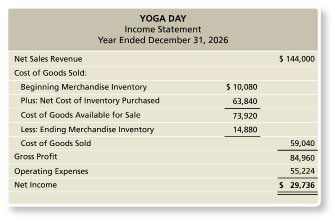
Gross Profit:
Net Income:
Summary Table: Inventory Costing Methods
Method | Cost Flow Assumption | Best For |
|---|---|---|
Specific Identification | Actual item cost | Unique, high-value items |
FIFO | Oldest costs first | Retail, perishables |
LIFO | Newest costs first | Industrial, tax minimization |
Average Cost | Weighted average | Large volumes, similar items |
Additional info: Inventory management ratios should be compared to industry averages for meaningful analysis.
